Statistics Algeria 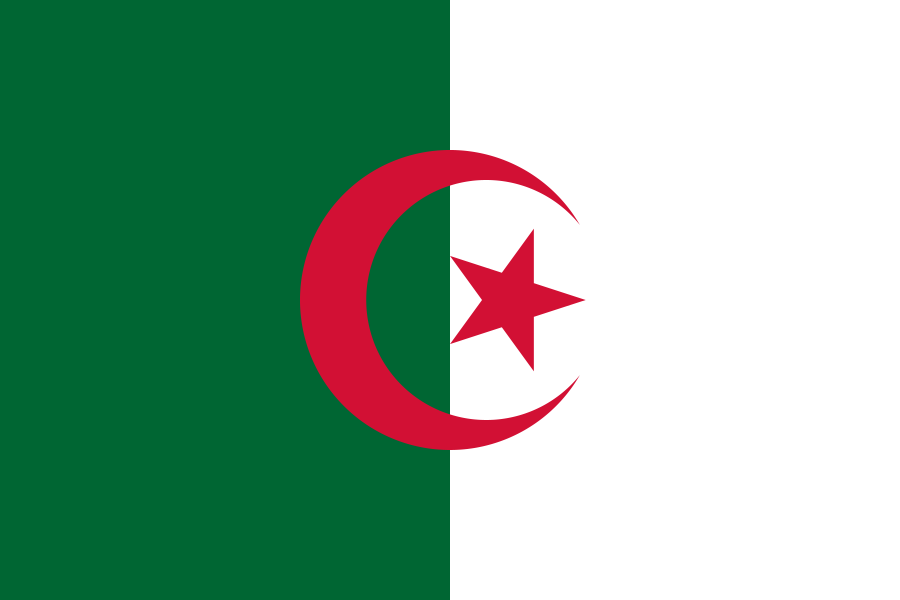

Algeria in the World

Algeria - Introduction 1990
top of pageLand boundaries: 6,343 km total; Libya 982 km, Mali 1,376 km, Mauritania 463 km, Morocco 1,559 km, Niger 956 km, Tunisia 965 km, Western Sahara 42 km
Climate: arid to semiarid; mild, wet winters with hot, dry summers along coast; drier with cold winters and hot summers on high plateau; sirocco is a hot, dust/sand-laden wind especially common in summer
Land use: 3% arable land; NEGL% permanent crops; 13% meadows and pastures; 2% forest and woodland; 82% other; includes NEGL% irrigated
Algeria - People 1990
top of pageAlgeria - Government 1990
top of pageAdministrative divisions: 31 provinces (wilayat, singular--wilaya; Adrar, Alger, Annaba, Batna, Bechar, Bejaia, Biskra, Blida, Bouira, Constantine, Djelfa, El Asnam, Guelma, Jijel, Laghouat, Mascara, Medea, Mostaganem, M'sila, Oran, Ouargla, Oum el Bouaghi, Saida, Setif, Sidi Bel Abbes, Skikda, Tamanrasset, Tebessa, Tiaret, Tizi Ouzou, Tlemcen; note--there may now be 48 provinces with El Asnam abolished, and the addition of 18 new provinces named Ain Delfa, Ain Temouchent, Bordjbou, Boumerdes, Chlef, El Bayadh, El Oued, El Tarf, Illizi, Jijel, Khenchela, Mila, Naama, Relizane, Souk Ahras, Tindouf, Tipaza, Tissemsilt
Legal system: socialist, based on French and Islamic law; judicial review of legislative acts in ad hoc Constitutional Council composed of various public officials, including several Supreme Court justices; has not accepted compulsory ICJ jurisdiction
Executive branch: Chief of State--President Chadli BENDJEDID (since 7 February 1979; Head of Government--Prime Minister Mouloud HAMROUCHE (since 9 September 1989)
International organization participation: AfDB, AIOEC, Arab League, ASSIMER, CCC, FAO, G-77, GATT (de facto), IAEA, IBRD, ICAO, IDA, IDB--Islamic Development Bank, IFAD, ILO, IMF, IMO, INTELSAT, ILZSG, INTERPOL, IOOC, ITU, NAM, OAPEC, OAU, OIC, OPEC, UN, UNESCO, UPU, WHO, WIPO, WMO
Diplomatic representation
In the us: Ambassador Abderrahmane BENSID; Chancery at 2,118 Kalorama Road NW, Washington DC 20,008; telephone (202) 328-5,300; US--Ambassador Christopher W. S. ROSS; Embassy at 4 Chemin Cheich Bachir Brahimi, Algiers (mailing address is B. P. Box 549, Alger-Gare, 16,000 Algiers; telephone p213o (2) 601-425 or 255, 186; there is a US Consulate in Oran
Flag description: two equal vertical bands of green (hoist side) and white with a red five-pointed star within a red crescent; the crescent, star, and color green are traditional symbols of Islam (the state religion)
Algeria - Economy 1990
top of pageEconomy overview: The exploitation of oil and natural gas products forms the backbone of the economy. Algeria depends on hydrocarbons for nearly all of its export receipts, about 30% of government revenues, and nearly 25% of GDP. In 1973-74 the sharp increase in oil prices led to a booming economy that helped to finance an ambitious program of industrialization. Plunging oil and gas prices, combined with the mismanagement of Algeria's highly centralized economy, have brought the nation to its most serious social and economic crisis since independence. The government has promised far-reaching reforms, including giving public sector companies more autonomy, encouraging private-sector activity, boosting gas and nonhydrocarbon exports, and a major overhaul of the banking and financial systems. In 1988 the government started to implement a new economic policy to dismantle large state farms into privately operated units.
Agriculture products: accounts for 8% of GDP and employs 24% of labor force; net importer of food--grain, vegetable oil, and sugar; farm production includes wheat, barley, oats, grapes, olives, citrus, fruits, sheep, and cattle
Industries: petroleum, light industries, natural gas, mining, electrical, petrochemical, food processing
Labor force:
3,700,000; 40%
industry and commerce, 24% agriculture, 17% government, 10%
services (1984)
industry and commerce, 24% agriculture, 17% government, 10%
services (1984)
Budget: revenues $17.4 billion; expenditures $22.0 billion, including capital expenditures of $8.0 billion (1988)
Exports: $9.1 billion (f.o.b., 1989 est.)
Commodities: petroleum and natural gas 98%
Partners: Netherlands, Czechoslovakia, Romania, Italy, France, US
Imports: $7.8 billion (f.o.b., 1989 est.)
Commodities: capital goods 35%, consumer goods 36%, food 20%
Partners: France 25%, Italy 8%, FRG 8%, US 6-7%
Exchange rates: Algerian dinars (DA) per US$1--8.0086 (January 1990), 7.6086 (1989), 5.9148 (1988), 4.8497 (1987), 4.7023 (1986), 5.0278 (1985)
Algeria - Energy 1990
top of pageAlgeria - Communication 1990
top of pageAlgeria - Military 1990
top of pageAlgeria - Transportation 1990
top of pageAirports: 147 total, 136 usable; 53 with permanent-surface runways; 2 with runways over 3,660 m; 29 with runways 2,440-3,659 m; 68 with runways 1,220-2,439 m
Merchant marine: 75 ships (1,000 GRT or over) totaling 900,957 GRT/1,063,994 DWT; includes 5 passenger, 27 cargo, 2 vehicle carrier, 10 roll-on/roll-off cargo, 5 petroleum, oils, and lubricants (POL) tanker, 9 liquefied gas, 7 chemical tanker, 9 bulk, 1 specialized liquid cargo
Algeria - Transnational issues 1990
top of page
🅶🅷🅴🅾🆂.🅲🅾🅼