Statistics Ecuador 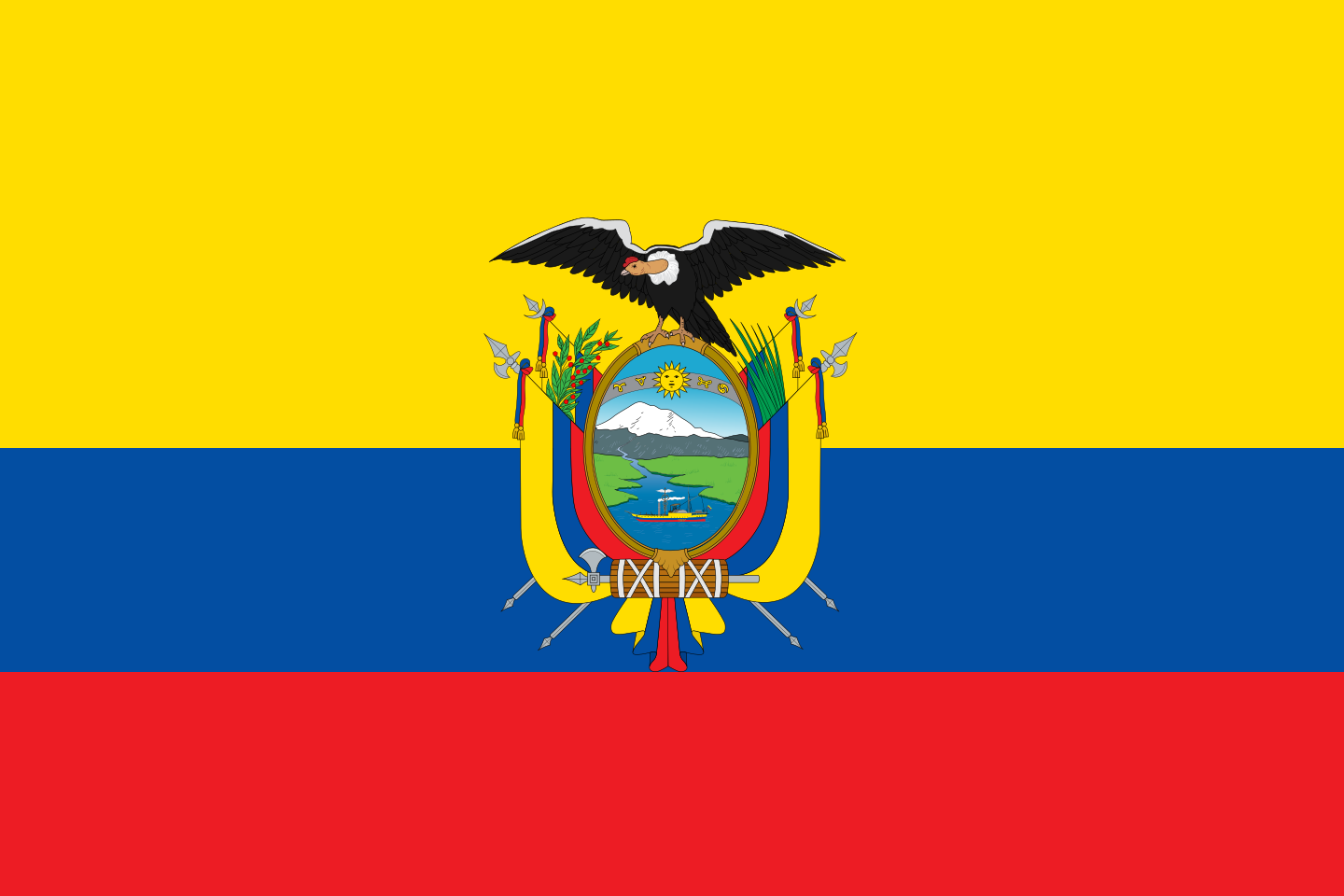

Ecuador in the World

Ecuador - Introduction 1990
top of pageBackground: The 'Republic of the Equator' was one of three countries that emerged from the collapse of Gran Colombia in 1830 (the others being Colombia and Venezuela). Between 1904 and 1942 Ecuador lost territories in a series of conflicts with its neighbors.
Terrain: coastal plain (Costa), inter-Andean central highlands (Sierra), and flat to rolling eastern jungle (Oriente)
Land use: 6% arable land; 3% permanent crops; 17% meadows and pastures; 51% forest and woodland; 23% other; includes 2% irrigated
Ecuador - People 1990
top of pageEnvironment
Current issues: subject to frequent earthquakes, landslides, volcanic activity; deforestation; desertification; soil erosion; periodic droughts
Ecuador - Government 1990
top of pageAdministrative divisions: 21 provinces (provincias, singular--provincia; Azuay, Bolivar, Canar, Carchi, Chimborazo, Cotopaxi, El Oro, Esmeraldas, Galapagos, Guayas, Imbabura, Loja, Los Rios, Manabi, Morona-Santiago, Napo, Pastaza, Pichincha, Sucumbios, Tungurahua, Zamora-Chinchipe
Suffrage: universal at age 18; compulsory for literate persons ages 18-65, optional for other eligible voters
Executive branch: Chief of State and Head of Government--President Rodrigo BORJA Cevallos (since 10 August 1988; Vice President Luis PARODI Valverde (since 10 August 1988)
Legislative branch: Ecuadorean Army (Ejercito Ecuatoriano), Ecuadorean Air Force (Fuerza Aerea Ecuatoriana), Ecuadorean Navy (Armada Ecuatoriana)
International organization participation: Andean Pact, ECOSOC, FAO, G-77, IADB, IAEA, IBRD, ICAO, ICO, IDA, IDB--Inter-American Development Bank, IFAD, IFC, IHO, ILO, IMF, IMO, INTELSAT, INTERPOL, IRC, ITU, LAIA, NAM, OAS, OPEC, PAHO, SELA, UN, UNESCO, UPEB, UPU, WFTU, WHO, WMO, WTO
Diplomatic representation
In the us: Ambassador Jaime MONCAYO; Chancery at 2,535 15th Street NW, Washington DC 20,009; telephone (202) 234-7,200; there are Ecuadorian Consulates General in Chicago, Houston, Los Angeles, Miami, New Orleans, New York, and San Francisco, and a Consulate in San Diego; US--Ambassador-designate Paul C. LAMBERT; Embassy at Avenida Patria 120, on the corner of Avenida 12 de Octubre, Quito (mailing address is P. O. Box 538, Quito, or APO Miami 34,039; telephone p593o (2) 562-890; there is a US Consulate General in Guayaquil
Flag description: three horizontal bands of yellow (top, double width), blue, and red with the coat of arms superimposed at the center of the flag; similar to the flag of Colombia which is shorter and does not bear a coat of arms
Ecuador - Economy 1990
top of pageEconomy overview: Ecuador continues to recover from a 1986 drop in international oil prices and a major earthquake in 1987 that interrupted oil exports for six months and forced Ecuador to suspend foreign debt payments. In 1988-89 oil exports recovered--accounting for nearly half of Ecuador's total export revenues--and Quito resumed full interest payments on its official debt, and partial payments on its commercial debt. The Borja administration has pursued austere economic policies that have helped reduce inflation and restore international reserves. Ecuador was granted an IMF standby agreement worth $135 million in 1989, and Quito will seek to reschedule its foreign commercial debt in 1990.
Agriculture products: accounts for 18% of GDP and 35% of labor force (including fishing and forestry; leading producer and exporter of bananas and balsawood; other exports--coffee, cocoa, fish, shrimp; crop production--rice, potatoes, manioc, plantains, sugarcane; livestock sector--cattle, sheep, hogs, beef, pork, dairy products; net importer of foodgrain, dairy products, and sugar
Labor force:
2,800,000; 35% agriculture, 21% manufacturing, 16% commerce, 28%
services and other activities (1982)
services and other activities (1982)
Budget: revenues $2.2 billion; expenditures $2.7 billion, including capital expenditures of $601 million (1988 est.)
Exports: $2.2 billion (f.o.b., 1988)
Commodities: petroleum 47%, coffee, bananas, cocoa products, shrimp, fish products
Partners: US 58%, Latin America, Caribbean, EC countries
Imports: $1.6 billion (f.o.b., 1988)
Commodities: transport equipment, vehicles, machinery, chemical, petroleum
Partners: US 28%, Latin America, Caribbean, EC, Japan
Exchange rates: sucres (S/) per US$1--526.35 (1989), 301.61 (1988), 170.46 (1987), 122.78 (1986), 69.56 (1985)
Ecuador - Energy 1990
top of pageEcuador - Communication 1990
top of pageEcuador - Military 1990
top of pageEcuador - Transportation 1990
top of pageAirports: 179 total, 178 usable; 43 with permanent-surface runways; 1 with runways over 3,659 m; 6 with runways 2,440-3,659 m; 20 with runways 1,220-2,439 m
Merchant marine: 47 ships (1,000 GRT or over) totaling 340,446 GRT/492,670 DWT; includes 1 passenger, 7 cargo, 17 refrigerated cargo, 2 container, 1 roll-on/roll-off cargo, 16 petroleum, oils, and lubricants (POL) tanker, 1 chemical tanker, 1 liquefied gas, 1 bulk
Ecuador - Transnational issues 1990
top of pageIllicit drugs: relatively small producer of coca following the successful eradication campaign of 1985-87; significant transit country, however, for derivatives of coca originating in Colombia, Bolivia, and Peru

🅶🅷🅴🅾🆂.🅲🅾🅼