Statistics Ukraine 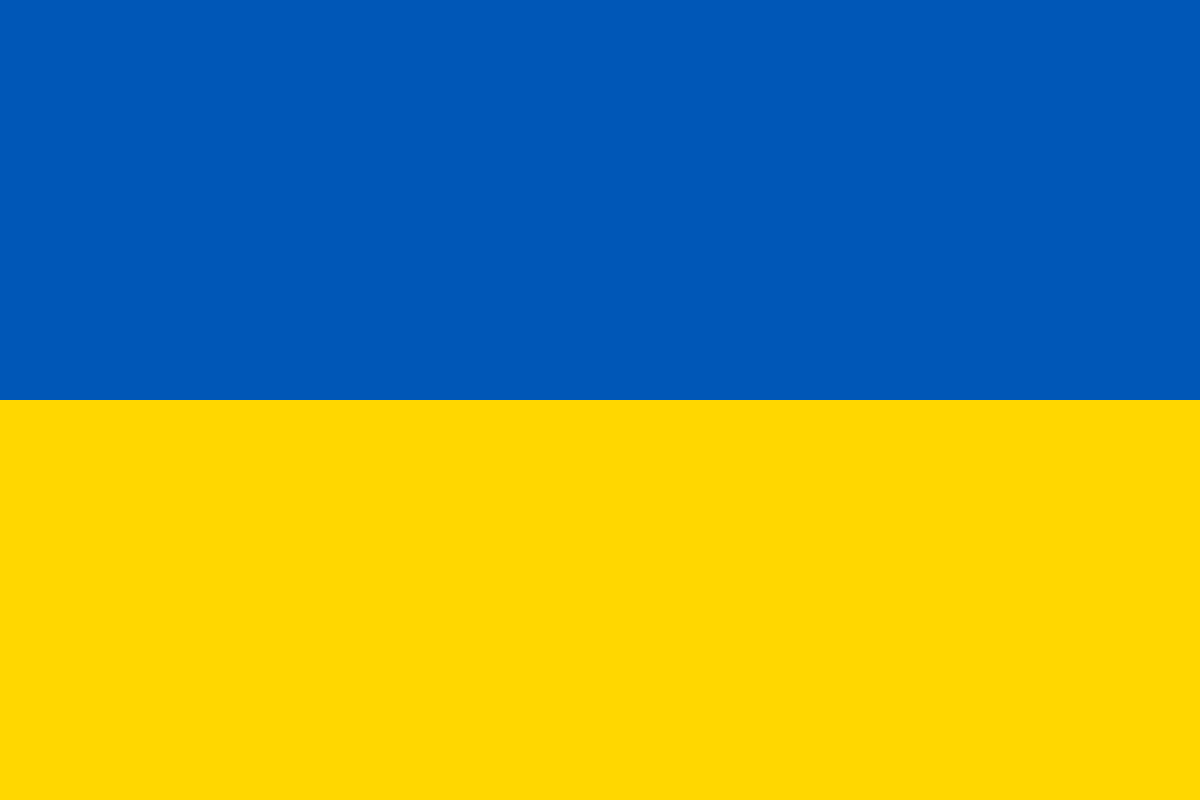

Ukraine in the World

Ukraine - Introduction 1994
top of pageBackground: Richly endowed in natural resources Ukraine has been fought over and subjugated for centuries; its 20th-century struggle for liberty is not yet complete. A short-lived independence from Russia (1917-1920) was followed by brutal Soviet rule that engineered two artificial famines (1921-22 and 1932-33) in which over 8 million died and World War II in which German and Soviet armies were responsible for some 7 million more deaths. Although independence was attained in 1991 with the dissolution of the USSR true freedom remains elusive as many of the former Soviet elite remain entrenched stalling efforts at economic reform privatization and civic liberties.
Map reference: Asia, Commonwealth of Independent States - European States, Europe, Standard Time Zones of the World
Land boundaries: total 4,558 km, Belarus 891 km, Hungary 103 km, Moldova 939 km, Poland 428 km, Romania (southwest) 169 km, Romania (west) 362 km, Russia 1,576 km, Slovakia 90 km
Climate: temperate continental; subtropical only on the southern Crimean coast; precipitation disproportionately distributed, highest in west and north, lesser in east and southeast; winters vary from cool along the Black Sea to cold farther inland; summers are warm across the greater part of the country, hot in the south
Terrain: most of Ukraine consists of fertile plains (steppes) and plateaux, mountains being found only in the west (the Carpathians), and in the Crimean Peninsula in the extreme south
Natural resources: iron ore, coal, manganese, natural gas, oil, salt, sulphur, graphite, titanium, magnesium, kaolin, nickel, mercury, timber
Land use
Arable land: 56%
Permanent crops: 2%
Meadows and pastures: 12%
Forest and woodland: 0%
Other: 30%
Geography
Note: strategic position at the crossroads between Europe and Asia; second largest country in Europe
Ukraine - People 1994
top of pageReligions: Ukrainian Orthodox - Moscow Patriarchate, Ukrainian Orthodox - Kiev Patriarchate, Ukrainian Autocephalous Orthodox, Ukrainian Catholic (Uniate), Protestant, Jewish
Environment
Current issues: unsafe drinking water; air and water pollution; deforestation; radiation contamination in the northeast from 1986 accident at Chornobyl' Nuclear Power Plant
Life expectancy at birth
Total population: 69.99 years
Male: 65.45 years
Female: 74.76 years (1994 est.)
Ukraine - Government 1994
top of pageCountry name
Conventional long form: none
Conventional short form:
local long form: none
local short form; Ukrayina
local short form; Ukrayina
Former: Ukrainian Soviet Socialist Republic
Administrative divisions: 24 oblasti (singular - oblast'), 1 autonomous republic* (avtomnaya respublika), and 2 municipalites (mista, singular - misto) with oblast status**; Cherkas'ka (Cherkasy), Chernihivs'ka (Chernihiv), Chernivets'ka (Chernitsi), Dnipropetrovs'ka (Dnipropetrovs'k), Donets'ka (Donets'k), Ivano-Frankivs'ka (Ivano-Frankivs'k), Kharkivs'ka (Kharkiv), Khersons'ka (Kherson), Khmel'nyts'ka (Khmel'nyts'kyy), Kirovohrads'ka (Kirovohrad), Kyyiv**, Kyyivs'ka (Kiev), Luhans'ka (Luhans'k), L'vivs'ka (L'viv), Mykolayivs'ka (Mykolayiv), Odes'ka (Odesa), Poltavs'ka (Poltava), Respublika Krym* (Simferopol'), Rivnens'ka (Rivne), Sevastopol'**,Sums'ka (Sevastopol'), Ternopil's'ka (Ternopil'), Vinnyts'ka (Vinnytsya), Volyns'ka (Luts'k), Zakarpats'ka (Uzhhorod), Zaporiz'ka (Zaporizhzhya), Zhytomyrs'ka (Zhytomyr)
Note: names in parentheses are administrative centers when name differs from oblast' name
Executive branch
Chief of state: President-elect Leonid D. KUCHMA; election last held 26 June and 10 July 1994 (next to be held NA 1999); results - Leonid KUCHMA 52.15%, Leonid KRAVCHUK 45.06%
Head of government: Prime Minister (vacant); Acting First Deputy Prime Minister (and Acting Prime Minister since September 1993) Yukhym Leonidovych ZVYAHIL'SKYY (since 11 June 1993) and five deputy prime ministers
Legislative branch: Army, Navy, Air and Air Defense Forces, Republic Security Forces (internal and border troops), National Guard
Supreme Council: elections last held 27 March 1994 (next to be held NA); results - percent of vote by party NA; seats - (450 total) number of seats by party NA; note - 338 deputies were elected; the remaining 112 seats to be filled on 24 July 1994
International organization participation: BSEC, CBSS (observer), CCC, CE (guest), CEI (participating), CIS, CSCE, EBRD, ECE, IAEA, IBRD, ICAO, ILO, IMF, INMARSAT, INTELSAT (nonsignatory user), INTERPOL, IOC, ITU, NACC, PCA, UN, UNCTAD, UNESCO, UNIDO, UNPROFOR, UPU, WHO, WIPO, WMO
Diplomatic representation
From the us chief of mission: Ambassador William MILLER
From the us chancery: 3,350 M Street NW, Suite 200, Washington, DC 20,007
From the us telephone: [7] (044) 244-7,349 or 244-7,344
From the us fax: (202) 333-0817
From the us consulates general: Chicago and New York
From the us embassy: 10 Yuria Kotsyubinskovo, 252,053 Kiev 53
From the us mailing address: use embassy street address
From the us FAX: [7] (044) 244-7,350
Flag description: two equal horizontal bands of azure (top) and golden yellow represent grainfields under a blue sky
Ukraine - Economy 1994
top of pageEconomy overview: After Russia, the Ukrainian republic was far and away the most important economic component of the former Soviet Union producing more than three times the output of the next-ranking republic. Its fertile black soil generated more than one-fourth of Soviet agricultural output, and its farms provided substantial quantities of meat, milk, grain and vegetables to other republics. Likewise, its diversified heavy industry supplied equipment and raw materials to industrial and mining sites in other regions of the former USSR. In 1992 the Ukrainian Government liberalized most prices and erected a legal framework for privatizing state enterprises while retaining many central economic controls and continuing subsidies to state production enterprises. In November 1992 the new Prime Minister KUCHMA launched a new economic reform program promising more freedom to the agricultural sector, faster privatization of small and medium enterprises, and stricter control over state subsidies. In 1993, however, severe internal political disputes over the scope and pace of economic reform and payment arrears on energy imports have led to further declines in output, and inflation of 50% or more per month by the last quarter. In first quarter 1994, national income and industrial output were less than two-thirds the first quarter 1993 figures, according to official statistics. At the same time an increasing number of people are developing small private businesses and exploiting opportunities in non-official markets. Even so, the magnitude of the problems and the slow pace in building new market-oriented institutions preclude a near-term recovery of output to the 1990 level. A vital economic concern in 1994 will continue to be Russia's decisions on the prices and quantities of oil and gas to be shipped to the Ukraine.
Industries: coal, electric power, ferrous and nonferrous metals, machinery and transport equipment, chemicals, food-processing (especially sugar)
Labor force: 23.985 million
By occupation industry and construction: 33%
By occupation agriculture and forestry: 21%
By occupation health education andculture: 16%
By occupation tradeanddistribution: 7%
By occupation transportandcommunication: 7%
By occupation other: 16% (1992)
Unemployment rate: 0.4% officially registered; large number of unregistered or underemployed workers
Exports: $3 billion to countries outside of the FSU (1993)
Commodities: coal, electric power, ferrous and nonferrous metals, chemicals, machinery and transport equipment, grain, meat
Partners: FSU countries, Germany, China, Austria
Imports: $2.2 billion from outside of the FSU countries (1993)
Commodities: machinery and parts, transportation equipment, chemicals, textiles
Partners: FSU countries, Germany, China, Austria
Ukraine - Energy 1994
top of pageElectricity
Capacity: 55,882,000 kW
Production: 281 billion kWh
Consumption per capita: 5,410 kWh (1992)
Ukraine - Communication 1994
top of pageUkraine - Military 1994
top of pageMilitary expenditures
Dollar figure: 544,256 million karbovantsi, NA% of GDP (forecast for 1993; note - conversion of the military budget into US dollars using the current exchange rate could produce misleading results
Ukraine - Transportation 1994
top of pageAirports: 694
Usable: 199
With permanentsurface runways: 111
With runways over 3659 m: 3
With runways 2440-3659 m: 81
With runways 10602439 m: 78
Note: a C-130 can land on a 1,060-m airstrip
Merchant marine: 390 ships (1,000 GRT or over) totaling 3,932,009 GRT/5,236,134 DWT, barge carriers 7, bulk cargo 55, cargo 231, chemical tanker 2, container 18, liquefied gas 1, multi-function-large-load-carrier 1, oil tanker 10, passenger 12, passenger cargo 5, railcar carrier 2, refrigerated cargo 5, roll-on/roll-off cargo 33, short-sea passenger 8
Ukraine - Transnational issues 1994
top of pageDisputes international: potential future border disputes with Moldova and Romania in Northern Bukovina and southern Odes'ka Oblast'; potential dispute with Moldova over former southern Bessarabian area; potential dispute with Russia over Crimea; has made no territorial claim in Antarctica (but has reserved the right to do so) and does not recognize the claims of any other nation
Illicit drugs: illicit cultivator of cannabis and opium poppy; mostly for CIS consumption; limited government eradication program; used as transshipment points for illicit drugs to Western Europe

🅶🅷🅴🅾🆂.🅲🅾🅼