Statistics Mozambique 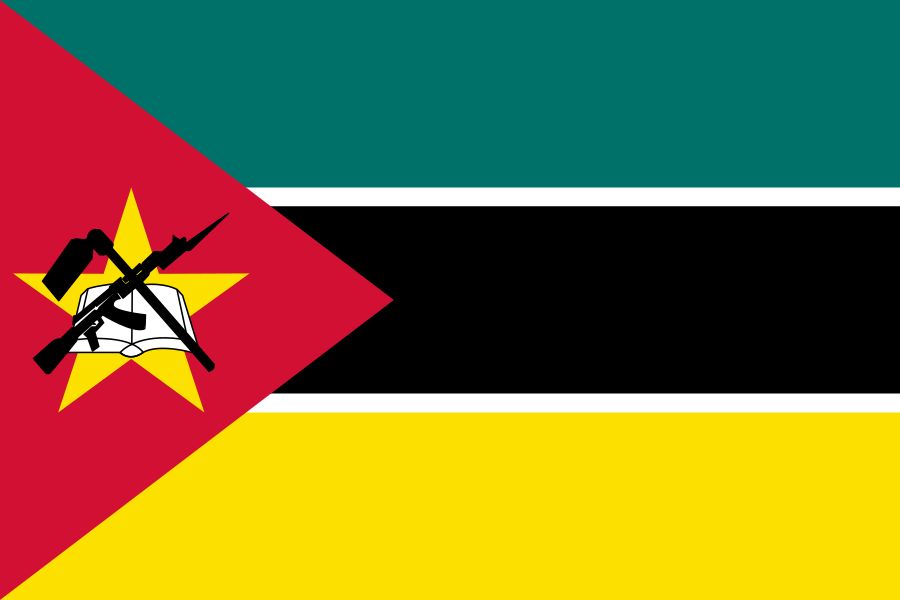

Mozambique in the World

Mozambique - Introduction 1995
top of pageBackground: Almost five centuries as a Portuguese colony came to a close with independence in 1975. Large-scale emigration by whites economic dependence on South Africa a severe drought and a prolonged civil war hindered the country's development. The ruling party formally abandoned Marxism in 1989 and a new constitution the following year provided for multiparty elections and a free market economy. A UN-negotiated peace agreement with rebel forces ended the fighting in 1992.
Area
Total area total: 801,590 km²
Land: 784,090 km²
Comparative: slightly less than twice the size of California
Land boundaries: total 4,571 km, Malawi 1,569 km, South Africa 491 km, Swaziland 105 km, Tanzania 756 km, Zambia 419 km, Zimbabwe 1,231 km
Land use
Arable land: 4%
Permanent crops: 0%
Meadows and pastures: 56%
Forest and woodland: 20%
Other: 20%
Mozambique - People 1995
top of pageEthnic groups: indigenous tribal groups, Europeans about 10,000, Euro-Africans 35,000, Indians 15,000
Age structure
0-14 years: 45% (female 4,069,117; male 4,078,429)
15-64 years: 53% (female 4,882,292; male 4,630,193)
65 years and over: 2% (female 260,057; male 195,162) (July 1995 est.)
Net migration rate: NA migrant(s)/1000 population (1995 est.)
Note: by the end of 1994, an estimated 1.6 million Mozambican refugees, who fled to Malawi, Zimbabwa, and South Africa in earlier years from the civil war, had returned; an estimated 100,000 refugees remain to be repatriated from those countries
Environment
Current issues: civil strife and recurrent drought in the hinterlands have resulted in increased migration to urban and coastal areas with adverse environmental consequences; desertification; pollution of surface and coastal waters
Current issues natural hazards: severe droughts and floods occur in central and southern provinces; devastating cyclones
Current issues international agreements: party to - Endangered Species, Ozone Layer Protection; signed, but not ratified - Biodiversity, Climate Change, Law of the Sea
Life expectancy at birth
Total population: 48.95 years
Male: 47.04 years
Female: 50.92 years (1995 est.)
Mozambique - Government 1995
top of pageCountry name
Conventional long form: Republic of Mozambique
Conventional short form: Mozambique
Local long form: Republica Popular de Mocambique
Local short form: Mocambique
Administrative divisions: 10 provinces (provincias, singular - provincia; Cabo Delgado, Gaza, Inhambane, Manica, Maputo, Nampula, Niassa, Sofala, Tete, Zambezia
Executive branch
Chief of state: President Joaquim Alberto CHISSANO (since 6 November 1986)
Head of government: Prime Minister Pascoal MOCUMBI (since December 1994)
Cabinet: Cabinet
Legislative branch: unicameral
Assembly of the Republic Assembleia da Republica: draft electoral law provides for periodic, direct presidential and Assembly elections
Note: as called for in the 1992 peace accords, presidential and legislative elections took place during 27-29 October 1994; fourteen parties, including the Mozambique National Resistance (RENAMO) participated; Joaquim Alberto CHISSANO was elected president and his FRELIMO party gathered a slim majority in the 250 seat legislature
International organization participation: ACP, AfDB, CCC, ECA, FAO, FLS, G-77, GATT, IBRD, ICAO, ICRM, IDA, IFAD, IFC, IFRCS, ILO, IMF, IMO, INMARSAT, INTELSAT, INTERPOL, IOC, IOM (observer), ITU, NAM, OAU, OIC, SADC, UN, UNCTAD, UNESCO, UNIDO, UPU, WFTU, WHO, WMO
Diplomatic representation
In the us chief of mission: Ambassador Hipolito Pereira Zozimo PATRICIO
In the us chancery: Suite 570, 1990 M Street NW, Washington, DC 20,036
In the us telephone: [1] (202) 293-7,146
In the us FAX: [1] (202) 835-0245
From the us chief of mission: Ambassador Dennis Coleman JETT
From the us embassy: Avenida Kenneth Kuanda, 193 Maputo
From the us mailing address: P. O. Box 783, Maputo
From the us telephone: [258] (1) 492,797
From the us FAX: [258] (1) 490,114
Flag description: three equal horizontal bands of green (top), black, and yellow with a red isosceles triangle based on the hoist side; the black band is edged in white; centered in the triangle is a yellow five-pointed star bearing a crossed rifle and hoe in black superimposed on an open white book
Mozambique - Economy 1995
top of pageEconomy overview: One of Africa's poorest countries, Mozambique has failed to exploit the economic potential of its sizable agricultural, hydropower, and transportation resources. Indeed, national output, consumption, and investment declined throughout the first half of the 1980s because of internal disorders, lack of government administrative control, and a growing foreign debt. A sharp increase in foreign aid, attracted by an economic reform policy, resulted in successive years of economic growth in the late 1980s, but aid has declined steadily since 1989. Agricultural output is at only 75% of its 1981 level, and grain has to be imported. Industry operates at only 20%-40% of capacity. The economy depends heavily on foreign assistance to keep afloat. Peace accords signed in October 1992 improved chances of foreign investment, aided IMF-supported economic reforms, and supported continued economic recovery. Elections held in 1994 diverted government attention from the economy, resulting in slippage and delays in the economic reform program. Nonetheless, growth in 1994 was solid and can continue into the late 1990s given continued foreign help in meeting debt obligations.
Agriculture products: accounts for 50% of GDP and about 90% of exports; cash crops - cotton, cashew nuts, sugarcane, tea, shrimp; other crops - cassava, corn, rice, tropical fruits; not self-sufficient in food
Industries: food, beverages, chemicals (fertilizer, soap, paints), petroleum products, textiles, nonmetallic mineral products (cement, glass, asbestos), tobacco
Budget
Revenues: $252 million
Expenditures: $607 million, including capital expenditures of $NA (1992 est.)
Exports: $150 million (f.o.b., 1994 est.)
Commodoties: shrimp 40%, cashews, cotton, sugar, copra, citrus
Partners: Spain, South Africa, US, Portugal, Japan
Imports: $1.14 billion (c.i.f., 1994 est.)
Commodoties: food, clothing, farm equipment, petroleum
Partners: South Africa, UK, France, Japan, Portugal
Exchange rates: meticais (Mt) per US$1 - 5,220.63 (1st quarter 1994), 3,874.24 (1993), 2,550.40 (1992), 1,763.99 (1991), 1,053.09 (1990)
Mozambique - Energy 1995
top of pageElectricity
Capacity: 2,360,000 kW
Production: 1.7 billion kWh
Production consumption per capita: 58 kWh (1993)
Mozambique - Communication 1995
top of pageTelephone system: NA telephone density; fair system of troposcatter, open-wire lines, and radio relay
Local: NA
Intercity: microwave radio relay and tropospheric scatter
International: 5 INTELSAT (2 Atlantic Ocean and 3 Indian Ocean) earth stations
Mozambique - Military 1995
top of pageMozambique - Transportation 1995
top of pageAirports: 192
With paved runways over 3047 m: 1
With paved runways 2438 to 3047 m: 4
With paved runways 15-24 to 2437 m: 11
With paved runways 914 to 1523 m: 5
With paved runways under 914 m: 112
With unpaved runways 15-24 to 2438 m: 15
With unpaved runways 914 to 1523 m: 44
Mozambique - Transnational issues 1995
top of page
🅶🅷🅴🅾🆂.🅲🅾🅼