Statistics Algeria 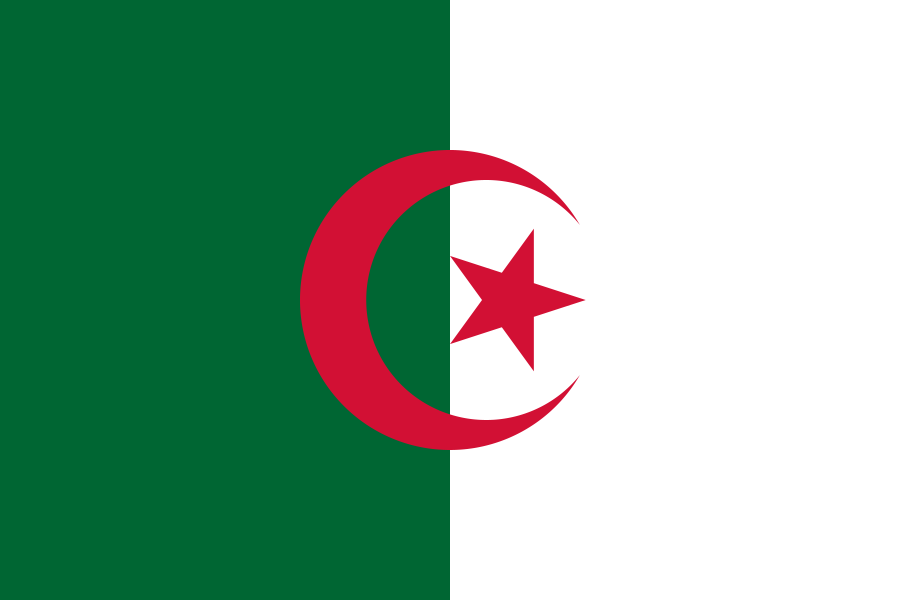

Algeria in the World

Algeria - Introduction 1996
top of pageBackground: After a century of rule by France Algeria became independent in 1962. The surprising first round success of the fundamentalist FIS (Islamic Salvation Front) party in December 1991 balloting caused the army to intervene crack down on the FIS and postpone the subsequent elections. The FIS response has resulted in a continuous low-grade civil conflict with the secular state apparatus which nonetheless has allowed elections featuring pro-government and moderate religious-based parties.
Area
Total: 2,381,740 km²
Land: 2,381,740 km²
Comparative: slightly less than 3.5 times the size of Texas
Land boundaries: Total 6,343 km, Libya 982 km, Mali 1,376 km, Mauritania 463 km, Morocco 1,559 km, Niger 956 km, Tunisia 965 km, Western Sahara 42 km
Climate: Arid to semiarid; mild, wet winters with hot, dry summers along coast; drier with cold winters and hot summers on high plateau; sirocco is a hot, dust/sand-laden wind especially common in summer
Algeria - People 1996
top of pagePopulation:
29,183,032 (July 1996 est.)
28,539,321 (July 1995 est.)
28,539,321 (July 1995 est.)
Growth rate:
2.21% (1996 est.)
2.25% (1995 est.)
2.25% (1995 est.)
Age structure
0-14 years:
40% (male 5,910,543; female 5,701,647) (July 1996 est.)
41% (male 5,885,246; female 5,678,879) (July 1995 est.)
41% (male 5,885,246; female 5,678,879) (July 1995 est.)
15-64 years:
56% (male 8,319,650; female 8,162,816) (July 1996 est.)
56% (male 8,033,508; female 7,887,885) (July 1995 est.)
56% (male 8,033,508; female 7,887,885) (July 1995 est.)
65 years and over:
4% (male 510,308; female 578,068) (July 1996 est.)
3% (male 496,167; female 557,636) (July 1995 est.)
3% (male 496,167; female 557,636) (July 1995 est.)
Net migration rate:
-0.49 migrant(s)/1000 population (1996 est.)
-0.49 migrant(s)/1000 population (1995 est.)
-0.49 migrant(s)/1000 population (1995 est.)
Environment
Current issues: soil erosion from overgrazing and other poor farming practices; desertification; dumping of raw sewage, petroleum refining wastes, and other industrial effluents is leading to the pollution of rivers and coastal waters; Mediterranean Sea, in particular, becoming polluted from oil wastes, soil erosion, and fertilizer runoff; inadequate supplies of potable water
Current issues Natural hazards: mountainous areas subject to severe earthquakes; mudslides
International agreements: party to_Climate Change, Endangered Species, Environmental Modification, Ozone Layer Protection, Ship Pollution, Wetlands; signed, but not ratified_Biodiversity, Desertification, Law of the Sea, Nuclear Test Ban
International agreements note: Second-largest country in Africa (after Sudan)
Sex ratio
At birth: 1.04 male(s)/female
Under 15 years: 1.04 male(s)/female
15-64 years: 1.02 male(s)/female
65 years and over: 0.88 male(s)/female
All ages:
1.02 male(s)/female (1996 est.) Infant Mortality Rate:48.7 deaths/1000 live births (1996 est.)
50.3 deaths/1000 live births (1995 est.)
50.3 deaths/1000 live births (1995 est.)
Life expectancy at birth
Total population: 68.31 years 91,996 est.), 68.01 years (1995 est.)
Male: 67.22 years (1996 est.), 66.94 years (1995 est.)
Female: 69.46 years (1996 est.), 69.13 years (1995 est.)
Literacy
Definition: age 15 and over that can read and write (1990 est.)
Total population: 61.1%
Male: 73.9%
Female: 49%
Algeria - Government 1996
top of pageCountry name
Conventional long form: Democratic and Popular Republic of Algeria
Conventional short form: Algeria
Local long form: Al Jumhuriyah al Jaza'iriyah ad Dimuqratiyah ash Shabiyah
Local short form: Al Jaza'ir
Administrative divisions: 48 provinces (wilayas, singular_wilaya; Adrar, Ain Defla, Ain Temouchent, Alger, Annaba, Batna, Bechar, Bejaia, Biskra, Blida, Bordj Bou Arreridj, Bouira, Boumerdes, Chlef, Constantine, Djelfa, El Bayadh, El Oued, El Tarf, Ghardaia, Guelma, Illizi, Jijel, Khenchela, Laghouat, Mascara, Medea, Mila, Mostaganem, M'Sila, Naama, Oran, Ouargla, Oum el Bouaghi, Relizane, Saida, Setif, Sidi Bel Abbes, Skikda, Souk Ahras, Tamanghasset, Tebessa, Tiaret, Tindouf, Tipaza, Tissemsilt, Tizi Ouzou, Tlemcen
Constitution: 19 November 1976, effective 22 November 1976; revised 3 November 1988 and 23 February 1989
Legal system: Socialist, based on French and Islamic law; judicial review of legislative acts in ad hoc Constitutional Council composed of various public officials, including several Supreme Court justices; has not accepted compulsory ICJ jurisdiction
Executive branch
Chief of state: President Liamine ZEROUAL (appointed president 31 January 1994, elected president 16 November 1995) was elected for a five-year term by universal suffrage; election last held 16 November 1995 (next to be held NA); results_percent of vote NA
Head of government: Prime Minister Ahmed OUYAHIA (since 31 December 1995) was appointed by the president
Cabinet: Council of Ministers; appointed by the prime minister
Legislative branch: Unicameral; note_suspended since 1992 National People's Assembly (Al-Majlis Ech-Chaabi Al-Watani):First-round elections held 26 December 1991; second round canceled by the military after President BENDJEDID resigned 11 January 1992, effectively suspending the assembly (next election promised by late 1996 or early 1997; results_percent of vote by party NA; seats_(281 total) the fundamentalist FIS won 188 of the 231 seats contested in the first round
International organization participation: ABEDA, AfDB, AFESD, AL, AMF, AMU, CCC, ECA, FAO, G-15, G-19, G-24, G-77, IAEA, IBRD, ICAO, ICRM, IDA, IDB, IFAD, IFC, IFRCS, ILO, IMF, IMO, Intelsat, Interpol, IOC, ISO, ITU, NAM, OAPEC, OAS (observer), OAU, OIC, OPEC, OSCE (partner), UN, UNAVEM III, UNCTAD, UNESCO, UNHCR, UNIDO, UNMIH, UPU, WCL, WHO, WIPO, WMO, WToO, WTrO (applicant)
Flag description: Two equal vertical bands of green (hoist side) and white with a red five-pointed star within a red crescent; the crescent, star, and color green are traditional symbols of Islam (the state religion)
Algeria - Economy 1996
top of pageEconomy overview: The hydrocarbons sector is the backbone of the economy, accounting for roughly 57% of government revenues, 25% of GDP, and almost all export earnings; Algeria has the fifth-largest reserves of natural gas in the world and ranks fourteenth for oil. Algiers' efforts to reform one of the most centrally planned economies in the Arab world began after the 1986 collapse of world oil prices plunged the country into a severe recession. In 1989, the government launched a comprehensive, IMF-supported program to achieve economic stabilization and to introduce market mechanisms into the economy. Despite substantial progress toward economic adjustment, in 1992 the reform drive stalled as Algiers became embroiled in political turmoil. In September 1993, a new government was formed, and one priority was the resumption and acceleration of the structural adjustment process. Buffeted by the slump in world oil prices and burdened with a heavy foreign debt, Algiers concluded a one-year standby arrangement with the IMF in April 1994. Following a Paris Club debt rescheduling in 1995 and a robust harvest, the economy experienced a strong recovery and key economic improvements.
Agriculture products: Accounts for 12% of GDP (1993) and employs 22% of labor force; products- wheat, barley, oats, grapes, olives, citrus, fruits, sheep, cattle; net importer of food_grain, vegetable oil, sugar
Labor force: 6.2 million (1992 est.)
By occupation Government: 29.5%
By occupation Agriculture: 22%
By occupation Construction and public works: 16.2%
By occupation Industry: 13.6%
By occupation Commerce and services: 13.5%
By occupation Transportation and communication: 5.2% (1989)
Exports:
total value. $9.5 billion (f.o.b., 1995 est.)
$9.1 billion (f.o.b., 1994)
$9.1 billion (f.o.b., 1994)
Commodities: Petroleum and natural gas 97%
Partners:
Italy 21%
France 16%
U.S. 14%
Germany 13%
Spain 9%
France 16%
U.S. 14%
Germany 13%
Spain 9%
Imports
Total value:
$10.6 billion (f.o.b., 1995 est.)
$9.2 billion (f.o.b., 1994 est.)
$9.2 billion (f.o.b., 1994 est.)
Commodities:
Capital goods 39.7%
Food and beverages 21.7%
Consumer goods 11.8% (1990)
Food and beverages 21.7%
Consumer goods 11.8% (1990)
Partners:
France 29%
Italy 14%
Spain 9%
U.S. 9%
Germany 7%
Italy 14%
Spain 9%
U.S. 9%
Germany 7%
Exchange rates: Algerian dinars (DA) per US$1_53.003 (January 1996), 47.663 (1995), 35.059 (1994), 23.345 (1993), 21.836 (1992), 18.473 (1991), 8.958 (1990)
Algeria - Energy 1996
top of pageAlgeria - Communication 1996
top of pageTelephone system: 862,000 telephones (1991 est.); excellent domestic and international service in the north, sparse in the south
Domestic: excellent service in north but sparse in south; domestic satellite system with 12 earth stations (20 additional domestic earth stations are planned)
International: 5 submarine cables; microwave radio relay to Italy, France, Spain, Morocco, and Tunisia; coaxial cable to Morocco and Tunisia; 2 INTELSAT (1 Atlantic Ocean and 1 Indian Ocean), 1 Intersputnik, 1 ARABSAT earth station
Algeria - Military 1996
top of pageAlgeria - Transportation 1996
top of pageAirports: 119
With paved runways over 3047 m: 8
With paved runways 2438 to 3047 m: 24
With paved runways 15-24 to 2437 m: 13
With paved runways 914 to 1523 m: 4
With paved runways under 914 m: 17
With unpaved runways 2438 to 3047 m: 3
With unpaved runways 15-24 to 2437 m: 19
With unpaved runways 914 to 1523 m: 31 (1995 est.)
Merchant marine
Total: 77 ships (1,000 GRT or over) totaling 916,701 GRT/1,086,324 DWT
Ships by type: bulk 9, cargo 27, chemical tanker 7, liquefied gas tanker 10, oil tanker 5, roll-on/roll-off cargo 13, short-sea passenger 5, specialized tanker 1 (1995 est.)
Algeria - Transnational issues 1996
top of page
🅶🅷🅴🅾🆂.🅲🅾🅼