Statistics Ecuador 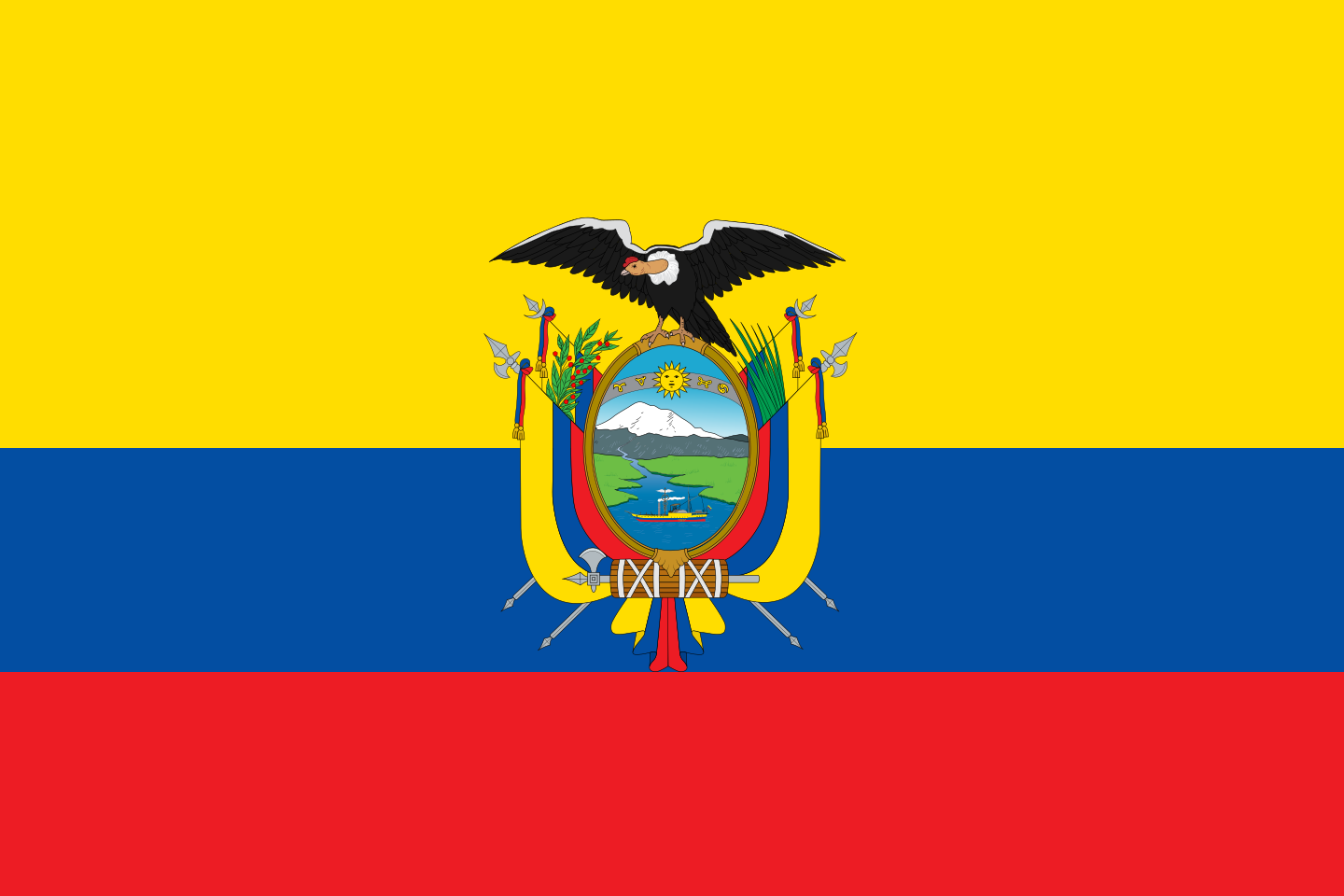

Ecuador in the World

Ecuador - Introduction 1996
top of pageBackground: The 'Republic of the Equator' was one of three countries that emerged from the collapse of Gran Colombia in 1830 (the others being Colombia and Venezuela). Between 1904 and 1942 Ecuador lost territories in a series of conflicts with its neighbors. A border war with Peru flared in 1995.
Area
Total: 283,560 km²
Land: 276,840 km²
Comparative: slightly smaller than Nevada
Comparative note: Includes Galapagos Islands
Maritime claims
Continental shelf: claims continental shelf between mainland and Galapagos Islands
Territorial sea: 200 nm
Terrain: Coastal plain (costa), inter-Andean central highlands (sierra), and flat to rolling eastern jungle (oriente)
Land use
Arable land: 6%
Permanent crops: 3%
Permanent pastures: 17%
Forests and woodland: 51%
Other: 23%
Ecuador - People 1996
top of pagePopulation:
11,466,291 (July 1996 est.)
10,890,950 (July 1995 est.)
10,890,950 (July 1995 est.)
Growth rate:
1.96% (1996 est.)
1.95% (1995 est.)
1.95% (1995 est.)
Age structure
0-14 years:
35% (male 2,062,468; female 1,996,679) (July 1996 est.)
36% (male 1,990,036; female 1,928,977) (July 1995 est.)
36% (male 1,990,036; female 1,928,977) (July 1995 est.)
15-64 years:
60% (male 3,403,197; female 3,489,728) (July 1996 est.)
60% (male 3,230,082; female 3,281,575) (July 1995 est.)
60% (male 3,230,082; female 3,281,575) (July 1995 est.)
65 years and over:
5% (male 241,217; female 273,002) (July 1996 est.)
4% (male 215,418; female 244,862) (July 1995 est.)
4% (male 215,418; female 244,862) (July 1995 est.)
Environment
Current issues: deforestation; soil erosion; desertification; water pollution
Current issues Natural hazards: frequent earthquakes, landslides, volcanic activity; periodic droughts
International agreements: party to_Antarctic-Environmental Protocol, Antarctic Treaty, Biodiversity, Climate Change, Desertification, Endangered Species, Hazardous Wastes, Nuclear Test Ban, Ozone Layer Protection, Ship Pollution, Tropical Timber 83, Tropical Timber 94, Wetlands, Whaling
International agreements note: Cotopaxi in Andes is highest active volcano in world
Sex ratio
At birth: 1.05 male(s)/female
Under 15 years: 1.03 male(s)/female
15-64 years: 0.98 male(s)/female
65 years and over: 0.88 male(s)/female
All ages:
0.99 male(s)/female (1996 est.) Infant Mortality Rate:34.8 deaths/1000 live births (1996 est.)
37.7 deaths/1000 live births (1995 est.)
37.7 deaths/1000 live births (1995 est.)
Life expectancy at birth
Total population: 71.09 years (1996 est.); 70.35 years (1995 est.)
Male: 68.49 years (1996 est.); 67.83 years (1995 est.)
Female: 73.82 years (1996 est.); 72.99 years (1995 est.) (1995 est.)
Literacy
Definition: age 15 and over that can read and write (1995 est.)
Total population: 90.1%
Male: 92%
Female: 88.2%
Ecuador - Government 1996
top of pageCountry name
Conventional long form: Republic of Ecuador
Conventional short form: Ecuador
Local long form: Republica del Ecuador
Local short form: Ecuador
Administrative divisions: 21 provinces (provincias, singular_provincia; Azuay, Bolivar, Canar, Carchi, Chimborazo, Cotopaxi, El Oro, Esmeraldas, Galapagos, Guayas, Imbabura, Loja, Los Rios, Manabi, Morona-Santiago, Napo, Pastaza, Pichincha, Sucumbios, Tungurahua, Zamora-Chinchipe
Suffrage: 18 years of age; universal, compulsory for literate persons ages 18-65, optional for other eligible voters
Executive branch
Chief of state and head of government: President Sixto DURAN-BALLEN Cordovez (since 10 August 1992); Vice President Eduardo PENA Trivino (since 18 October 1995); president and vice president were elected for four-year terms by universal suffrage; runoff election held 5 July 1992; results_Sixto DURAN-BALLEN elected as president (next election was held 19 May 1996; no presidential candidate received more than 50% of the vote; a runoff election between BUCARAM and NEBOT will be held on 7 July 1996); note_former Vice President DAHIK resigned 11 October 1995 and left the country to escape arrest on corruption charges; National Congress chose PENA as his successor in accordance with the constitution
Cabinet: Cabinet; appointed by the president
Legislative branch: Unicameral National Congress (Congreso Nacional):Elections last held 19 May 1996; results_percent of vote by party NA; seats_(82 total) PSC 27, PRE 21, DP 10, Pachakutik Movement 7, ID 5, PLRE 3, MPD 2, APRE 2, CFP 1, independent and other 4
Judicial branch: Supreme Court (Corte Suprema), judges are elected by the Chamber of Representatives
International organization participation: AG, ECLAC, FAO, G-11, G-77, IADB, IAEA, IBRD, ICAO, ICC, ICFTU, ICRM, IDA, IFAD, IFC, IFRCS, ILO, IMF, IMO, Intelsat, Interpol, IOC, IOM, ITU, LAES, LAIA, NAM, OAS, OPANAL, PCA, RG, UN, UNCTAD, UNESCO, UNIDO, UPU, WCL, WFTU, WHO, WIPO, WMO, WToO, WTrO (applicant)
Flag description: Three horizontal bands of yellow (top, double width), blue, and red with the coat of arms superimposed at the center of the flag; similar to the flag of Colombia that is shorter and does not bear a coat of arms
Ecuador - Economy 1996
top of pageEconomy overview: Ecuador has substantial oil resources and rich agricultural areas. Growth has been uneven in recent years because of fluctuations in prices for Ecuador's primary exports_oil and bananas_as well as because of government policies designed to curb inflation. President Sixto DURAN-BALLEN launched a series of macroeconomic reforms when he came into office in August 1992, which included raising domestic fuel prices and utility rates, eliminating most subsidies, and bringing the government budget into balance. These measures helped to reduce inflation from 55% in 1992 to 25% in 1995. DURAN-BALLEN has a much more favorable attitude toward foreign investment than his predecessor and has supported several laws designed to encourage foreign investment. Ecuador has implemented free or complementary trade agreements with Bolivia, Chile, Colombia, Peru, and Venezuela, as well as joined the World Trade Organization. Growth slowed to 2.3% in 1995 due in part to high domestic interest rates and shortages of electric power.
Agriculture products: Accounts for 13% of GDP (including fishing and forestry; leading producer and exporter of bananas and balsawood; other agricultural exports_coffee, cocoa, fish, shrimp; other crops_rice, potatoes, manioc, plantains, sugarcane; livestock products_cattle, sheep, hogs, beef, pork, dairy products; net importer of foodgrains, dairy products, and sugar
Industries:
Petroleum
Food processing
Textiles
Metal work
Paper products
Wood products
Chemicals
Plastics
Fishing
Lumber
Food processing
Textiles
Metal work
Paper products
Wood products
Chemicals
Plastics
Fishing
Lumber
Industrial production growth rate: Growth rate 6.4% (1993; accounts for almost 35% of GDP, including petroleum
Labor force: 2.8 million
By occupation Agriculture: 35%
By occupation Manufacturing: 21%
By occupation Commerce: 16%
By occupation Services and other activities: 28% (1982)
Budget
Revenues: $3.3 billion (1996 est.); $2.76 billion (1994)
Expenditures: $3.3 billion, including capital expenditures of $NA (1996 est.); $2.76 billion, including capital expenditures of NA (1994)
Exports: total value. $4 billion (f.o.b., 1994 est.)
Commodities:
Petroleum 39%
Bananas 17%
Shrimp 16%
Cocoa 3%
Coffee 6%
Bananas 17%
Shrimp 16%
Cocoa 3%
Coffee 6%
Partners:
U.S. 42%
Latin America 29%
Caribbean
EU countries 17%
Latin America 29%
Caribbean
EU countries 17%
Imports: total value:$3.7 billion (f.o.b., 1994 est.)
Commodities:
Transport equipment
Consumer goods
Vehicles
Machinery
Chemicals
Consumer goods
Vehicles
Machinery
Chemicals
Partners:
U.S. 28%
EU 17%
Latin America 31%
Caribbean
Japan
EU 17%
Latin America 31%
Caribbean
Japan
Exchange rates: Sucres (S/) per US$1_2,915 (31 December 1995), 2,564.5 (1995), 2,196.7 (1994), 1,919.1 (1993), 1,534.0 (1992), 1,046.25 (1991), 767.78 (1990), 526.35 (1989)
Ecuador - Energy 1996
top of pageEcuador - Communication 1996
top of pageTelephone system: 586,000 telephones (1994 est.); domestic facilities generally inadequate and unreliable
Local: NA
Intercity: NA
International: 1 INTELSAT (Atlantic Ocean) earth station
Ecuador - Military 1996
top of pageEcuador - Transportation 1996
top of pageAirports: 188
With paved runways over 3047 m: 2
With paved runways 2438 to 3047 m: 7
With paved runways 15-24 to 2437 m: 5
With paved runways 914 to 1523 m: 32 (1995 est.)
With paved runways under 914 m: 121
Merchant marine
Total: 19 ships (1,000 GRT or over) totaling 114,701 GRT/171,240 DWT
Ships by type: container 2, liquefied gas tanker 1, oil tanker 12, passenger 3, refrigerated cargo 1 (1995 est.)
Ecuador - Transnational issues 1996
top of pageIllicit drugs: Significant transit country for derivatives of coca originating in Colombia, Bolivia, and Peru; minor illicit producer of coca; importer of precursor chemicals used in production of illicit narcotics; important money-laundering hub

🅶🅷🅴🅾🆂.🅲🅾🅼