Statistics Gabon 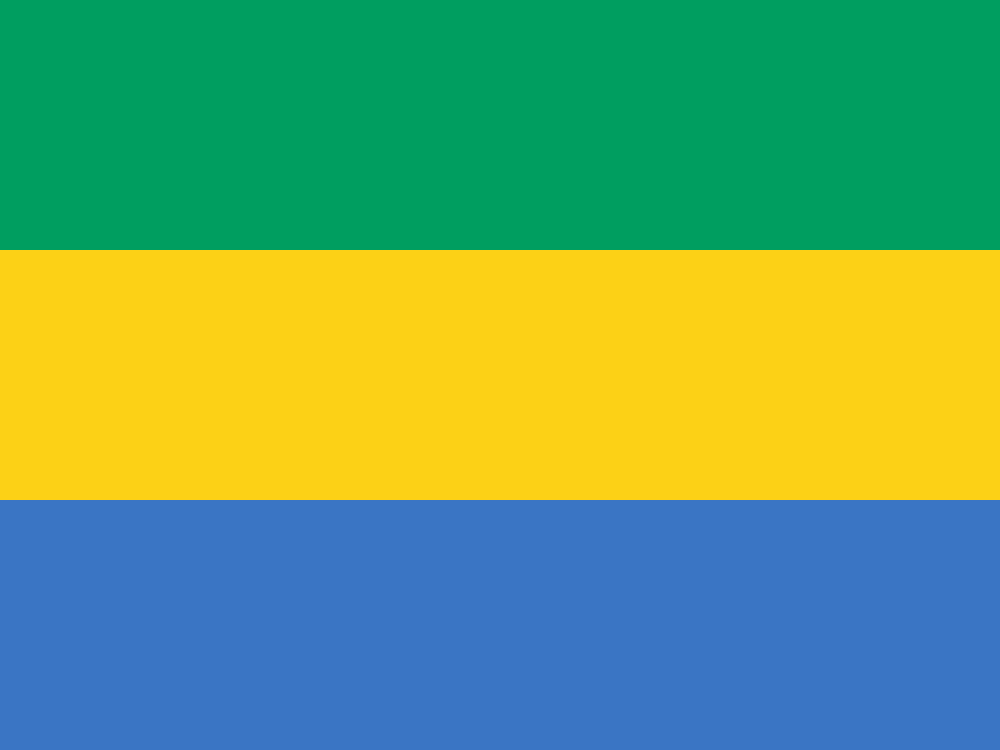

Gabon in the World

Gabon - Introduction 1997
top of pageBackground: Ruled by autocratic presidents since independence from France in 1960 Gabon introduced a multiparty system and a new constitution in the early 1990s that allowed for a more transparent electoral process and for reforms of governmental institutions. A small population abundant natural resources and foreign private investment have helped make Gabon one of the more prosperous black African countries.
Land boundaries
Total: 2,551 km
Border countries: (3) Cameroon 298 km; , Republic of the Congo 1,903 km; , Equatorial Guinea 350 km
Land use
Arable land: 1%
Permanent crops: 1%
Permanent pastures: 18%
Forests and woodland: 77%
Other: 3% (1993 est.)
Gabon - People 1997
top of pageEthnic groups: Bantu tribes including four major tribal groupings (Fang, Eshira, Bapounou, Bateke), other Africans and Europeans 154,000, including 6,000 French and 11,000 persons of dual nationality
Age structure
0-14 years: 34% (male 199,730; female 199,369)
15-64 years: 61% (male 368,086; female 359,086)
65 years and over: 5% (male 31,475; female 32,413) (July 1997 est.)
Sex ratio
At birth: 1.03 male(s)/female
Under 15 years: 1 male(s)/female
15-64 years: 1.02 male(s)/female
65 years and over: 0.97 male(s)/female
Total population: 1.01 male(s)/female (1997 est.)
Life expectancy at birth
Total population: 56.05 years
Male: 53.13 years
Female: 50.06 years (1997 est.)
Literacy
Definition: age 15 and over can read and write
Total population: 63.2%
Male: 73.7%
Female: 53.3% (1995 est.)
Gabon - Government 1997
top of pageCountry name
Conventional long form: Gabonese Republic
Conventional short form: Gabon
Local long form: Republique Gabonaise
Local short form: Gabon
Administrative divisions: 9 provinces; Estuaire, Haut-Ogooue, Moyen-Ogooue, Ngounie, Nyanga, Ogooue-Ivindo, Ogooue-Lolo, Ogooue-Maritime, Woleu-Ntem
Legal system: based on French civil law system and customary law; judicial review of legislative acts in Constitutional Chamber of the Supreme Court; compulsory ICJ jurisdiction not accepted
Executive branch
Chief of state: President El Hadj Omar BONGO (since 2 December 1967)
Head of government: Prime Minister Paulin OBAME Nguema (since 9 December 1994)
Cabinet: Council of Ministers appointed by the prime minister in consultation with the president
Elections: president elected by popular vote for a five-year term; election last held 5 December 1993 (next to be held NA 1998); prime minister appointed by the president
Election results: President Omar BONGO reelected; percent of vote - Omar BONGO 51%
Legislative branch: bicameral legislature consists of a Senate (91 seats) and a National Assembly or Assemblee Nationale (120 seats); members are elected by direct popular vote to serve five-year terms
Elections: National Assembly - last held in December 1996 (next to be held in December 2001); Senate - last held 12 January 1997 (next to be held in January 2002)
Election results: National Assembly - percent of vote by party - NA; seats by party - PDG 100, Morena-Bucherons/RNB 8, PUP 3, CLR 3, FAR 1, UPG 1, USG 2, PGP 2; Senate - percent of vote by party - NA; seats by party - PDG 51, RNB 17, PGP 4, ADERA 3, RDP 1, others 15
Note: the provision of the constitution for the establishment of a senate was implemented in the 12 January 1997 elections
Judicial branch: Supreme Court or Cour Supreme consisting of three chambers - Judicial, Administrative, and Accounts; Constitutional Court; Courts of Appeal (2; Court of State Security; County Courts
International organization participation: ACCT, ACP, AfDB, BDEAC, CCC, CEEAC, ECA, FAO, FZ, G-24, G-77, IAEA, IBRD, ICAO, ICFTU, IDA, IDB, IFAD, IFC, ILO, IMF, IMO, Inmarsat, Intelsat, Interpol, IOC, ITU, NAM, OAU, OIC, UDEAC, UN, UNCTAD, UNESCO, UNIDO, UPU, WCL, WHO, WIPO, WMO, WToO, WTrO
Diplomatic representation
In the us chief of mission: Ambassador Paul BOUNDOUKOU-LATHA
In the us chancery: Suite 200, 2,034 20th Street NW, Washington, DC 20,009
In the us telephone: [1] (202) 797-1000
In the us FAX: [1] (202) 332-0668
In the us consulates: New York
From the us chief of mission: Ambassador Elizabeth RASPOLIC
From the us embassy: Boulevard de la Mer, Libreville
From the us mailing address: B. P. 4,000, Libreville
From the us telephone: [241] 76 20 03 through 76 20 04, 74 34 92
From the us FAX: [241] 74 55 07
Gabon - Economy 1997
top of pageEconomy overview: Notwithstanding its serious ongoing economic problems, Gabon enjoys a per capita income three times that of most nations of sub-Saharan Africa. Gabon depended on timber and manganese until oil was discovered offshore in the early 1970s. The oil sector now accounts for 50% of GDP. Real GDP growth has been feeble since 1991 and Gabon continues to face fluctuating prices for its oil, timber, manganese, and uranium exports. Despite an abundance of natural wealth and a manageable rate of population growth, the economy is hobbled by poor fiscal management. In 1992, the fiscal deficit widened to 2.4% of GDP, and Gabon failed to settle arrears on its bilateral debt, leading to a cancellation of rescheduling agreements with official and private creditors. Devaluation of its Francophone currency by 50% on 12 January 1994 sparked a one-time inflationary surge, to 35%; the rate dropped to 6% in 1996. The IMF provided a one-year standby arrangement in 1994-95 and a three-year Enhanced Financing Facility (EFF) at near commercial rates beginning in late 1995. Those agreements mandate progress in privatization and fiscal discipline. France provided additional financial support in January 1997 after Gabon had met IMF targets for mid-1996.
Agriculture products: cocoa, coffee, sugar, palm oil; rubber; okoume (a tropical softwood; cattle; small fishing operations (provide a catch of about 30,000 metric tons)
Industries: food and beverage; textile; lumbering and plywood; cement; petroleum extraction and refining; manganese, uranium, and gold mining; chemicals; ship repair
Labor force: NA
By occupation agriculture: 65%
By occupation services and government: 25%
By occupation industry and commerce: 10%
Budget
Revenues: $1.3 billion
Expenditures: $1.6 billion, including capital expenditures of $311 million (1993 est.)
Exports
Total value: $2.7 billion (f.o.b., 1995)
Commodities: crude oil 78%, timber 14%, manganese 4%, uranium
Partners: US 59%, France 12%, Japan 4%, China 5%, Spain, Germany
Imports
Total value: $700 million (f.o.b., 1995)
Commodities: machinery and equipment, foodstuffs, chemicals, petroleum products, construction materials
Partners: France 39%, Cote d'Ivoire 13%, US 6%, Netherlands 5%, Japan
Exchange rates: CFA francs (CFAF) per US$1 - 541.69 (January 1997), 511.55 (1996), 499.15 (1995), 555.20 (1994), 283.16 (1993), 264.69 (1992)
Note: beginning 12 January 1994, the CFA franc was devalued to CFAF 100 per French franc from CFAF 50 at which it had been fixed since 1948
Gabon - Energy 1997
top of pageElectricity
Capacity: 301,000 kW (1992)
Production: 930 million kWh (1994)
Consumption per capita: 744 kWh (1994 est.)
Gabon - Communication 1997
top of pageTelephone system
Domestic: adequate system of cable, microwave radio relay, tropospheric scatter, radiotelephone communication stations, and a domestic satellite system with 12 earth stations
International: satellite earth stations - 3 Intelsat (Atlantic Ocean)
Gabon - Military 1997
top of pageGabon - Transportation 1997
top of pageAirports: 54 (1996 est.)
With paved runways total: 31
With paved runways over 3047 m: 1
With paved runways 2438 to 3047 m: 1
With paved runways 15-24 to 2437 m: 7
With paved runways 914 to 1523 m: 1
With paved runways under 914 m: 21 (1996 est.)
With unpaved runways total: 23
With unpaved runways 15-24 to 2437 m: 10
With unpaved runways 914 to 1523 m: 13 (1996 est.)
Railways
Total: 649 km Gabon State Railways (OCTRA)
Standard gauge: 649 km 1.435-m gauge; single track (1994)
Gabon - Transnational issues 1997
top of pageDisputes international: maritime boundary dispute with Equatorial Guinea because of disputed sovereignty over islands in Corisco Bay

🅶🅷🅴🅾🆂.🅲🅾🅼