Statistics Mauritius 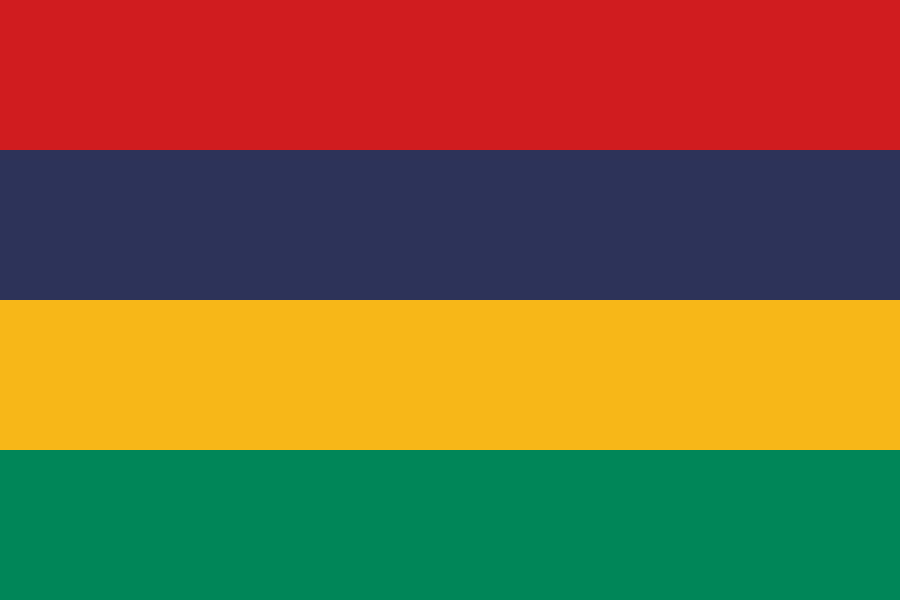

Mauritius in the World

Mauritius - Introduction 1997
top of pageBackground: Discovered by the Portuguese in 1505 Mauritius was subsequently held by the Dutch French and British before independence was attained in 1968. A stable democracy with regular free elections and a positive human rights record the country has attracted considerable foreign investment and has earned one of Africa's highest per capita incomes. Recent poor weather and declining sugar prices have slowed economic growth leading to some protests over standards of living in the Creole community.
Area
Total: 1,860 km²
Land: 1,850 km²
Water: 10 km²
Note: includes Agalega Islands, Cargados Carajos Shoals (Saint Brandon), and Rodrigues
Comparative: almost 11 times the size of Washington, DC
Maritime claims
Continental shelf: 200 nm or to the edge of the continental margin
Exclusive economic zone: 200 nm
Territorial sea: 12 nm
Climate: tropical, modified by southeast trade winds; warm, dry winter (May to November; hot, wet, humid summer (November to May)
Elevation
Extremes lowest point: Indian Ocean 0 m
Extremes highest point: Piton de la Petite Riviere Noire 828 m
Land use
Arable land: 49%
Permanent crops: 3%
Permanent pastures: 3%
Forests and woodland: 22%
Other: 23% (1993 est.)
Natural hazards: cyclones (November to April; almost completely surrounded by reefs that may pose maritime hazards
Mauritius - People 1997
top of pageReligions: Hindu 52%, Christian 28.3% (Roman Catholic 26%, Protestant 2.3%), Muslim 16.6%, other 3.1%
Age structure
0-14 years: 27% (male 155,779; female 151,964)
15-64 years: 67% (male 387,406; female 391,167)
65 years and over: 6% (male 27,719; female 40,237) (July 1997 est.)
Sex ratio
At birth: 1 male(s)/female
Under 15 years: 1.02 male(s)/female
15-64 years: 0.99 male(s)/female
65 years and over: 0.69 male(s)/female
Total population: 0.98 male(s)/female (1997 est.)
Life expectancy at birth
Total population: 70.71 years
Male: 66.88 years
Female: 74.53 years (1997 est.)
Literacy
Definition: age 15 and over can read and write
Total population: 82.9%
Male: 87.1%
Female: 78.8% (1995 est.)
Mauritius - Government 1997
top of pageAdministrative divisions: 9 districts and 3 dependencies*; Agalega Islands*, Black River, Cargados Carajos*, Flacq, Grand Port, Moka, Pamplemousses, Plaines Wilhems, Port Louis, Riviere du Rempart, Rodrigues*, Savanne
Executive branch
Chief of state: President Cassam UTEEM (since 1 July 1992) and Vice President Rabindranath GHURBURRUN (since 1 July 1992)
Head of government: Prime Minister Navin RAMGOOLAM (since 27 December 1995) and Deputy Prime Minister Paul BERENGER (since 27 December 1995)
Cabinet: Council of Ministers appointed by the president on the recommendation of the prime minister
Elections: president and vice president elected by the National Assembly for five-year terms; election last held NA June 1992 (next to be held NA 1997); prime minister and deputy prime minister appointed by the president and are responsible to the National Assembly
Election results: Cassam UTEEM elected president and Rabindranath GHURBURRUN elected vice president; percent of vote by the National Assembly - NA
Legislative branch: unicameral National Assembly (66 seats - 62 popularly elected, 4 appointed; members serve five-year terms); note - the election commission appoints four members from the losing political parties to give representation to various ethnic minorities
Elections: last held on 20 December 1995 (next to be held by December 2000)
Election results: percent of vote by party - MLP/MMM 65%, MSM/RMM 20%, other 15%; seats by party - MLP 35, MMM 25, allies of MLP and MMM on Rodrigues Island 2; appointed were Rodrigues Movement 2, PMSD 1, Hizbullah 1
International organization participation: ACCT, ACP, AfDB, C, CCC, ECA, FAO, G-77, IAEA, IBRD, ICAO, ICFTU, ICRM, IDA, IFAD, IFC, IFRCS, ILO, IMF, IMO, Inmarsat, Intelsat, Interpol, IOC, ISO, ITU, NAM, OAU, PCA, SADC, UN, UNCTAD, UNESCO, UNIDO, UPU, WCL, WFTU, WHO, WIPO, WMO, WToO, WTrO
Diplomatic representation
In the us chief of mission: Ambassador Chitmansing JESSERAMSING
In the us chancery: Suite 441, 4,301 Connecticut Avenue NW, Washington, DC 20,008
In the us telephone: [1] (202) 244-1491, 1492
In the us FAX: [1] (202) 966-0983
From the us chief of mission: Ambassador Harold Walter GEISEL (8 July 1996)
From the us embassy: 4th Floor, Rogers House, John Kennedy Street, Port Louis
From the us mailing address: International Mail:P.O. Box 544, Port Louis; US Mail:American Embassy, Port Louis, Department of State, Washington, DC 20,521-2,450
From the us telephone: [230] 208-2,347, 208-2,354, 208-9,763 through 9,767
From the us FAX: [230] 208-9,534
Mauritius - Economy 1997
top of pageEconomy overview: Since independence in 1968, Mauritius has developed from a low income, agriculturally based economy to a middle income diversified economy with growing industrial, financial services, and tourist sectors. For most of the period, annual growth has been of the order of 5% to 6%. This remarkable achievement has been reflected in increased life expectancy, lowered infant mortality, and a much improved infrastructure. Sugarcane is grown on about 90% of the cultivated land area and accounts for 25% of export earnings. The government's development strategy centers on industrialization (with a view to modernization and to exports), agricultural diversification, and tourism. Economic performance in 1991-96 continued strong with solid growth and low unemployment.
Industries: food processing (largely sugar milling), textiles, wearing apparel; chemicals, metal products, transport equipment, nonelectrical machinery; tourism
Labor force
Total: 479,500 (1993 est.)
By occupation constructionandindustry: 37%
By occupation services: 24%
By occupation agriculture and fishing: 15%
By occupation trade restaurants hotels: 14%
By occupation transportationandcommunication: 7%
By occupation finance: 3%
Budget
Revenues: $732 million
Expenditures: $550 million, including capital expenditures of $123 million (FY94/95 est.)
Exports
Total value: $1.57 billion (f.o.b., 1995)
Commodities: clothing and textiles 67%, sugar 25%
Partners: UK 34%, France 21%, US 15%, Germany 6%, Italy 4%
Imports
Total value: $1.98 billion (c.i.f., 1995)
Commodities: manufactured goods 50%, capital equipment 17%, foodstuffs 13%, petroleum products 8%, chemicals 7%
Partners: France 20%, India 8%, Hong Kong 7%, UK 6%, Germany 5%
Exchange rates: Mauritian rupees (MauRs) per US$1 - 18.528 (January 1997), 17.948 (1996), 17.386 (1995), 17.960 (1994), 17.648 (1993), 15.563 (1992)
Mauritius - Energy 1997
top of pageElectricity
Capacity: 235,000 kW (1991)
Production: 425 million kWh (1991)
Consumption per capita: 393 kWh (1991 est.)
Mauritius - Communication 1997
top of pageTelephone system: small system with good service
Domestic: primarily microwave radio relay
International: satellite earth station - 1 Intelsat (Indian Ocean); new microwave link to Reunion; HF radiotelephone links to several countries
Mauritius - Military 1997
top of pageMauritius - Transportation 1997
top of pageAirports: 4 (1996 est.)
With paved runways total: 4
With paved runways 2438 to 3047 m: 1
With paved runways 914 to 1523 m: 1
With paved runways under 914 m: 2 (1996 est.)
Merchant marine
Total: 17 ships (1,000 GRT or over) totaling 221,147 GRT/309,513 DWT
Ships by type: bulk 1, cargo 9, container 4, liquefied gas tanker 1, oil tanker 1, refrigerated cargo 1 (1996 est.)
Mauritius - Transnational issues 1997
top of pageDisputes international: claims the island of Diego Garcia in UK-administered British Indian Ocean Territory; claims French-administered Tromelin Island
Illicit drugs: illicit producer of cannabis for the international drug trade; heroin consumption and transshipment are growing problems

🅶🅷🅴🅾🆂.🅲🅾🅼