Statistics Pakistan 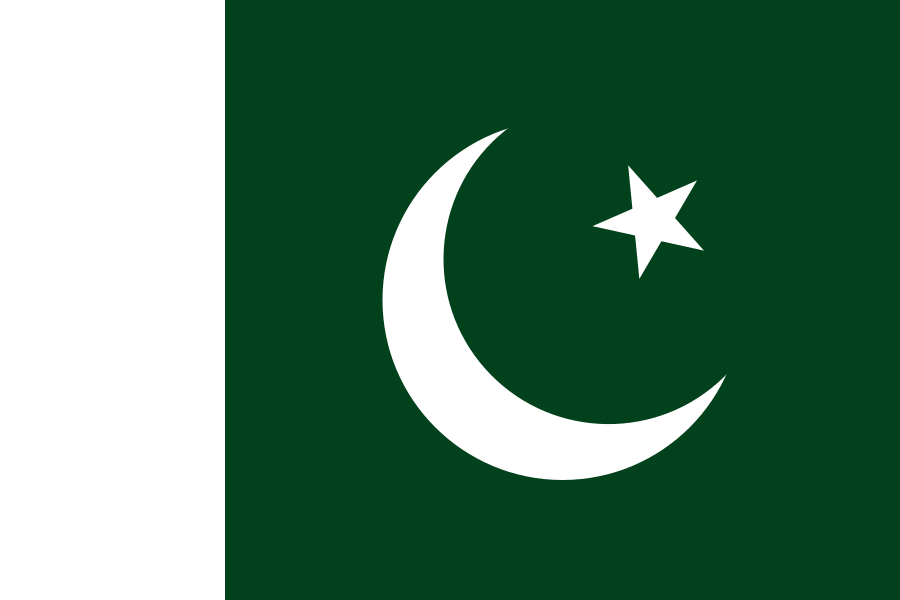

Pakistan in the World

Pakistan - Introduction 1997
top of pageBackground: The separation in 1947 of British India into the Muslim state of Pakistan (with two sections West and East) and largely Hindu India was never satisfactorily resolved. A third war between these countries in 1971 resulted in East Pakistan seceding and becoming the separate nation of Bangladesh. A dispute over the state of Kashmir is ongoing.
Area
Total: 803,940 km²
Land: 778,720 km²
Water: 25,220 km²
Comparative: slightly less than twice the size of California
Land boundaries
Total: 6,774 km
Border countries: (4) Afghanistan 2,430 km; , China 523 km; , India 2,912 km; , Iran 909 km
Maritime claims
Contiguous zone: 24 nm
Continental shelf: 200 nm or to the edge of the continental margin
Exclusive economic zone: 200 nm
Territorial sea: 12 nm
Elevation
Extremes lowest point: Indian Ocean 0 m
Extremes highest point: K2 (Mt. Godwin-Austen) 8,611 m
Natural resources: land, extensive natural gas reserves, limited petroleum, poor quality coal, iron ore, copper, salt, limestone
Land use
Arable land: 27%
Permanent crops: 1%
Permanent pastures: 6%
Forests and woodland: 5%
Other: 61% (1993 est.)
Natural hazards: frequent earthquakes, occasionally severe especially in north and west; flooding along the Indus after heavy rains (July and August)
Geography
Note: controls Khyber Pass and Bolan Pass, traditional invasion routes between Central Asia and the Indian Subcontinent
Pakistan - People 1997
top of pagePopulation: 132,185,299 (July 1997 est.)
Note: no national census has been conducted since 1981
Growth rate: 2.22% (1997 est.)
Ethnic groups: Punjabi, Sindhi, Pashtun (Pathan), Baloch, Muhajir (immigrants from India and their descendants)
Languages: Punjabi 48%, Sindhi 12%, Siraiki (a Punjabi variant) 10%, Pashtu 8%, Urdu (official) 8%, Balochi 3%, Hindko 2%, Brahui 1%, English (official and lingua franca of Pakistani elite and most government ministries), Burushaski, and other 8%
Age structure
0-14 years: 42% (male 28,702,496; female 27,048,787)
15-64 years: 54% (male 36,387,329; female 34,708,803)
65 years and over: 4% (male 2,667,936; female 2,669,948) (July 1997 est.)
Environment
Current issues: water pollution from raw sewage, industrial wastes, and agricultural runoff; limited natural fresh water resources; a majority of the population does not have access to potable water; deforestation; soil erosion; desertification
Sex ratio
At birth: 1.05 male(s)/female
Under 15 years: 1.06 male(s)/female
15-64 years: 1.05 male(s)/female
65 years and over: 1 male(s)/female
Total population: 1.05 male(s)/female (1997 est.)
Life expectancy at birth
Total population: 58.77 years
Male: 57.97 years
Female: 59.61 years (1997 est.)
Literacy
Definition: age 15 and over can read and write
Total population: 37.8%
Male: 50%
Female: 24.4% (1995 est.)
Pakistan - Government 1997
top of pageCountry name
Conventional long form: Islamic Republic of Pakistan
Conventional short form: Pakistan
Former: West Pakistan
Administrative divisions: 4 provinces, 1 territory*, and 1 capital territory**; Balochistan, Federally Administered Tribal Areas*, Islamabad Capital Territory**, North-West Frontier, Punjab, Sindh
Note: the Pakistani-administered portion of the disputed Jammu and Kashmir region includes Azad Kashmir and the Northern Areas
Legal system: based on English common law with provisions to accommodate Pakistan's stature as an Islamic state; accepts compulsory ICJ jurisdiction, with reservations
Suffrage: 21 years of age; universal; separate electorates and reserved parliamentary seats for non-Muslims
Executive branch
Chief of state: President Sardar Farooq LEGHARI (since 13 November 1993)
Head of government: Prime Minister Mohammad Nawaz SHARIF (since 17 February 1997)
Cabinet: Cabinet appointed by the prime minister
Elections: president elected by Parliament for a five-year term; election last held 13 November 1993 (next to be held no later than 14 October 1998); following legislative elections, the leader of the majority party or leader of a majority coalition is usually elected prime minister by the National Assembly; election last held 3 February 1997 (next to be held NA February 2002)
Election results: Sardar Farooq LEGHARI elected president; percent of Parliament vote - NA; Mohammad Nawaz SHARIF elected prime minister; percent of National Assembly vote - NA
Legislative branch: bicameral Parliament or Majlis-e-Shoora consists of the Senate (87 seats; members indirectly elected by provincial assemblies to serve six-year terms; one-third of the members up for election every two years; has advisory powers only) and the National Assembly (217 seats; 207 represent Muslims and 10 represent non-Muslims; members elected by popular vote to serve five-year terms)
Elections: Senate - last held 12 March 1997 (next to be held NA March 1999); National Assembly - last held 3 February 1997 (next to be held NA February 2002)
Election results: Senate - percent of vote by party - NA; seats by party - PML/N 30, PPP 17, ANP 7, MQM/A 6, JWP 5, BNP 4, JUI/F 2, PML/J 2, BNM/M 1, PKMAP 1, TJP 1, independents 6, vacant 5; National Assembly - percent of vote by party - NA; seats by party - PML/N 137, PPP 18, MQM/A 12, ANP 10, BNP 3, JWP 2, JUI/F 2, PPP/SB 1, NPP 1, independents 21, minorities 10
Judicial branch: Supreme Court, judicial chiefs are appointed by the president; Federal Islamic (Shari'at) Court
International organization participation: AsDB, C, CCC, CP, ECO, ESCAP, FAO, G-19, G-24, G-77, IAEA, IBRD, ICAO, ICC, ICFTU, ICRM, IDA, IDB, IFAD, IFC, IFRCS, IHO, ILO, IMF, IMO, Inmarsat, Intelsat, Interpol, IOC, IOM, ISO, ITU, MINURSO, NAM, OAS (observer), OIC, PCA, SAARC, UN, UNAVEM III, UNCTAD, UNESCO, UNHCR, UNIDO, UNIKOM, UNITAR, UNMIBH, UNMIH, UNOMIG, UNOMIL, UNPREDEP, UNTAES, UPU, WCL, WFTU, WHO, WIPO, WMO, WToO, WTrO
Diplomatic representation
In the us chief of mission: Ambassador Riaz KHOKAR
In the us chancery: 2,315 Massachusetts Avenue NW, Washington, DC 20,008
In the us telephone: [1] (202) 939-6,200
In the us FAX: [1] (202) 387-0484
In the us consulates general: Los Angeles and New York
From the us chief of mission: Ambassador Thomas W. SIMONS, Jr.
From the us embassy: Diplomatic Enclave, Ramna 5, Islamabad
From the us mailing address: P. O. Box 1048, Unit 62,200, APO AE 9,812-2,200
From the us telephone: [92] (51) 826,161 through 826,179
From the us FAX: [92] (51) 214,222
From the us consulates general: Karachi, Lahore
From the us consulates: Peshawar
Flag description: green with a vertical white band (symbolizing the role of religious minorities) on the hoist side; a large white crescent and star are centered in the green field; the crescent, star, and color green are traditional symbols of Islam
Pakistan - Economy 1997
top of pageEconomy overview: Pakistan is a poor, highly populated Third World country struggling to make the difficult transition to the modern world of high technology and international markets. Even though GDP growth has remained strong, at roughly 5% annually, international confidence in Prime Minister Benazir BHUTTO's government declined in 1996. The IMF suspended a Standby Agreement in the spring; foreign investment declined; and the budget and trade deficits rose substantially. In October 1996, BHUTTO responded to IMF pressure to implement reforms, devaluing the rupee by about 8% and raising petroleum prices in an attempt to slow the drain on foreign exchange reserves. But Islamabad still failed to meet IMF revenue and borrowing targets. Pakistan's interim government - in power since President LEGHARI sacked BHUTTO on 5 November 1996 - agreed to slash the budget deficit, push down bank borrowing, implement an agricultural tax; and speed up reforms in the financial sector; accordingly, the Standby Agreement was reinstated in December 1996 and a tranche of $80 million released; but Pakistan fell out of compliance in February 1997. For the long run, Pakistan must deal with serious problems of deteriorating infrastructure, low literacy levels, and persistent sectarian and political violence.
Industries: textiles, food processing, beverages, construction materials, clothing, paper products, shrimp
Labor force
Total: 36.7 million (1997)
By occupation agriculture: 47%
By occupation mining and manufacturing: 17%
By occupation services: 17%
By occupation other: 19%
Note: extensive export of labor, mostly to the Middle East, and use of child labor
Budget
Revenues: $12.5 billion
Expenditures: $14 billion, including capital expenditures of $2.8 billion (FY95/96 est.)
Exports
Total value: $8.3 billion (FY95/96)
Commodities: cotton, textiles, clothing, rice, leather, carpets
Partners: US, Japan, Hong Kong, Germany, UK, UAE, France
Imports
Total value: $12 billion (FY95/96)
Commodities: petroleum, petroleum products, machinery, transportation equipment, vegetable oils, animal fats, chemicals
Partners: Japan, US, Germany, UK, Saudi Arabia, Malaysia, South Korea
Exchange rates: Pakistani rupees (PRs) per US$1 - 40.120 (January 1997), 36.078 (1996), 31.643 (1995), 30.567 (1994), 28.1 (1993), 25.1 (1992; note - annual average of official rate; parallel market rate is higher
Pakistan - Energy 1997
top of pageElectricity
Capacity: 13.17 million kW (1994)
Production: 46.1 billion kWh (FY95/96)
Consumption per capita: 403 kWh (1995 est.)
Pakistan - Communication 1997
top of pageTelephone system: the domestic system is mediocre, but adequate for government and business use, in part because major businesses have established their own private systems; since 1988, the government has promoted investment in the national telecommunications system on a priority basis; despite major improvements in trunk and urban systems, telecommunication services are still not readily available to the major portion of the population
Domestic: microwave radio relay
International: satellite earth stations - 3 Intelsat (1 Atlantic Ocean and 2 Indian Ocean); microwave radio relay to neighboring countries
Pakistan - Military 1997
top of pagePakistan - Transportation 1997
top of pageAirports: 102 (1996 est.)
With paved runways total: 86
With paved runways over 3047 m: 11
With paved runways 2438 to 3047 m: 19
With paved runways 15-24 to 2437 m: 27
With paved runways 914 to 1523 m: 11
With paved runways under 914 m: 18 (1996 est.)
With unpaved runways total: 16
With unpaved runways over 3047 m: 1
With unpaved runways 15-24 to 2437 m: 7
With unpaved runways 914 to 1523 m: 8 (1996 est.)
Railways
Total: 8,163 km
Broad gauge: 7,718 km 1.676-m gauge (293 km electrified; 1,037 km double track)
Narrow gauge: 445 km 1.000-m gauge (1996 est.)
Merchant marine
Total: 26 ships (1,000 GRT or over) totaling 425,140 GRT/699,040 DWT
Ships by type: bulk 5, cargo 17, container 3, oil tanker 1 (1996 est.)
Pakistan - Transnational issues 1997
top of pageDisputes international: status of Kashmir with India; water-sharing problems with upstream riparian India over the Indus (Wular Barrage)
Illicit drugs: illicit producer of opium and hashish for the international drug trade (produced 75 metric tons in 1996, down from 155 metric tons in 1995; major center for processing Afghan heroin and key transit area for Southwest Asian heroin moving to Western markets

🅶🅷🅴🅾🆂.🅲🅾🅼