Statistics Ukraine 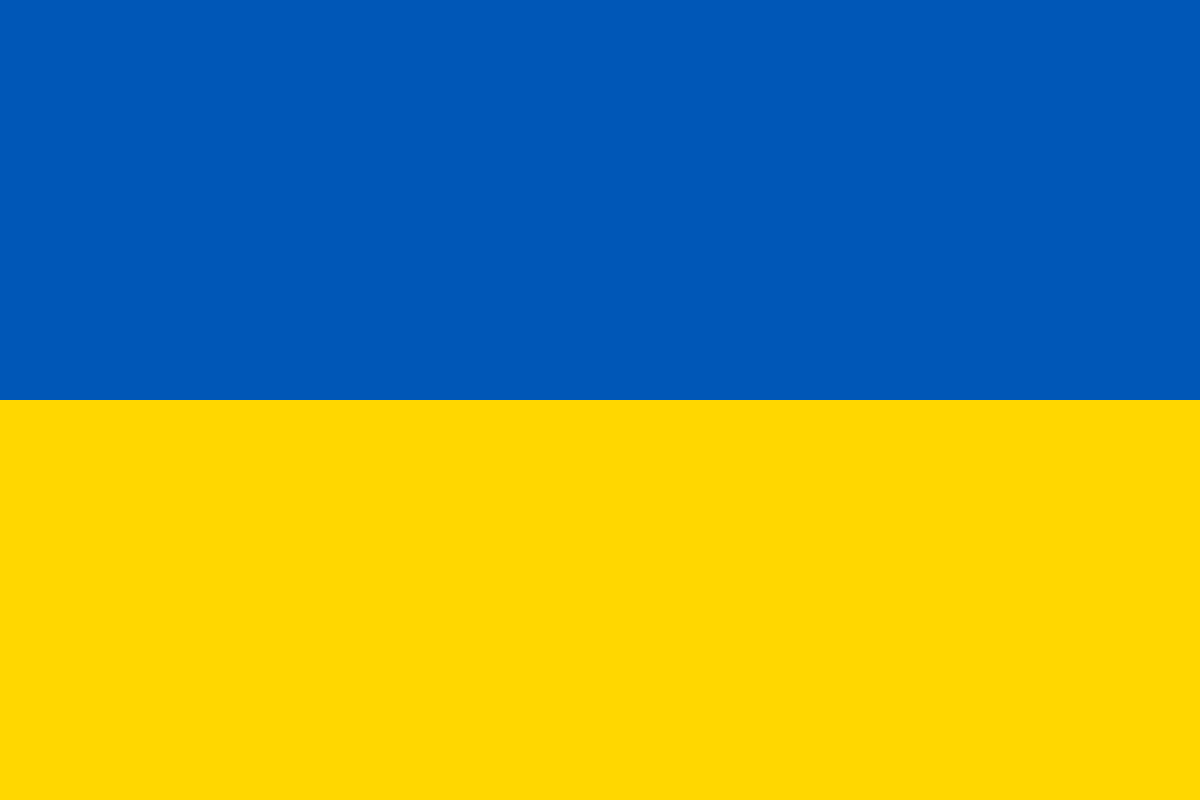

Ukraine in the World

Ukraine - Introduction 2000
top of pageBackground: Richly endowed in natural resources Ukraine has been fought over and subjugated for centuries; its 20th-century struggle for liberty is not yet complete. A short-lived independence from Russia (1917-1920) was followed by brutal Soviet rule that engineered two artificial famines (1921-22 and 1932-33) in which over 8 million died and World War II in which German and Soviet armies were responsible for some 7 million more deaths. Although independence was attained in 1991 with the dissolution of the USSR true freedom remains elusive as many of the former Soviet elite remain entrenched stalling efforts at economic reform privatization and civic liberties.
Climate: temperate continental; Mediterranean only on the southern Crimean coast; precipitation disproportionately distributed highest in west and north lesser in east and southeast; winters vary from cool along the Black Sea to cold farther inland; summers are warm across the greater part of the country hot in the south
Terrain: most of Ukraine consists of fertile plains (steppes) and plateaus mountains being found only in the west (the Carpathians) and in the Crimean Peninsula in the extreme south
Natural resources: iron ore coal manganese natural gas oil salt sulfur graphite titanium magnesium kaolin nickel mercury timber arable land
Geography
Note: strategic position at the crossroads between Europe and Asia; second-largest country in Europe
Ukraine - People 2000
top of pagePopulation: 49,153,027 (July 2000 est.)
Growth rate: -0.83% (2000 est.)
Below poverty line: 50% (1999 est.)
Religions: Ukrainian Orthodox - Moscow Patriarchate Ukrainian Orthodox - Kiev Patriarchate Ukrainian Autocephalous Orthodox Ukrainian Catholic (Uniate) Protestant Jewish
Environment
Current issues: inadequate supplies of potable water; air and water pollution; deforestation; radiation contamination in the northeast from 1986 accident at Chornobyl' Nuclear Power Plant
Ukraine - Government 2000
top of pageAdministrative divisions: 24 oblasti (singular - oblast') 1 autonomous republic* (avtomnaya respublika) and 2 municipalities (mista singular - misto) with oblast status**; Cherkas'ka (Cherkasy) Chernihivs'ka (Chernihiv) Chernivets'ka (Chernivtsi) Dnipropetrovs'ka (Dnipropetrovs'k) Donets'ka (Donets'k) Ivano-Frankivs'ka (Ivano-Frankivs'k) Kharkivs'ka (Kharkiv) Khersons'ka (Kherson) Khmel'nyts'ka (Khmel'nyts'kyy) Kirovohrads'ka (Kirovohrad) Kyyiv** Kyyivs'ka (Kiev) Luhans'ka (Luhans'k) L'vivs'ka (L'viv) Mykolayivs'ka (Mykolayiv) Odes'ka (Odesa) Poltavs'ka (Poltava) Avtonomna Respublika Krym* (Simferopol') Rivnens'ka (Rivne) Sevastopol'** Sums'ka (Sumy) Ternopil's'ka (Ternopil') Vinnyts'ka (Vinnytsya) Volyns'ka (Luts'k) Zakarpats'ka (Uzhhorod) Zaporiz'ka (Zaporizhzhya) Zhytomyrs'ka (Zhytomyr)
Legislative branch: unicameral Supreme Council or Verkhovna Rada (450 seats; under Ukraine's new election law half of the Rada's seats are allocated on a proportional basis to those parties that gain 4% of the national electoral vote; the other 225 members are elected by popular vote in single-mandate constituencies; all serve four-year terms)
Political parties and leaders: Agrarian Party of Ukraine or APU [Mykhaylo HLADIY chairperson]; Communist Party of Ukraine [Petro SYMONENKO]; Fatherland (Motherland) All Ukrainian Party [Yuliya TYMOSHENKO chairperson]; Green Party of Ukraine or PZU [Vitaliy KONONOV chairman]; Hromada [Pavlo LAZARENKO]; Liberal Party of Ukraine or LPU [Volodymyr SHCHERBAN]; Party of Regional Revival of Ukraine or PRVU [Volodymyr RYBAK]; Peasant Party of Ukraine or SelPU [Serhiy DOVHAN]; People's Democratic Party [Valeriy PUSTOVOYTENKO chairman]; People's Movement of Ukraine or Rukh U [Hennadiy UDOVENKO chairman]; Progressive Socialist Party [Nataliya VITRENKO]; Reforms Congress [leader NA]; Reforms and Order Party [Viktor PYNZENYK]; Sobor Party [Anatoliy MATVIYENKO chairman]; Social Democratic Party of Ukraine (United) [Viktor MEDVEDCHUK chairman]; Socialist Party of Ukraine or SPU [Oleksandr MOROZ chairman]; Trudova Ukrayina/Working Ukraine [Igor SHAROV chairman]; Ukrainian Popular Movement or Rukh K [Yuriy KOSTENKO chairman]; United Social Democratic Party of Ukraine [Viktor MEDVEDCHUK]; Yabluko Party [Viktor CHAYKA chairman]
International organization participation: BSEC CCC CE CEI CIS EAPC EBRD ECE IAEA IBRD ICAO ICRM IFC IFRCS IHO ILO IMF IMO Inmarsat Intelsat (nonsignatory user) Interpol IOC IOM (observer) ISO ITU NAM (observer) NSG OAS (observer) OPCW OSCE PCA PFP UN UN Security Council (temporary) UNCTAD UNESCO UNIDO UNMIBH UNMIK UNMOP UNMOT UPU WFTU WHO WIPO WMO WToO WTrO (applicant) ZC
Flag description: two equal horizontal bands of azure (top) and golden yellow represent grainfields under a blue sky
Ukraine - Economy 2000
top of pageEconomy overview: After Russia the Ukrainian republic was far and away the most important economic component of the former Soviet Union producing about four times the output of the next-ranking republic. Its fertile black soil generated more than one-fourth of Soviet agricultural output and its farms provided substantial quantities of meat milk grain and vegetables to other republics. Likewise its diversified heavy industry supplied equipment and raw materials to industrial and mining sites in other regions of the former USSR. Ukraine depends on imports of energy especially natural gas. Shortly after the implosion of the USSR in December 1991 the Ukrainian Government liberalized most prices and erected a legal framework for privatization but widespread resistance to reform within the government and the legislature soon stalled reform efforts and led to some backtracking. Output in 1992-99 fell to less than 40% the 1991 level. Loose monetary policies pushed inflation to hyperinflationary levels in late 1993. Since his election in July 1994 President KUCHMA has pushed economic reforms maintained financial discipline and tried to remove almost all remaining controls over prices and foreign trade. The onset of the financial crisis in Russia dashed Ukraine's hopes for its first year of economic growth in 1998 due to a sharp fall in export revenue and reduced domestic demand. Output continued to drop slightly in 1999. The government has also not been able to significantly decrease its huge backlog of wage and pension arrears. Despite increasing pressure from the IMF to accelerate reform substantial economic restructuring remains unlikely in 2000 largely because of resistance in the communist-dominated legislature to further privatization.
Industries: coal electric power ferrous and nonferrous metals machinery and transport equipment chemicals food-processing (especially sugar)
Labor force: 22.8 million (yearend 1997)
By occupation: industry and construction 32% agriculture and forestry 24% health education and culture 17% trade and distribution 8% transport and communication 7% other 12% (1996)
Unemployment rate: 4.3% officially registered; large number of unregistered or underemployed workers (December 1999)
Exports: $11.6 billion (1999 est.)
Commodities: ferrous and nonferrous metals fuel and petroleum products machinery and transport equipment food products
Partners: Russia 20% EU 17% China 7% Turkey 6% US 4% (1999)
Imports: $11.8 billion (1999 est.)
Commodities: energy machinery and parts transportation equipment chemicals
Partners: Russia 48% EU 23% US 3% (1999)
Exchange rates: hryvnia per US$1 - 5.59 (February 2000) 5.3811 (January 2000) 4.1304 (1999) 2.4495 (1998) 1.8617 (1997) 1.8295 (1996) 1.4731 (1995)
Ukraine - Energy 2000
top of pageElectricity
Production: 171 billion kWh (1999)
Consumption: 144.011 billion kWh (1998)
Exports: 7 billion kWh (1998)
Imports: 4.15 billion kWh (1998)
Ukraine - Communication 2000
top of pageTelephone system: Ukraine's telecommunication development plan running through 2005 emphasizes improving domestic trunk lines and international connections and developing a mobile cellular system
Ukraine - Military 2000
top of pageUkraine - Transportation 2000
top of pagePipelines: crude oil 4,000 km (1995); petroleum products 4,500 km (1995); natural gas 34,400 km (1998)
Ukraine - Transnational issues 2000
top of pageDisputes international: dispute with Romania over continental shelf of the Black Sea under which significant gas and oil deposits may exist; agreed in 1997 to two-year negotiating period after which either party can refer dispute to the ICJ; has made no territorial claim in Antarctica (but has reserved the right to do so) and does not recognize the claims of any other nation
Illicit drugs: limited cultivation of cannabis and opium poppy mostly for CIS consumption; some synthetic drug production for export to West; limited government eradication program; used as transshipment point for opiates and other illicit drugs from Africa Latin America and Turkey and to Europe and Russia; drug-related money laundering a minor but growing problem

🅶🅷🅴🅾🆂.🅲🅾🅼