Statistics Pakistan 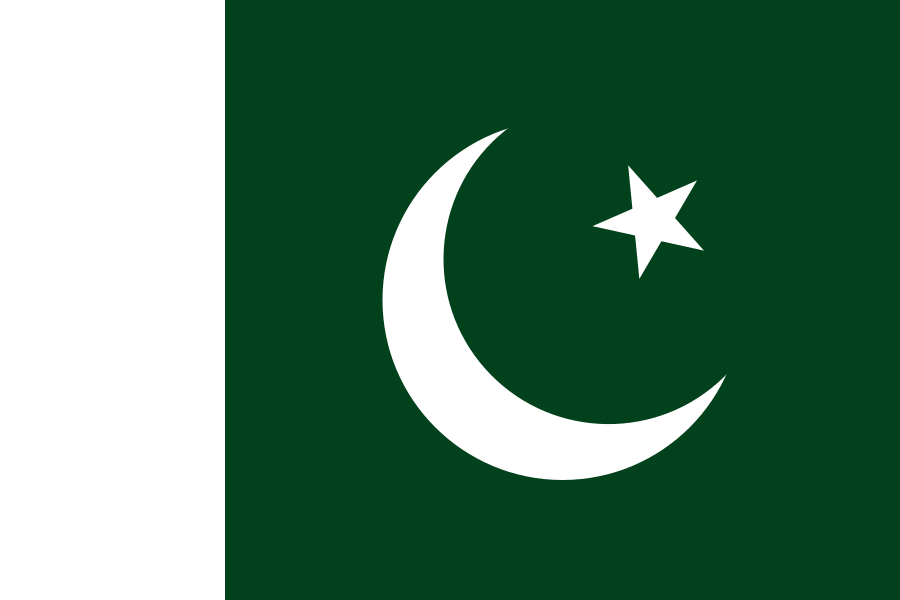

Pakistan in the World

Pakistan - Introduction 2003
top of pageBackground: The separation in 1947 of British India into the Muslim state of Pakistan (with two sections West and East) and largely Hindu India was never satisfactorily resolved. A third war between these countries in 1971 resulted in East Pakistan seceding and becoming the separate nation of Bangladesh. A dispute over the state of Kashmir is ongoing. In response to Indian nuclear weapons testing Pakistan conducted its own tests in 1998.
Area
Total: 803,940 km²
Land: 778,720 km²
Water: 25,220 km²
Comparative: slightly less than twice the size of California
Land boundaries
Total: 6,774 km
Border countries: (4) Afghanistan 2,430 km; , China 523 km; , India 2,912 km; , Iran 909 km
Maritime claims
Contiguous zone: 24 NM
Territorial sea: 12 NM
Continental shelf: 200 NM or to the edge of the continental margin
Exclusive economic zone: 200 NM
Elevation
Extremes lowest point: Indian Ocean 0 m
Extremes highest point: K2 (Mt. Godwin-Austen) 8,611 m
Natural resources: land extensive natural gas reserves limited petroleum poor quality coal iron ore copper salt limestone
Natural hazards: frequent earthquakes occasionally severe especially in north and west; flooding along the Indus after heavy rains (July and August)
Geography
Note: controls Khyber Pass and Bolan Pass traditional invasion routes between Central Asia and the Indian Subcontinent
Pakistan - People 2003
top of pagePopulation: 150,694,740 (July 2003 est.)
Growth rate: 2.01% (2003 est.)
Below poverty line: 35% (2001 est.)
Ethnic groups: Punjabi Sindhi Pashtun (Pathan) Baloch Muhajir (immigrants from India at the time of partition and their descendants)
Languages: Punjabi 48% Sindhi 12% Siraiki (a Punjabi variant) 10% Pashtu 8% Urdu (official) 8% Balochi 3% Hindko 2% Brahui 1% English (official and lingua franca of Pakistani elite and most government ministries) Burushaski and other 8%
Age structure
0-14 years: 39.3% (male 30,463,958; female 28,726,776)
15-64 years: 56.5% (male 43,571,093; female 41,651,872)
65 years and over: 4.2% (male 3,051,674; female 3,229,367) (2003 est.)
Environment
Current issues: water pollution from raw sewage industrial wastes and agricultural runoff; limited natural fresh water resources; a majority of the population does not have access to potable water; deforestation; soil erosion; desertification
International agreements party to: Biodiversity, Climate Change, Desertification, Endangered Species, Environmental Modification, Hazardous Wastes, Law of the Sea, Marine Dumping, Ozone Layer Protection, Ship Pollution, Wetlands
International agreements signed but not ratified: Marine Life Conservation, Nuclear Test Ban
Sex ratio
At birth: 1.05 male/female
Under 15 years: 1.06 male/female
15-64 years: 1.05 male/female
65 years and over: 0.94 male/female
Total population: 1.05 male/female (2003 est.)
Infant mortality rate
Total: 76.53 deaths/1000 live births
Female: 76.09 deaths/1000 live births (2003 est.)
Male: 76.95 deaths/1000 live births
Hivaids
Adult prevalence rate: 0.1% (2001 est.)
People living with hivaids: 78,000 (2001 est.)
Deaths: 4,500 (2001 est.)
Literacy
Definition: age 15 and over can read and write
Total population: 45.7%
Male: 59.8%
Female: 30.6% (2003 est.)
Pakistan - Government 2003
top of pageCountry name
Conventional long form: Islamic Republic of Pakistan
Conventional short form: Pakistan
Former: West Pakistan
Administrative divisions
Note: the Pakistani-administered portion of the disputed Jammu and Kashmir region includes Azad Kashmir and the Northern Areas
Constitution
Note: selected provisions of the Constitution pertaining to changes President MUSHARRAF made while the Constitution was suspended, remain contested by political opponents
Legal system: based on English common law with provisions to accommodate Pakistan's status as an Islamic state; accepts compulsory ICJ jurisdiction with reservations
Suffrage: 18 years of age; universal; joint electorates and reserved parliamentary seats for women and non-Muslims
Executive branch
Note: following a military takeover on 12 October 1999, Chief of Army Staff and Chairman of the Joint Chiefs of Staff Committee, General Pervez MUSHARRAF, suspended Pakistan's constitution and assumed the additional title of Chief Executive; exercising the powers of the head of the government, he appointed an eight-member National Security Council to function as Pakistan's supreme governing body; on 12 May 2000, Pakistan's Supreme Court unanimously validated the October 1999 coup and granted MUSHARRAF executive and legislative authority for three years from the coup date; on 20 June 2001, MUSHARRAF named himself as president and was sworn in, replacing Mohammad Rafiq TARAR; in a referendum held on 30 April 2002, MUSHARRAF's presidency was extended by five more years
Chief of state: President Pervez MUSHARRAF (since 20 June 2001)
Head of government: Prime Minister Mir Zafarullah Khan JAMALI (since 23 November 2002)
Elections: the president is elected by Parliament for a five-year term; note - in a referendum held on 30 April 2002, MUSHARRAF's presidency was extended by five more years (next to be held NA 2007); the prime minister is selected by the National Assembly for a four-year term (next to be held NA 2006)
Election results: results are for the 10 October 2002 election for prime minister - Mir Zafarullah Khan JAMALI elected prime minister
Cabinet: Cabinet appointed by the Prime Minister
Legislative branch
Election results: Senate results - percent of vote by party - NA%; seats by party - PML/Q 40, PPPP 11, MMA 21, MQM/A 6, PML/N 4, NA 3, PML/F 1, PkMAP 2, ANP 2, PPP/S 2, JWP 1, BNP-Awami 1, BNP-Mengal 1, BNM/H 1, independents 4; National Assembly results - percent of votes by party - NA%; seats by party - PML/Q 126, PPPP 81, MMA 63, PML/N 19, MQM/A 17, NA 16, PML/F 5, PML/J 3, PPP/S 2, BNP 1, JWP 1, PAT 1, PML/Z 1, PTI 1, MQM/H 1, PkMAP 1, independents 3
Elections: Senate - last held 24 and 27 February 2003 (next to be held by February 2007); National Assembly - last held 10 October 2002 (next to be held by October 2006)
Judicial branch: Supreme Court (justices appointed by the president); Federal Islamic or Shari'a Court
International organization participation: AsDB ASEAN (dialogue partner) C (suspended) CP ECO ESCAP FAO G-19 G-24 G-77 IAEA IBRD ICAO ICC ICFTU ICRM IDA IDB IFAD IFC IFRCS IHO ILO IMF IMO Interpol IOC IOM ISO ITU MINURSO MONUC NAM OAS (observer) OIC OPCW PCA SAARC UN UN Security Council (temporary) UNAMSIL UNCTAD UNESCO UNHCR UNIDO UNIKOM UNITAR UNMIBH UNMIK UNMISET UNMOP UNOMIG UPU WCL WCO WFTU WHO WIPO WMO WToO WTrO
Diplomatic representation
In the us chief of mission: Ambassador Ashraf Jehangir QAZI
In the us chancery: 2,315 Massachusetts Avenue NW, Washington, DC 20,008
In the us fax: [1] (202) 387-0484
In the us consulates general: Los Angeles, New York, and Sunnyvale (California)
In the us telephone: [1] (202) 939-6,205
From the us chief of mission: Ambassador Nancy J. POWELL
From the us embassy: Diplomatic Enclave, Ramna 5, Islamabad
From the us mailing address: P. O. Box 1048, Unit 62,200, APO AE 9,812-2,200
From the us telephone: [92] (51) 2,080-0000
From the us fax: [92] (51) 2,276,427
From the us consulates: Karachi, Lahore, Peshawar
Flag description: green with a vertical white band (symbolizing the role of religious minorities) on the hoist side; a large white crescent and star are centered in the green field; the crescent star and color green are traditional symbols of Islam
Pakistan - Economy 2003
top of pageEconomy overview: Pakistan an impoverished and underdeveloped country suffers from internal political disputes low levels of foreign investment and a costly ongoing confrontation with neighboring India. Pakistan's economic prospects although still marred by poor human development indicators continued to improve in 2002 following unprecedented inflows of foreign assistance beginning in 2001. Foreign exchange reserves have grown to record levels supported largely by fast growth in recorded worker remittances. Trade levels rebounded after a sharp decline in late 2001. The government has made significant inroads in macroeconomic reform since 2000 but progress is beginning to slow. Although it is in the second year of its $1.3 billion IMF Poverty Reduction and Growth Facility Islamabad continues to require waivers for politically difficult reforms. Long-term prospects remain uncertain as development spending remains low regional tensions remain high and political tensions weaken Pakistan's commitment to lender-recommended economic reforms. GDP growth will continue to hinge on crop performance; dependence on foreign oil leaves the import bill vulnerable to fluctuating oil prices; and efforts to open and modernize the economy remain uneven.
Industries: textiles and apparel food processing beverages construction materials paper products fertilizer shrimp
Labor force
Note: extensive export of labor, mostly to the Middle East, and use of child labor (2000)
By occupation agriculture: 44%
By occupation industry: 17%
By occupation services: 39% (1999 est.)
Budget
Revenues: $12.6 billion
Expenditures: $14.8 billion, including capital expenditures of $NA (FY02/03 est.)
Exports: $9.8 billion f.o.b. (FY02/03 est.)
Commodities: textiles (garments cotton cloth and yarn) rice leather sports goods and carpets and rugs
Partners: US 24.5% UAE 8.5% UK 7.2% Germany 4.9% Hong Kong 4.8% (2002)
Imports: $11.1 billion f.o.b. (FY02/03 est.)
Commodities: petroleum petroleum products machinery chemicals transportation equipment edible oils pulses iron an steel tea
Partners: UAE 11.7% Saudi Arabia 11.7% Kuwait 6.7% US 6.4% China 6.2% Japan 6% Malaysia 4.5% Germany 4.4% (2002)
Exchange rates: Pakistani rupees per US dollar - 59.72 (2002) 61.93 (2001) 53.65 (2000) 49.12 (1999) 44.94 (1998)
Pakistan - Energy 2003
top of pageElectricity
Production: 66.96 billion kWh (2001)
Production by source fossil fuel: 68.8%
Production by source hydro: 28.2%
Production by source other: 0% (2001)
Production by source nuclear: 3%
Consumption: 62.27 billion kWh (2001)
Exports: 0 kWh (2001)
Imports: 0 kWh (2001)
Natural gas
Production: 23.4 billion m³ (2001 est.)
Consumption: 23.4 billion m³ (2001 est.)
Exports: 0 m³ (2001 est.)
Imports: 0 m³ (2001 est.)
Proven reserves: 695.6 billion m³ (37,257)
Pakistan - Communication 2003
top of pageTelephone system
General assessment: the domestic system is mediocre, but improving; service is adequate for government and business use, in part because major businesses have established their own private systems; since 1988, the government has promoted investment in the national telecommunications system on a priority basis, significantly increasing network capacity; despite major improvements in trunk and urban systems, telecommunication services are still not readily available to the majority of the rural population
Domestic: microwave radio relay, coaxial cable, fiber-optic cable, cellular, and satellite networks
International: satellite earth stations - 3 Intelsat (1 Atlantic Ocean and 2 Indian Ocean); 3 operational international gateway exchanges (1 at Karachi and 2 at Islamabad); microwave radio relay to neighboring countries (1999)
Pakistan - Military 2003
top of pagePakistan - Transportation 2003
top of pageAirports: 124 (2002)
With paved runways total: 87
With paved runways over 3047 m: 14
With paved runways 2438 to 3047 m: 21
With paved runways 914 to 1523 m: 17
With paved runways under 914 m: 3 (2002)
With paved runways 15-24 to 2437 m: 32
With unpaved runways total: 37
With unpaved runways 15-24 to 2437 m: 9
With unpaved runways 914 to 1523 m: 9
With unpaved runways under 914 m: 19 (2002)
Railways
Total: 8,163 km
Broad gauge: 7,718 km 1.676-m gauge (293 km electrified)
Narrow gauge: 445 km 1.000-m gauge (2002)
Merchant marine
Total: 18 ships (1,000 GRT or over) 247,675 GRT/375,435 DWT
Ships by type: cargo 14, container 3, petroleum tanker 1 (2002 est.)
Pakistan - Transnational issues 2003
top of pageDisputes international: thousands of Afghan refugees still reside in Pakistan; isolating terrain and close ties among Pashtuns in Pakistan make cross-border activities difficult to control; armed stand-off with India over the status and sovereignty of Kashmir continues - India objects to Pakistan ceding lands to China in 1965 boundary agreement that India believes are part of disputed Kashmir; disputes with India over Indus River water sharing and the terminus of the Rann of Kutch which prevents maritime boundary delimitation
Illicit drugs: opium poppy cultivation practically eliminated; key transit point for Southwest Asian heroin bound for Western markets; Afghan narcotics continue to transit Federally Administered Tribal Areas Balochistan Province and Karachi; financial crimes related to drug trafficking terrorism corruption and smuggling remain problems

🅶🅷🅴🅾🆂.🅲🅾🅼