top of pageBackground: The 'Republic of the Equator' was one of three countries that emerged from the collapse of Gran Colombia in 1830 (the others being Colombia and Venezuela). Between 1904 and 1942 Ecuador lost territories in a series of conflicts with its neighbors. A border war with Peru that flared in 1995 was resolved in 1999. Although Ecuador marked 25 years of civilian governance in 2004 the period has been marred by political instability. Nine presidents have governed Ecuador since 1996.
Climate: tropical along coast becoming cooler inland at higher elevations; tropical in Amazonian jungle lowlands
Terrain: coastal plain (costa) inter-Andean central highlands (sierra) and flat to rolling eastern jungle (oriente)
Natural hazards: frequent earthquakes landslides volcanic activity; floods; periodic droughts
top of pageEthnic groups: mestizo (mixed Amerindian and white) 65% Amerindian 25% Spanish and others 7% black 3%
Languages: Spanish (official) Amerindian languages (especially Quechua)
Age structure0-14 years: 33.9% (male 2,285,775; female 2,199,356)
15-64 years: 61.2% (male 4,020,873; female 4,062,672)
65 years and over: 4.9% (male 302,129; female 341,937) (2004 est.)
Birth rate: 23.18 births/1000 population (2004 est.)
Death rate: 4.26 deaths/1000 population (2004 est.)
EnvironmentCurrent issues: deforestation; soil erosion; desertification; water pollution; pollution from oil production wastes in ecologically sensitive areas of the Amazon Basin and Galapagos Islands
International agreements party to: Antarctic-Environmental Protocol, Antarctic Treaty, Biodiversity, Climate Change, Climate Change-Kyoto Protocol, Desertification, Endangered Species, Hazardous Wastes, Ozone Layer Protection, Ship Pollution, Tropical Timber 83, Tropical Timber 94, Wetlands
International agreements signed but not ratified: none of the selected agreements
top of pageAdministrative divisions: 22 provinces (provincias singular - provincia); Azuay Bolivar Canar Carchi Chimborazo Cotopaxi El Oro Esmeraldas Galapagos Guayas Imbabura Loja Los Rios Manabi Morona-Santiago Napo Orellana Pastaza Pichincha Sucumbios Tungurahua Zamora-Chinchipe
Legal system: based on civil law system; has not accepted compulsory ICJ jurisdiction
Suffrage: 18 years of age; universal compulsory for literate persons ages 18-65 optional for other eligible voters
Executive branchChief of state: President Lucio GUTIERREZ (since 15 January 2003); Vice President Alfredo PALACIO (since 15 January 2003); note - the president is both the chief of state and head of government
Head of government: President Lucio GUTIERREZ (since 15 January 2003); Vice President Alfredo PALACIO (since 15 January 2003); note - the president is both the chief of state and head of government
Cabinet: Cabinet appointed by the president
Elections: the president and vice president are elected on the same ticket by popular vote for a four-year term (no immediate reelection); election last held 20 October 2002; runoff election held 24 November 2002 (next to be held NA October 2006)
Election results: results of the 24 November 2002 runoff election - Lucio GUTIERREZ elected president; percent of vote - Lucio GUTIERREZ 54.3%; Alvaro NOBOA 45.7%
Legislative branchElections: last held 20 October 2002 (next to be held NA October 2006)
Election results: percent of vote by party - NA; seats by party - PSC 25, PRE 15, ID 16, PRIAN 10, PSP 9, Pachakutik Movement 6, MPD 5, DP 4, PS-FA 3, independents 7; note - defections by members of National Congress are commonplace, resulting in frequent changes in the numbers of seats held by the various parties
Judicial branch: Supreme Court or Corte Suprema; note - per the Constitution new justices are elected by the full Supreme Court; In December 2004 however Congress successfully replaced the entire court via a simple-majority resolution
Political parties and leaders: Concentration of Popular Forces or CFP [Averroes BUCARAM]; Democratic Left or ID [Guillermo LANDAZURI]; National Action Institutional Renewal Party or PRIAN [Alvaro NOBOA]; Pachakutik Movement [Gilberto TALAHUA]; Patriotic Society Party or PSP [Lucio GUTIERREZ Borbua]; Popular Democracy or DP [Dr. Juan Manuel FUERTES]; Popular Democratic Movement or MPD [Gustavo TERAN Acosta]; Radical Alfarista Front or FRA [Fabian ALARCON director]; Roldosist Party or PRE [Abdala BUCARAM Ortiz director]; Social Christian Party or PSC [Leon FEBRES CORDERO]; Socialist Party - Broad Front or PS-FA [Victor GRANDA]
International organization participation: CAN FAO G-77 IADB IAEA IBRD ICAO ICC ICCt ICFTU ICRM IDA IFAD IFC IFRCS IHO ILO IMF IMO Interpol IOC IOM ISO ITU LAES LAIA Mercosur (associate) MIGA MINUSTAH NAM OAS OPANAL OPCW PCA RG UN UNCTAD UNESCO UNHCR UNIDO UNMIL UNOCI UPU WCL WCO WFTU WHO WIPO WMO WToO WTO
Diplomatic representationIn the us chief of mission: Ambassador (vacant)
In the us chancery: 2,535 15th Street NW, Washington, DC 20,009
In the us telephone: [1] (202) 234-7,200
In the us fax: [1] (202) 667-3,482
In the us consulates general: Chicago, Houston, Los Angeles, Miami, New Orleans, New York, Newark, Philadelphia, and San Francisco
From the us chief of mission: Ambassador Kristie Anne KENNEY
From the us embassy: Avenida 12 de Octubre y Avenida Patria, Quito
From the us mailing address: APO AA 34,039
From the us telephone: [593] (2) 256-2,890
From the us fax: [593] (2) 250-2,052
From the us consulates general: Guayaquil
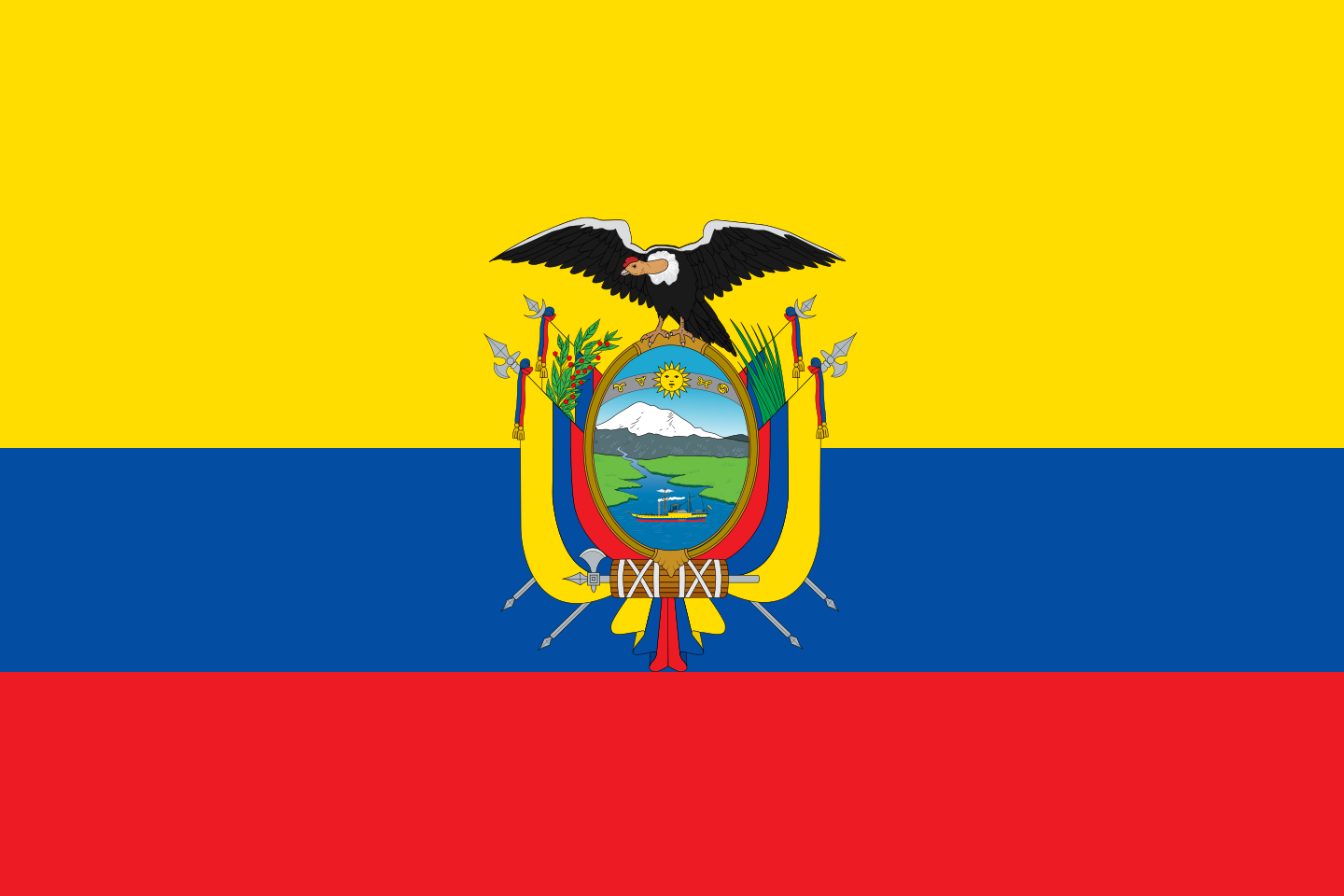
Flag description: three horizontal bands of yellow (top double width) blue and red with the coat of arms superimposed at the center of the flag; similar to the flag of Colombia which is shorter and does not bear a coat of arms
top of pageEconomy overview: Ecuador has substantial petroleum resources which have accounted for 40% of the country's export earnings and one-fourth of public sector revenues in recent years. Consequently fluctuations in world market prices can have a substantial domestic impact. In the late 1990s Ecuador suffered its worst economic crisis with natural disasters and sharp declines in world petroleum prices driving Ecuador's economy into free fall in 1999. Real GDP contracted by more than 6% with poverty worsening significantly. The banking system also collapsed and Ecuador defaulted on its external debt later that year. The currency depreciated by some 70% in 1999 and on the brink of hyperinflation the MAHAUD government announced it would dollarize the economy. A coup however ousted MAHAUD from office in January 2000 and after a short-lived junta failed to garner military support Vice President Gustavo NOBOA took over the presidency. In March 2000 Congress approved a series of structural reforms that also provided the framework for the adoption of the US dollar as legal tender. Dollarization stabilized the economy and growth returned to its pre-crisis levels in the years that followed. Under the administration of Lucio GUTIERREZ who took office in January 2003 Ecuador benefited from higher world petroleum prices but the government has made little progress on fiscal reforms and reforms of state-owned enterprises necessary to reduce Ecuador's vulnerability to petroleum price swings and financial crises.
Agriculture products: bananas coffee cocoa rice potatoes manioc (tapioca) plantains sugarcane; cattle sheep pigs beef pork dairy products; balsa wood; fish shrimp
Industries: petroleum food processing textiles wood products chemicals
Imports: $6.22 billion (2003 est.)
Commodities: consumer goods industrial raw materials capital goods
Partners: US 23.9% Colombia 12.8% Venezuela 7.1% Brazil 6.1% Chile 4.8% Japan 4.2% (2003)
Exchange rates: Ecuador formally adopted the US dollar as legal tender in March 2000
top of pagetop of pagetop of pagetop of pagePipelines: extra heavy crude 578 km; gas 71 km; oil 1386 km; refined products 1185 km (2004)
Waterways: 1500 km (most inaccessible) (2003)
Merchant marineTotal: 34 ships (1,000 GRT or over) 241,403 GRT/391,898 DWT
By type: cargo 2, chemical tanker 4, liquefied gas 1, passenger 5, petroleum tanker 21, specialized tanker 1
Foreign owned: Greece 1, Paraguay 1, Peru 1
Registered in other countries: 3 (2004 est.)
Ecuador - Transnational issues 2004
top of pageDisputes international: the continuing civil disorder in Colombia has created a serious refugee crisis in neighboring states especially Ecuador
Illicit drugs: significant transit country for cocaine originating in Colombia and Peru; importer of precursor chemicals used in production of illicit narcotics; attractive location for cash-placement by drug traffickers laundering money because of dollarization and weak anti-money-laundering regime especially vulnerable along the border with Colombia; increased activity on the northern frontier by trafficking groups and Colombian insurgents
🅶🅷🅴🅾🆂.🅲🅾🅼