Statistics Gabon 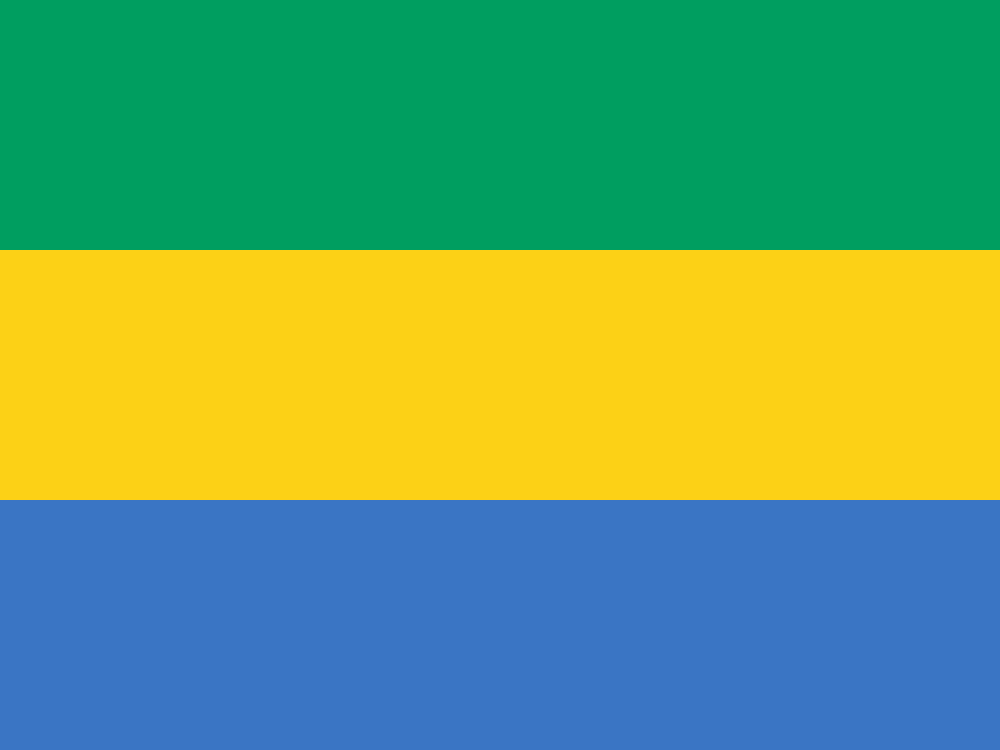

Gabon in the World

Gabon - Introduction 2004
top of pageBackground: Only two autocratic presidents have ruled Gabon since independence from France in 1960. Gabon's current President El Hadj Omar BONGO - one of the longest-serving heads of state in the world - has dominated Gabon's political scene for almost four decades. President BONGO introduced a nominal multiparty system and a new constitution in the early 1990s. However the low turnout and allegations of electoral fraud during the most recent local elections in 2002-03 have exposed the weaknesses of formal political structures in Gabon. In addition recent strikes have underscored the popular disenchantment with the political system. Presidential elections scheduled for 2005 are unlikely to bring change since the opposition remains weak divided and financially dependent on the current regime. Despite political conditions a small population abundant natural resources and considerable foreign support have helped make Gabon one of the more prosperous and stable African countries.
Land boundaries
Total: 2,551 km
Border countries: (3) Cameroon 298 km; , Republic of the Congo 1,903 km; , Equatorial Guinea 350 km
Geography
Note: a small population and oil and mineral reserves have helped Gabon become one of Africa's wealthier countries; in general these circumstances have allowed the country to maintain and conserve its pristine rain forest and rich biodiversity
Gabon - People 2004
top of pagePopulation
Note: estimates for this country explicitly take into account the effects of excess mortality due to AIDS; this can result in lower life expectancy, higher infant mortality and death rates, lower population and growth rates, and changes in the distribution of population by age and sex than would otherwise be expected (July 2004 est.)
Growth rate: 2.5% (2004 est.)
Below poverty line: NA
Ethnic groups: Bantu tribes including four major tribal groupings (Fang Bapounou Nzebi Obamba) other Africans and Europeans 154,000 including 10,700 French and 11,000 persons of dual nationality
Age structure
0-14 years: 42.2% (male 286,819; female 285,184)
15-64 years: 53.7% (male 362,311; female 365,132)
65 years and over: 4.1% (male 23,157; female 32,643) (2004 est.)
Environment
Current issues: deforestation; poaching
International agreements party to: Biodiversity, Climate Change, Desertification, Endangered Species, Law of the Sea, Marine Dumping, Ozone Layer Protection, Ship Pollution, Tropical Timber 83, Tropical Timber 94, Wetlands
International agreements signed but not ratified: none of the selected agreements
Sex ratio
At birth: 1.03 male/female
Under 15 years: 1.01 male/female
15-64 years: 0.99 male/female
65 years and over: 0.71 male/female
Total population: 0.98 male/female (2004 est.)
Infant mortality rate
Total: 54.34 deaths/1000 live births
Male: 64.15 deaths/1000 live births
Female: 44.23 deaths/1000 live births (2004 est.)
Life expectancy at birth
Total population: 56.46 years
Male: 54.85 years
Female: 58.12 years (2004 est.)
Hivaids
Adult prevalence rate: 8.1% (2003 est.)
People living with hivaids: 48,000 (2003 est.)
Deaths: 3,000 (2003 est.)
Literacy
Definition: age 15 and over can read and write
Total population: 63.2%
Male: 73.7%
Female: 53.3% (1995 est.)
Gabon - Government 2004
top of pageCountry name
Conventional long form: Gabonese Republic
Conventional short form: Gabon
Local long form: Republique Gabonaise
Local short form: Gabon
Administrative divisions: 9 provinces; Estuaire Haut-Ogooue Moyen-Ogooue Ngounie Nyanga Ogooue-Ivindo Ogooue-Lolo Ogooue-Maritime Woleu-Ntem
Legal system: based on French civil law system and customary law; judicial review of legislative acts in Constitutional Chamber of the Supreme Court; has not accepted compulsory ICJ jurisdiction
Executive branch
Chief of state: President El Hadj Omar BONGO (since 2 December 1967)
Head of government: Prime Minister Jean-Francois NTOUTOUME-EMANE (since 23 January 1999)
Cabinet: Council of Ministers appointed by the prime minister in consultation with the president
Elections: president elected by popular vote for a seven-year term; election last held 6 December 1998 (next to be held NA 2005); prime minister appointed by the president
Election results: President El Hadj Omar BONGO reelected; percent of vote - El Hadj Omar BONGO 66.6%, Pierre MAMBOUNDOU 16.5%, Fr. Paul M'BA-ABESSOLE 13.4%
Legislative branch
Elections: National Assembly - last held 9 and 23 December 2001 (next to be held NA December 2006); Senate - last held 26 January and 9 February 2003 (next to be held by January 2009)
Election results: National Assembly - percent of vote by party - NA; seats by party - PDG 86, RNB-RPG 8, PGP 3, ADERE 3, CLR 2, PUP 1, PSD 1, independents 13, others 3; Senate - percent of vote by party - NA; seats by party - PDG 53, RNB 20, PGP 4, ADERE 3, RDP 1, CLR 1, independents 9
Judicial branch: Supreme Court or Cour Supreme consisting of three chambers - Judicial Administrative and Accounts; Constitutional Court; Courts of Appeal; Court of State Security; County Courts
Political parties and leaders: Circle of Liberal Reformers or CLR [General Jean Boniface ASSELE]; Democratic and Republican Alliance or ADERE [Divungui-di-Ndinge DIDJOB]; Gabonese Democratic Party or PDG former sole party [Simplice Nguedet MANZELA]; Gabonese Party for Progress or PGP [Pierre-Louis AGONDJO-OKAWE]; National Rally of Woodcutters-Rally for Gabon or RNB-RPG (Bucherons) [Fr. Paul M'BA-ABESSOLE]; People's Unity Party or PUP [Louis Gaston MAYILA]; Rally for Democracy and Progress or RDP [Pierre EMBONI]; Social Democratic Party or PSD [Pierre Claver MAGANGA-MOUSSAVOU]
International organization participation: ACCT ACP AfDB AU BDEAC CEMAC FAO FZ G-24 G-77 IAEA IBRD ICAO ICCt ICFTU IDA IDB IFAD IFC IFRCS ILO IMF IMO Interpol IOC ITU MIGA NAM OIC ONUB OPCW UN UNCTAD UNESCO UNIDO UPU WCL WCO WHO WIPO WMO WToO WTO
Diplomatic representation
In the us chief of mission: Ambassador Jules Marius OGOUEBANDJA
In the us chancery: Suite 200, 2,034 20th Street NW, Washington, DC 20,009
In the us telephone: [1] (202) 797-1000
In the us fax: [1] (202) 332-0668
In the us consulates: New York
From the us chief of mission: Ambassador Kenneth P. MOOREFIELD
From the us embassy: Boulevard de la Mer, Libreville
From the us mailing address: Centre Ville, B. P. 4,000, Libreville
From the us telephone: [241] 76 20 03 through 76 20 04, after hours - 74 34 92
From the us fax: [241] 74 55 07
Gabon - Economy 2004
top of pageEconomy overview: Gabon enjoys a per capita income four times that of most nations of sub-Saharan Africa. This has supported a sharp decline in extreme poverty; yet because of high income inequality a large proportion of the population remains poor. Gabon depended on timber and manganese until oil was discovered offshore in the early 1970s. The oil sector now accounts for 50% of GDP. Gabon continues to face fluctuating prices for its oil timber and manganese exports. Despite the abundance of natural wealth poor fiscal management hobbles the economy. Devaluation of its Francophone currency by 50% on 12 January 1994 sparked a one-time inflationary surge to 35%; the rate dropped to 6% in 1996. The IMF provided a one-year standby arrangement in 1994-95 a three-year Enhanced Financing Facility (EFF) at near commercial rates beginning in late 1995 and stand-by credit of $119 million in October 2000. Those agreements mandate progress in privatization and fiscal discipline. France provided additional financial support in January 1997 after Gabon had met IMF targets for mid-1996. In 1997 an IMF mission to Gabon criticized the government for overspending on off-budget items overborrowing from the central bank and slipping on its schedule for privatization and administrative reform. The rebound of oil prices in 1999-2000 helped growth but drops in production hampered Gabon from fully realizing potential gains. In December 2000 Gabon signed a new agreement with the Paris Club to reschedule its official debt. A follow-up bilateral repayment agreement with the US was signed in December 2001. Short-term progress depends on an upbeat world economy and fiscal and other adjustments in line with IMF policies.
Agriculture products: cocoa coffee sugar palm oil rubber; cattle; okoume (a tropical softwood); fish
Industries: petroleum extraction and refining; manganese and gold mining; chemicals; ship repair; food and beverage; textile; lumbering and plywood; cement
Labor force: 610,000 (2003)
By occupation agriculture: 60%
By occupation industry: 15%
By occupation services: 25%
Budget
Revenues: $1.771 billion
Expenditures: $1.413 billion, including capital expenditures of $310 million (2003 est.)
Exports: $2.891 billion f.o.b. (2003 est.)
Commodities: crude oil 77% timber manganese uranium (2001)
Partners: US 51.5% France 8.7% China 7.5% Japan 4% (2003)
Imports: $1.079 billion f.o.b. (2003 est.)
Commodities: machinery and equipment foodstuffs chemicals construction materials
Partners: France 49.9% US 5.3% UK 4.6% (2003)
Exchange rates: Communaute Financiere Africaine francs (XAF) per US dollar - 581.2 (2003) 696.988 (2002) 733.039 (2001) 711.976 (2000) 615.699 (1999)
Gabon - Energy 2004
top of pageElectricity
Production: 798.4 million kWh (2001)
Consumption: 742.5 million kWh (2001)
Exports: 0 kWh (2001)
Imports: 0 kWh (2001)
Natural gas
Production: 80 million m³ (2001 est.)
Consumption: 80 million m³ (2001 est.)
Exports: 0 m³ (2001 est.)
Imports: 0 m³ (2001 est.)
Proven reserves: 66.47 billion m³ (1 January 2002)
Gabon - Communication 2004
top of pageTelephone system
General assessment: adequate service by African standards and improving with the help of the growing mobile cell system
Domestic: adequate system of cable, microwave radio relay, tropospheric scatter, radiotelephone communication stations, and a domestic satellite system with 12 earth stations
International: country code - 241; satellite earth stations - 3 Intelsat (Atlantic Ocean); fiber optic submarine cable (SAT-3/WASC) provides connectivity to Europe and Asia
Gabon - Military 2004
top of pageGabon - Transportation 2004
top of pageAirports: 56 (2003 est.)
With paved runways total: 11
With paved runways over 3047 m: 1
With paved runways 2438 to 3047 m: 1
With paved runways 15-24 to 2437 m: 8
With paved runways 914 to 1523 m: 1 (2004 est.)
With unpaved runways total: 45
With unpaved runways 15-24 to 2437 m: 7
With unpaved runways 914 to 1523 m: 15
With unpaved runways under 914 m: 23 (2004 est.)
Gabon - Transnational issues 2004
top of pageDisputes international: creation of a maritime boundary in hydrocarbon-rich Corisco Bay with Equatorial Guinea is hampered by dispute over Mbane Island administered and occupied by Gabon since the 1970s

🅶🅷🅴🅾🆂.🅲🅾🅼