Statistics Belize 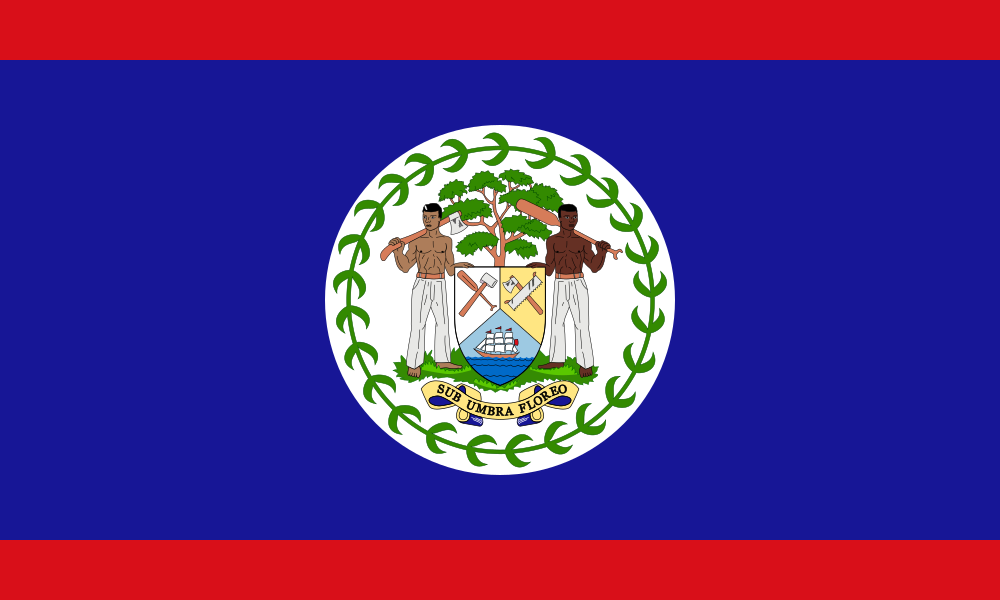

Belize in the World

Belize - Introduction 2012
top of pageBackground: Belize was the site of several Mayan city states until their decline at the end of the first millennium A.D. The British and Spanish disputed the region in the 17th and 18th centuries; it formally became the colony of British Honduras in 1854. Territorial disputes between the UK and Guatemala delayed the independence of Belize until 1981. Guatemala refused to recognize the new nation until 1992 and the two countries are involved in an ongoing border dispute. Guatemala and Belize plan to hold a simultaneous referendum tentatively set for October 2013 to determine if this dispute will go before the International Court of Justice at The Hague. Tourism has become the mainstay of the economy. Current concerns include the country's heavy foreign debt burden high unemployment growing involvement in the Mexican and South American drug trade high crime rates and one of the highest prevalence rates of HIV/AIDS in Central America.
Natural hazards: frequent devastating hurricanes (June to November) and coastal flooding (especially in south)
Belize - People 2012
top of pagePopulation: 327,719 (July 2012 est.)
Rank: 177
Growth rate: 2.011% (2012 est.)
Growth rate rank: 52
Below poverty line: 43% (2010 est.)
Languages: Spanish 46% Creole 32.9% Mayan dialects 8.9% English 3.9% (official) Garifuna 3.4% (Carib) German 3.3% other 1.4% unknown 0.2% (2000 census)
Religions: Roman Catholic 39.3% Pentacostal 8.3% Seventh Day Adventist 5.3% Anglican 4.5% Mennonite 3.7% Baptist 3.5% Methodist 2.8% Nazarene 2.8% Jehovah's Witnesses 1.6% other 9.9% (includes Bahai Faith Buddhism Hinduism Islam and Mormon) other (unknown) 3.1% none 15.2% (2010 census)
Demographic profile:
Migration continues to transform Belize's population. About 16% of Belizeans live abroad while immigrants constitute approximately 15% of Belize's population. Belizeans seeking job and educational opportunities have preferred to emigrate to the United States rather than former colonizer Great Britain because of the United States' closer proximity and stronger trade ties with Belize. Belizeans also emigrate to Canada Mexico and English-speaking Caribbean countries. The emigration of a large share of Creoles (Afro-Belizeans) and the influx of Central American immigrants mainly Guatemalans Salvadorans and Hondurans has changed Belize's ethnic composition. Mestizos have become the largest ethnic group and Belize now has more native Spanish speakers than English or Creole speakers despite English being the official language. In addition Central American immigrants are establishing new communities in rural areas which contrasts with the urbanization trend seen in neighboring countries. Recently Chinese European and North American immigrants have become more frequent.
Immigration accounts for an increasing share of Belize's population growth rate which is steadily falling due to fertility decline. Belize's declining birth rate and its increased life expectancy are creating an aging population. As the elderly population grows and nuclear families replace extended households Belize's government will be challenged to balance a rising demand for pensions social services and healthcare for its senior citizens with the need to reduce poverty and social inequality and to improve sanitation.
Immigration accounts for an increasing share of Belize's population growth rate which is steadily falling due to fertility decline. Belize's declining birth rate and its increased life expectancy are creating an aging population. As the elderly population grows and nuclear families replace extended households Belize's government will be challenged to balance a rising demand for pensions social services and healthcare for its senior citizens with the need to reduce poverty and social inequality and to improve sanitation.
Environment
Current issues: deforestation; water pollution from sewage industrial effluents agricultural runoff; solid and sewage waste disposal
Sanitation facility access:
urban: 93% of population
rural: 86% of population
total: 90% of population
rural: 86% of population
total: 90% of population
Unimproved:
urban: 7% of population
rural: 14% of population
total: 10% of population
rural: 14% of population
total: 10% of population
Hivaids
Adult prevalence rate: 2.3% (2009 est.)
Adult prevalence rate rank: 28
People living with hivaids: 4,800 (2009 est.)
People living with hivaids rank: 119
Deaths: fewer than 500 (2009 est.)
Deaths rank: 82
Belize - Government 2012
top of pageInternational law organization participation: has not submitted an ICJ jurisdiction declaration; accepts ICCt jurisdiction
Legislative branch: bicameral National Assembly consists of the Senate (12 seats; members appointed by the governor general - 6 on the advice of the prime minister 3 on the advice of the leader of the opposition and 1 each on the advice of the Belize Council of Churches and Evangelical Association of Churches the Belize Chamber of Commerce and Industry and the Belize Better Business Bureau and the National Trade Union Congress and the Civil Society Steering Committee; to serve five-year terms) and the House of Representatives (31 seats; members are elected by direct popular vote to serve five-year terms)
Judicial branch: Supreme Court (the chief justice is appointed by the governor general on the advice of the prime minister); Court of Appeal; Privy Council in the UK; member of the Caribbean Court of Justice (CCJ); Summary Jurisdiction Courts (criminal) and District Courts (civil jurisdiction)
Political parties and leaders: National Alliance for Belizean Rights or NABR; National Reform Party or NRP [Cornelius DUECK]; People's National Party or PNP [Wil MAHEIA]; People's United Party or PUP [John BRICENO]; United Democratic Party or UDP [Dean BARROW]; Vision Inspired by the People or VIP [Paul MORGAN]; We the People Reform Movement or WTP [Hipolito BAUTISTA]
International organization participation: ACP AOSIS C Caricom CD CDB CELAC FAO G-77 IADB IAEA IBRD ICAO ICC (NGOs) ICRM IDA IFAD IFC IFRCS ILO IMF IMO Interpol IOC IOM ITU LAES MIGA NAM OAS OPANAL OPCW PCA Petrocaribe SICA UN UNCTAD UNESCO UNIDO UPU WCO WHO WIPO WMO WTO
Flag description: blue with a narrow red stripe along the top and the bottom edges; centered is a large white disk bearing the coat of arms; the coat of arms features a shield flanked by two workers in front of a mahogany tree with the related motto SUB UMBRA FLOREO (I Flourish in the Shade) on a scroll at the bottom all encircled by a green garland of 50 mahogany leaves; the colors are those of the two main political parties: blue for the PUP and red for the UDP; various elements of the coat of arms - the figures the tools the mahogany tree and the garland of leaves - recall the logging industry that led to British settlement of Belize
Belize - Economy 2012
top of pageEconomy overview: Tourism is the number one foreign exchange earner in this small economy followed by exports of marine products citrus cane sugar bananas and garments. The government's expansionary monetary and fiscal policies initiated in September 1998 led to GDP growth averaging nearly 4% in 1999-2007. Oil discoveries in 2006 bolstered this growth. Exploration efforts have continued and production has increased a small amount. Growth slipped to 0% in 2009 and has remained at just over 2% per year during 2010-12 as a result of the global slowdown natural disasters and a temporary drop in the price of oil. With weak economic growth and a large public debt burden fiscal spending is likely to be tight. In September 2012 the government defaulted on a $23 million payment on its global bond and is in talks with international bondholders to restructure the debt. The $544 million global bond due in 2,029 - called the superbond because it was the product in 2007 of a debt consolidation - represents one-half of the country's public debt. A key government objective remains the reduction of poverty and inequality with the help of international donors. Although Belize has the second highest per capita income in Central America the average income figure masks a huge income disparity between rich and poor. The 2010 Poverty Assessment shows that more than 4 out of 10 people live in poverty. The sizable trade deficit and heavy foreign debt burden continue to be major concerns.
Exports: $603.3 million (2011 est.)
Rank: 169
Commodities: sugar bananas citrus clothing fish products molasses wood crude oil
Partners: US 38.1% UK 16.5% Costa Rica 10% Nigeria 4.4% (2011)
Imports: $773.9 million (2011 est.)
Rank: 185
Commodities: machinery and transport equipment manufactured goods; fuels chemicals pharmaceuticals; food beverages tobacco
Partners: US 38.2% Mexico 10.2% Cuba 9.2% Guatemala 5.4% China 5% Trinidad and Tobago 4.1% (2011)
Exchange rates:
Belizean dollars (BZD) per US dollar -
2 (2012 est.)
2 (2011 est.)
2 (2010 est.)
2 (2009)
2 (2008)
2 (2012 est.)
2 (2011 est.)
2 (2010 est.)
2 (2009)
2 (2008)
Belize - Energy 2012
top of pageElectricity
Production: 307.2 million kWh (2009 est.)
Production rank: 170
Consumption: 285.7 million kWh (2009 est.)
Consumption rank: 177
Exports: 0 kWh (2010 est.)
Exports rank: 165
Imports: 0 kWh (2010 est.)
Imports rank: 162
Installed generating capacity: 102,100 kW (2009 est.)
Installed generating capacity rank: 168
Generation sources fossil fuels: 33.3% of total installed capacity (2009 est.)
Generation sources fossil fuels rank: 176
Generation sources nuclear: 0% of total installed capacity (2009 est.)
Generation sources nuclear rank: 50
Generation sources hydroelectricity: 37.2% of total installed capacity (2009 est.)
Generation sources hydroelectricity rank: 57
Generation sources other renewable sources: 29.5% of total installed capacity (2009 est.)
Generation sources other renewable sources rank: 2
Petroleum
Petroleum total petroleum production: 4,000 bbl/day (2011 est.)
Petroleum total petroleum production rank: 90
Crude oil exports: 0 bbl/day (2009 est.)
Crude oil exports rank: 84
Crude oil imports: 0 bbl/day (2009 est.)
Crude oil imports rank: 160
Crude oil proven reserves: 6.7 million bbl (1 January 2012 est.)
Crude oil proven reserves rank: 97
Refined petroleum
Products production: 0 bbl/day (2008 est.)
Products production rank: 126
Products consumption: 7,044 bbl/day (2011 est.)
Products consumption rank: 162
Products exports: 0 bbl/day (2008 est.)
Products exports rank: 154
Products imports: 3,553 bbl/day (2008 est.)
Products imports rank: 166
Natural gas
Production: 0 m³ (2010 est.)
Production rank: 103
Consumption: 0 m³ (2010 est.)
Consumption rank: 121
Exports: 0 m³ (2010 est.)
Exports rank: 161
Imports: 0 m³ (2010 est.)
Imports rank: 162
Proven reserves: 0 m³ (1 January 2012 est.)
Proven reserves rank: 114
Carbon dioxide emissions
From consumption of energy: 980,500 Mt (2010 est.)
From consumption of energy rank: 166
Belize - Communication 2012
top of pageTelephones
Main lines in use: 28,800 (2011)
Main lines in use rank: 178
Mobile cellular: 222,000 (2011)
Mobile cellular rank: 178
Broadcast media: 8 privately-owned TV stations; multi-channel cable TV provides access to foreign stations; about 25 radio stations broadcasting on roughly 50 different frequencies; state-run radio was privatized in 1998 (2007)
Belize - Military 2012
top of pageMilitary service age and obligation: 18 years of age for voluntary military service; laws allow for conscription only if volunteers are insufficient; conscription has never been implemented; volunteers typically outnumber available positions by 3:1; initial service obligation 12 years (2012)
Belize - Transportation 2012
top of pageBelize - Transnational issues 2012
top of pageDisputes international: Guatemala persists in its territorial claim to half of Belize but agrees to the Line of Adjacency to keep Guatemalan squatters out of Belize's forested interior; both countries agreed in April 2012 to hold simultaneous referenda scheduled for 6 October 2013 to decide whether to refer the dispute to the ICJ for binding resolution; Belize and Mexico are working to solve minor border demarcation discrepancies arising from inaccuracies in the 1898 border treaty
Illicit drugs: transshipment point for cocaine; small-scale illicit producer of cannabis primarily for local consumption; offshore sector money-laundering activity related to nar
🅶🅷🅴🅾🆂.🅲🅾🅼