Statistics Jordan 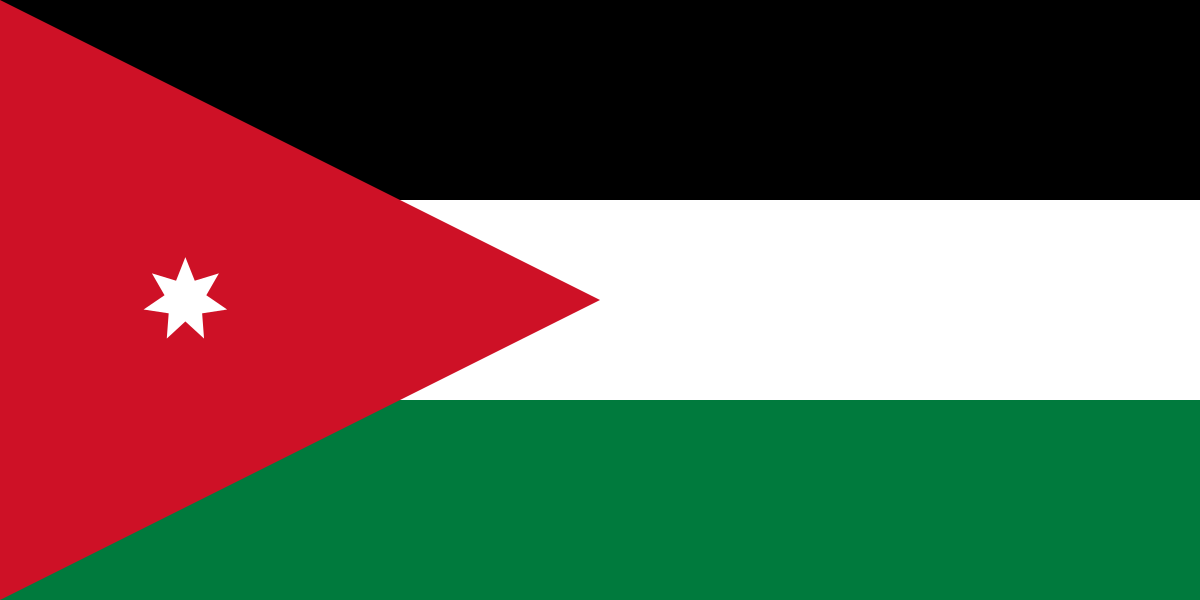

Jordan in the World

Jordan - Introduction 2012
top of pageBackground:
Following World War I and the dissolution of the Ottoman Empire the UK received a mandate to govern much of the Middle East. Britain separated out a semi-autonomous region of Transjordan from Palestine in the early 1920s and the area gained its independence in 1946; it adopted the name of Jordan in 1950. The country's long-time ruler was King HUSSEIN (1953-99). A pragmatic leader he successfully navigated competing pressures from the major powers (US USSR and UK) various Arab states Israel and a large internal Palestinian population. Jordan lost the West Bank to Israel in the 1967 war and defeated Palestinian rebels who attempted to overthrow the monarchy in 1970. King HUSSEIN in 1988 permanently relinquished Jordanian claims to the West Bank. In 1989 he reinstituted parliamentary elections and initiated a gradual political liberalization; political parties were legalized in 1992. In 1994 he signed a peace treaty with Israel. King ABDALLAH II King HUSSEIN's eldest son assumed the throne following his father's death in February 1999. Since then he has consolidated his power and implemented some economic and political reforms. Jordan acceded to the World Trade Organization in 2000 and began to participate in the European Free Trade Association in 2001. In 2003 Jordan staunchly supported the Coalition ouster of SADDAM in Iraq and following the outbreak of insurgent violence in Iraq absorbed thousands of displaced Iraqis. Municipal elections were held in July 2007 under a system in which 20% of seats in all municipal councils were reserved by quota for women. Parliamentary elections were last held in November 2010 and saw independent pro-government candidates win the vast majority of seats.
Beginning in January 2011 in the wake of unrest in Tunisia and Egypt as many as several thousand Jordanians staged weekly demonstrations and marches in Amman and other cities throughout Jordan to push for political reforms and protest government corruption rising prices rampant poverty and high unemployment. In response King ABDALLAH replaced his prime minister and formed two commissions - one to propose specific reforms to Jordan's electoral and political parties laws and the other to consider limited constitutional amendments. In a televised speech in June 2011 the King announced plans to work toward transferring authority for appointing future prime ministers and cabinet ministers to parliament; in a subsequent announcement he outlined a revised political parties law intended to encourage greater political participation. Protesters and opposition elements generally acknowledged those measures as steps in the right direction but many continue to push for greater limits on the King's authority and to fight against government corruption. In September 2011 a royal decree approved constitutional amendments passed by the Parliament aimed at strengthening a more independent judiciary and establishing a constitutional court and independent election commission to oversee the next municipal and parliamentary elections slated for April 2012 and fall 2012 respectively. King ABDALLAH in October 2011 dismissed the Jordanian cabinet and replaced the prime minister in response to widespread public dissatisfaction with government performance and escalating criticism of the premier because of public concerns over his reported involvement in corruption.
Beginning in January 2011 in the wake of unrest in Tunisia and Egypt as many as several thousand Jordanians staged weekly demonstrations and marches in Amman and other cities throughout Jordan to push for political reforms and protest government corruption rising prices rampant poverty and high unemployment. In response King ABDALLAH replaced his prime minister and formed two commissions - one to propose specific reforms to Jordan's electoral and political parties laws and the other to consider limited constitutional amendments. In a televised speech in June 2011 the King announced plans to work toward transferring authority for appointing future prime ministers and cabinet ministers to parliament; in a subsequent announcement he outlined a revised political parties law intended to encourage greater political participation. Protesters and opposition elements generally acknowledged those measures as steps in the right direction but many continue to push for greater limits on the King's authority and to fight against government corruption. In September 2011 a royal decree approved constitutional amendments passed by the Parliament aimed at strengthening a more independent judiciary and establishing a constitutional court and independent election commission to oversee the next municipal and parliamentary elections slated for April 2012 and fall 2012 respectively. King ABDALLAH in October 2011 dismissed the Jordanian cabinet and replaced the prime minister in response to widespread public dissatisfaction with government performance and escalating criticism of the premier because of public concerns over his reported involvement in corruption.
Terrain: mostly desert plateau in east highland area in west; Great Rift Valley separates East and West Banks of the Jordan River
Geography
Note: strategic location at the head of the Gulf of Aqaba and as the Arab country that shares the longest border with Israel and the occupied West Bank
Jordan - People 2012
top of pagePopulation: 6,508,887 (July 2012 est.)
Rank: 104
Growth rate: -0.965% (2012 est.)
Growth rate rank: 228
Below poverty line: 14.2% (2002)
Religions: Sunni Muslim 92% (official) Christian 6% (majority Greek Orthodox but some Greek and Roman Catholics Syrian Orthodox Coptic Orthodox Armenian Orthodox and Protestant denominations) other 2% (several small Shia Muslim and Druze populations) (2001 est.)
Environment
Current issues: limited natural freshwater resources; deforestation; overgrazing; soil erosion; desertification
Sanitation facility access:
urban: 98% of population
rural: 97% of population
total: 98% of population
rural: 97% of population
total: 98% of population
Unimproved:
urban: 2% of population
rural: 3% of population
total: 2% of population
rural: 3% of population
total: 2% of population
Hivaids
Adult prevalence rate: less than 0.1% (2001 est.)
Adult prevalence rate rank: 132
People living with hivaids: 600 (2007 est.)
People living with hivaids rank: 149
Deaths: fewer than 500 (2003 est.)
Deaths rank: 88
Jordan - Government 2012
top of pageAdministrative divisions: 12 governorates (muhafazat singular - muhafazah); Ajlun Al 'Aqabah Al Balqa' Al Karak Al Mafraq 'Amman At Tafilah Az Zarqa' Irbid Jarash Ma'an Madaba
Legal system: mixed legal system of civil law and Islamic religious law; judicial review of legislative acts in a specially provided High Tribunal
International law organization participation: has not submitted an ICJ jurisdiction declaration; accepts ICCt jurisdiction
Legislative branch: bicameral National Assembly or Majlis al-'Umma consists of the Senate also called the House of Notables or Majlis al-Ayan (60 seats; members appointed by the monarch to serve four-year terms) and the Chamber of Deputies also called the House of Representatives or Majlis al-Nuwaab (120 seats; members elected using a single non-transferable vote system in multi-member districts to serve four-year terms); note - the new electoral law enacted in May 2010 allocated an additional 10 seats (6 seats added to the number reserved for women bringing the total to 12; 2 additional seats for Amman; and 1 seat each for the cities of Zarqa and Irbid; unchanged are 9 seats reserved for Christian candidates 9 for Bedouin candidates and 3 for Jordanians of Chechen or Circassian descent
Political parties and leaders: Arab Ba'ath Socialist Party [Akram al-HIMSI]; Ba'ath Arab Progressive Party [Fuad DABBOUR]; Call Party [Muhammed ABU BAKR]; Democratic People's Party [Ablah ABU ULBAH]; Democratic Popular Unity Party [Sa'id DIAB]; Islamic Action Front or IAF [Hamzah MANSOUR]; Islamic Center Party [Marwan al-FA'URI]; Jordanian Communist Party [Munir HAMARNAH]; Jordanian National Party [Muna ABU BAKR]; Jordanian United Front [Amjad al-MAJALI]; Life Party [Zahier AMR]; Message Party [Hazem QASHOU]; National Constitution Party [Ahmad al-SHUNAQ]; National Current Party [Abd al-Hadi al-MAJALI]; National Movement for Direct Democracy [Muhammad al-QAQ]
International organization participation: ABEDA AFESD AMF CAEU CD CICA EBRD FAO G-11 G-77 IAEA IBRD ICAO ICC (national committees) ICRM IDA IDB IFAD IFC IFRCS ILO IMF IMO Interpol IOC IOM IPU ISO ITSO ITU ITUC (NGOs) LAS MIGA MINUSTAH MONUSCO NAM OIC OPCW OSCE (partner) PCA UN UNAMID UNCTAD UNESCO UNHCR UNIDO UNISFA UNMIL UNMISS UNOCI UNRWA UNWTO UPU WCO WFTU (NGOs) WHO WIPO WMO WTO
Flag description: three equal horizontal bands of black (top) representing the Abbassid Caliphate white representing the Ummayyad Caliphate and green representing the Fatimid Caliphate; a red isosceles triangle on the hoist side representing the Great Arab Revolt of 1916 and bearing a small white seven-pointed star symbolizing the seven verses of the opening Sura (Al-Fatiha) of the Holy Koran; the seven points on the star represent faith in One God humanity national spirit humility social justice virtue and aspirations; design is based on the Arab Revolt flag of World War I
Jordan - Economy 2012
top of pageEconomy overview: Jordan's economy is among the smallest in the Middle East with insufficient supplies of water oil and other natural resources underlying the government's heavy reliance on foreign assistance. Other economic challenges for the government include chronic high rates of poverty unemployment inflation and a large budget deficit. Since assuming the throne in 1999 King ABDALLAH has implemented significant economic reforms such as opening the trade regime privatizing state-owned companies and eliminating some fuel subsidies which in the last decade spurred economic growth by attracting foreign investment and creating some jobs. The global economic slowdown and regional turmoil however have depressed Jordan's GDP growth impacting export-oriented sectors construction and tourism. In 2011 the government approved two economic relief packages and a budgetary supplement largely to improve the living conditions for the middle and poor classes. Jordan's finances have also been strained by a series of natural gas pipeline attacks in Egypt causing Jordan to substitute more expensive heavy fuel oils to generate electricity. An influx of foreign aid especially from Gulf countries has helped to somewhat offset these extrabudgetary expenditures but the budget deficit is likely to remain high at more than 11% of GDP in 2012 excluding grants. Amman likely will continue to depend heavily on foreign assistance to finance the deficit in 2012. Jordan's financial sector has been relatively isolated from the international financial crisis because of its limited exposure to overseas capital markets. Jordan is currently exploring nuclear power generation to forestall energy shortfalls.
Agriculture products: citrus tomatoes cucumbers olives strawberries stone fruits; sheep poultry dairy
Market value of publicly traded shares:
$30.86 billion (31 December 2010)
$31.86 billion (31 December 2009)
$31.86 billion (31 December 2009)
Rank: 58
Exports: $7.963 billion (2011 est.)
Rank: 100
Commodities: clothing fertilizers potash phosphates vegetables pharmaceuticals
Partners: US 15.4% Iraq 15% India 12.9% Saudi Arabia 9.4% Lebanon 4.4% (2011)
Imports: $16.27 billion (2011 est.)
Rank: 81
Commodities: crude oil machinery transport equipment iron cereals
Partners: Saudi Arabia 22.1% China 9.8% US 6.4% Italy 5.1% Germany 4.5% (2011)
Exchange rates:
Jordanian dinars (JOD) per US dollar -
0.709 (2012 est.)
0.709 (2011 est.)
0.71 (2010 est.)
0.709 (2009)
0.709 (2008)
0.709 (2012 est.)
0.709 (2011 est.)
0.71 (2010 est.)
0.709 (2009)
0.709 (2008)
Jordan - Energy 2012
top of pageElectricity
Production: 13.42 billion kWh (2009 est.)
Production rank: 87
Consumption: 11.64 billion kWh (2009 est.)
Consumption rank: 83
Exports: 139 million kWh (2009 est.)
Exports rank: 71
Imports: 383 million kWh (2009 est.)
Imports rank: 78
Installed generating capacity: 2.616 million kW (2009 est.)
Installed generating capacity rank: 92
Generation sources fossil fuels: 99.3% of total installed capacity (2009 est.)
Generation sources fossil fuels rank: 57
Generation sources nuclear: 0% of total installed capacity (2009 est.)
Generation sources nuclear rank: 116
Generation sources hydroelectricity: 0.5% of total installed capacity (2009 est.)
Generation sources hydroelectricity rank: 145
Generation sources other renewable sources: 0.2% of total installed capacity (2009 est.)
Generation sources other renewable sources rank: 86
Petroleum
Petroleum total petroleum production: 20 bbl/day (2011 est.)
Petroleum total petroleum production rank: 102
Crude oil exports: 0 bbl/day (2009 est.)
Crude oil exports rank: 134
Crude oil imports: 70,700 bbl/day (2009 est.)
Crude oil imports rank: 51
Crude oil proven reserves: 1 million bbl (1 January 2012 est.)
Crude oil proven reserves rank: 100
Refined petroleum
Products production: 79,190 bbl/day (2008 est.)
Products production rank: 79
Products consumption: 107,000 bbl/day (2011 est.)
Products consumption rank: 76
Products exports: 0 bbl/day (2008 est.)
Products exports rank: 188
Products imports: 18,620 bbl/day (2008 est.)
Products imports rank: 107
Natural gas
Production: 220 million m³ (2010 est.)
Production rank: 77
Consumption: 2.74 billion m³ (2010 est.)
Consumption rank: 76
Exports: 0 m³ (2010 est.)
Exports rank: 94
Imports: 2.52 billion m³ (2010 est.)
Imports rank: 45
Proven reserves: 6.031 billion m³ (1 January 2012 est.)
Proven reserves rank: 88
Carbon dioxide emissions
From consumption of energy: 19.07 million Mt (2010 est.)
From consumption of energy rank: 85
Jordan - Communication 2012
top of pageTelephones
Main lines in use: 465,400 (2011)
Main lines in use rank: 102
Mobile cellular: 7.483 million (2011)
Mobile cellular rank: 93
Broadcast media: radio and TV dominated by the government-owned Jordan Radio and Television Corporation (JRTV) that operates a main network a sports network a film network and a satellite channel; first independent TV broadcaster aired in 2007; international satellite TV and Israeli and Syrian TV broadcasts are available; roughly 30 radio stations with JRTV operating the main government-owned station; transmissions of multiple international radio broadcasters are available (2007)
Internet
Country code: .jo
Hosts: 69,473 (2012)
Hosts rank: 89
Users: 1.642 million (2009)
Users rank: 78
Jordan - Military 2012
top of pageMilitary service age and obligation: 17 years of age for voluntary military service; initial service term 2 years with option to reenlist for 18 years; conscription for males at age 18 was suspended in 1999 but reinstated in July 2007 in order to provide youth training necessary for job market needs; all males under age 37 are required to register; women not subject to conscription but can volunteer to serve in noncombat military positions in the Royal Jordanian Arab Army Women's Corps and RJAF (2012)
Jordan - Transportation 2012
top of pageJordan - Transnational issues 2012
top of page
🅶🅷🅴🅾🆂.🅲🅾🅼