Statistics Mauritius 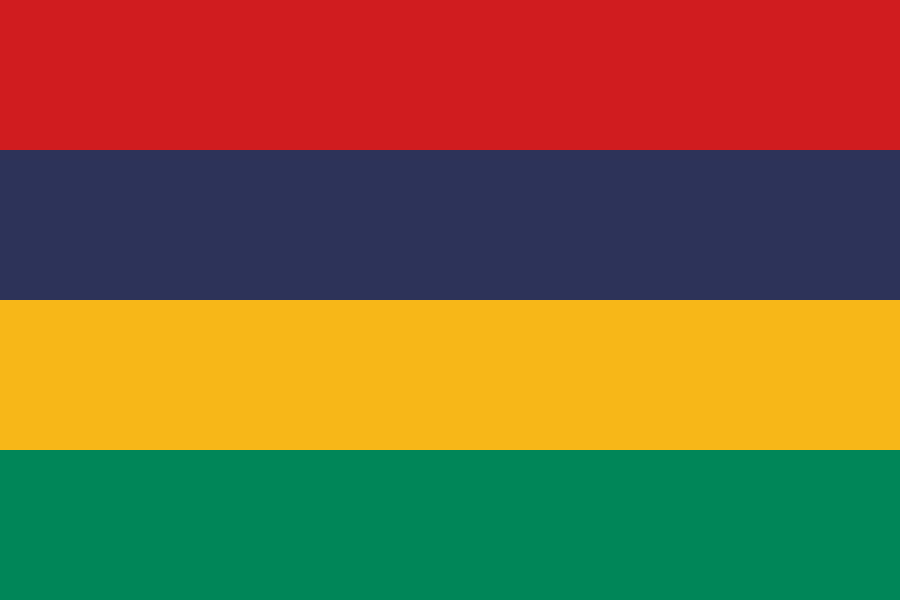

Mauritius in the World

Mauritius - Introduction 2012
top of pageBackground: Although known to Arab and Malay sailors as early as the 10th century Mauritius was first explored by the Portuguese in the 16th century and subsequently settled by the Dutch - who named it in honor of Prince Maurits van NASSAU - in the 17th century. The French assumed control in 1715 developing the island into an important naval base overseeing Indian Ocean trade and establishing a plantation economy of sugar cane. The British captured the island in 1810 during the Napoleonic Wars. Mauritius remained a strategically important British naval base and later an air station playing an important role during World War II for anti-submarine and convoy operations as well as the collection of signal intelligence. Independence from the UK was attained in 1968. A stable democracy with regular free elections and a positive human rights record the country has attracted considerable foreign investment and has earned one of Africa's highest per capita incomes.
Climate: tropical modified by southeast trade winds; warm dry winter (May to November); hot wet humid summer (November to May)
Natural hazards: cyclones (November to April); almost completely surrounded by reefs that may pose maritime hazards
Geography
Note: the main island from which the country derives its name is of volcanic origin and is almost entirely surrounded by coral reefs; former home of the dodo a large flightless bird related to pigeons driven to extinction by the end of the 17th century through a combination of hunting and the introduction of predatory species
Mauritius - People 2012
top of pagePopulation: 1,313,095 (July 2012 est.)
Rank: 155
Growth rate: 0.705% (2012 est.)
Growth rate rank: 140
Below poverty line: 8% (2006 est.)
Languages: Creole 80.5% Bhojpuri 12.1% French 3.4% English (official; spoken by less than 1% of the population) other 3.7% unspecified 0.3% (2000 census)
Religions: Hindu 48% Roman Catholic 23.6% Muslim 16.6% other Christian 8.6% other 2.5% unspecified 0.3% none 0.4% (2000 census)
Sanitation facility access:
urban: 93% of population
rural: 90% of population
total: 91% of population
rural: 90% of population
total: 91% of population
Unimproved:
urban: 7% of population
rural: 10% of population
total: 9% of population
rural: 10% of population
total: 9% of population
Hivaids
Adult prevalence rate: 1% (2009 est.)
Adult prevalence rate rank: 48
People living with hivaids: 8,800 (2009 est.)
People living with hivaids rank: 102
Deaths: fewer than 500 (2009 est.)
Deaths rank: 93
Mauritius - Government 2012
top of pageAdministrative divisions: 9 districts and 3 dependencies*; Agalega Islands* Black River Cargados Carajos Shoals* Flacq Grand Port Moka Pamplemousses Plaines Wilhems Port Louis Riviere du Rempart Rodrigues* Savanne
International law organization participation: accepts compulsory ICJ jurisdiction with reservations; accepts ICCt jurisdiction
Legislative branch: unicameral National Assembly (70 seats; 62 members elected by popular vote 8 appointed by the election commission to give representation to various ethnic minorities; members to serve five-year terms)
Political parties and leaders: Alliance of the Future or AF [Navinchandra RAMGOOLAM] (governing coalition - includes MLP MMSM MR MSD PMSD); Mauritian Labor Party or MLP [Navinchandra RAMGOOLAM]; Mauritian Militant Movement or MMM [Paul BERENGER]; Mauritian Militant Socialist Movement or MMSM [Pravind JUGNAUTH]; Mauritian Socialist Militant Movement or MSMM [Madan DULLOO]; Mauritian Solidarity Front of FSM [Cehl FAKEERMEEAH]; Mouvement Republicain or MR [Jayarama VALAYDEN]; Maurition Social Democratic Party or PMSD [Xavier Luc DUVAL]; Rodrigues Movement or MR [Joseph (Nicholas) Von MALLY]; Rodrigues Peoples Organization or OPR [Serge CLAIR]
International organization participation: ACP AfDB AOSIS AU C CD COMESA CPLP (associate) FAO G-77 IAEA IBRD ICAO ICC (NGOs) ICRM IDA IFAD IFC IFRCS IHO ILO IMF IMO IMSO InOC Interpol IOC IOM IPU ISO ITSO ITU ITUC (NGOs) MIGA NAM OIF OPCW PCA SAARC (observer) SADC UN UNCTAD UNESCO UNIDO UNWTO UPU WCO WFTU (NGOs) WHO WIPO WMO WTO
Flag description: four equal horizontal bands of red (top) blue yellow and green; red represents self-determination and independence blue the Indian Ocean surrounding the island yellow has been interpreted as the new light of independence golden sunshine or the bright future and green can symbolize either agriculture or the lush vegetation of the island
Mauritius - Economy 2012
top of pageEconomy overview: Since independence in 1968 Mauritius has developed from a low-income agriculturally based economy to a middle-income diversified economy with growing industrial financial and tourist sectors. For most of the period annual growth has been in the order of 5% to 6%. This remarkable achievement has been reflected in more equitable income distribution increased life expectancy lowered infant mortality and a much-improved infrastructure. The economy rests on sugar tourism textiles and apparel and financial services and is expanding into fish processing information and communications technology and hospitality and property development. Sugarcane is grown on about 90% of the cultivated land area and accounts for 15% of export earnings. The government's development strategy centers on creating vertical and horizontal clusters of development in these sectors. Mauritius has attracted more than 32,000 offshore entities many aimed at commerce in India South Africa and China. Investment in the banking sector alone has reached over $1 billion. Mauritius with its strong textile sector has been well poised to take advantage of the Africa Growth and Opportunity Act (AGOA). Mauritius' sound economic policies and prudent banking practices helped to mitigate negative effects from the global financial crisis in 2008-09. GDP grew in the 3-4% per year range in 2010-12 and the country continues to expand its trade and investment outreach around the globe.
Market value of publicly traded shares:
$6.506 billion (31 December 2010)
$4.74 billion (31 December 2009)
$4.74 billion (31 December 2009)
Rank: 79
Exports: $2.645 billion (2011 est.)
Rank: 135
Commodities: clothing and textiles sugar cut flowers molasses fish
Partners: UK 21.3% France 17.8% US 10.5% Italy 8.1% South Africa 7.7% Spain 7.1% Madagascar 6.2% (2011)
Imports: $4.926 billion (2011 est.)
Rank: 128
Commodities: manufactured goods capital equipment foodstuffs petroleum products chemicals
Partners: India 25.2% China 13.6% France 9.1% South Africa 6.9% (2011)
Exchange rates:
Mauritian rupees (MUR) per US dollar -
29.96 (2012 est.)
28.706 (2011 est.)
30.784 (2010 est.)
31.96 (2009)
27.973 (2008)
29.96 (2012 est.)
28.706 (2011 est.)
30.784 (2010 est.)
31.96 (2009)
27.973 (2008)
Mauritius - Energy 2012
top of pageElectricity
Production: 2.889 billion kWh (2009 est.)
Production rank: 130
Consumption: 2.687 billion kWh (2009 est.)
Consumption rank: 134
Exports: 0 kWh (2010 est.)
Exports rank: 102
Imports: 0 kWh (2010 est.)
Imports rank: 214
Installed generating capacity: 885,200 kW (2009 est.)
Installed generating capacity rank: 125
Generation sources fossil fuels: 75.2% of total installed capacity (2009 est.)
Generation sources fossil fuels rank: 98
Generation sources nuclear: 0% of total installed capacity (2009 est.)
Generation sources nuclear rank: 140
Generation sources hydroelectricity: 6.7% of total installed capacity (2009 est.)
Generation sources hydroelectricity rank: 122
Generation sources other renewable sources: 18.1% of total installed capacity (2009 est.)
Generation sources other renewable sources rank: 8
Petroleum
Petroleum total petroleum production: 0 bbl/day (2011 est.)
Petroleum total petroleum production rank: 167
Crude oil exports: 0 bbl/day (2009 est.)
Crude oil exports rank: 155
Crude oil imports: 0 bbl/day (2009 est.)
Crude oil imports rank: 96
Crude oil proven reserves: 0 bbl (1 January 2012 est.)
Crude oil proven reserves rank: 166
Refined petroleum
Products production: 0 bbl/day (2008 est.)
Products production rank: 176
Products consumption: 24,710 bbl/day (2011 est.)
Products consumption rank: 124
Products exports: 0 bbl/day (2008 est.)
Products exports rank: 202
Products imports: 22,750 bbl/day (2008 est.)
Products imports rank: 101
Natural gas
Production: 0 m³ (2010 est.)
Production rank: 167
Consumption: 0 m³ (2010 est.)
Consumption rank: 173
Exports: 0 m³ (2010 est.)
Exports rank: 118
Imports: 0 m³ (2010 est.)
Imports rank: 99
Proven reserves: 0 m³ (1 January 2012 est.)
Proven reserves rank: 171
Carbon dioxide emissions
From consumption of energy: 4.545 million Mt (2010 est.)
From consumption of energy rank: 127
Mauritius - Communication 2012
top of pageTelephones
Main lines in use: 374,600 (2011)
Main lines in use rank: 107
Mobile cellular: 1.294 million (2011)
Mobile cellular rank: 150
Broadcast media: the government maintains control over TV broadcasting through the Mauritius Broadcasting Corporation (MBC) which operates 3 analog and 10 digital TV stations; MBC is a shareholder in a local company that operates 2 pay-TV stations; the state retains the largest radio broadcast network with multiple stations; several private radio broadcasters have entered the market since 2001; transmissions of at least 2 international broadcasters are available (2007)
Mauritius - Military 2012
top of pageMauritius - Transportation 2012
top of pageMauritius - Transnational issues 2012
top of pageDisputes international: Mauritius and Seychelles claim the Chagos Islands; claims French-administered Tromelin Island
Illicit drugs: consumer and transshipment point for heroin from South Asia; small amounts of cannabis produced and consumed locally; significant offshore financial industry creates potential for money laundering but corruption levels are relatively low and the government appears generally to be committed

🅶🅷🅴🅾🆂.🅲🅾🅼