Statistics Mauritius 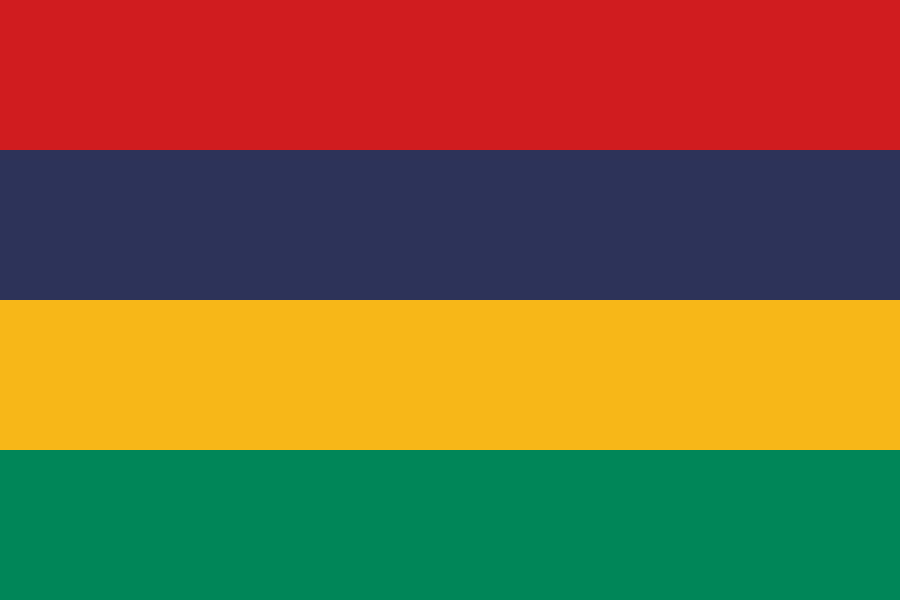

Mauritius in the World

Mauritius - Introduction 2013
top of pageBackground: Although known to Arab and Malay sailors as early as the 10th century Mauritius was first explored by the Portuguese in the 16th century and subsequently settled by the Dutch - who named it in honor of Prince Maurits van NASSAU - in the 17th century. The French assumed control in 1715 developing the island into an important naval base overseeing Indian Ocean trade and establishing a plantation economy of sugar cane. The British captured the island in 1810 during the Napoleonic Wars. Mauritius remained a strategically important British naval base and later an air station playing an important role during World War II for anti-submarine and convoy operations as well as the collection of signals intelligence. Independence from the UK was attained in 1968. A stable democracy with regular free elections and a positive human rights record the country has attracted considerable foreign investment and has earned one of Africa's highest per capita incomes.
Maritime claims: measured from claimed archipelagic straight baselines
Territorial sea: 12 nm
Exclusive economic zone: 200 nm
Continental shelf: 200 nm or to the edge of the continental margin
Climate: tropical modified by southeast trade winds; warm dry winter (May to November); hot wet humid summer (November to May)
Natural hazards: cyclones (November to April); almost completely surrounded by reefs that may pose maritime hazards
Geography
Note: the main island from which the country derives its name is of volcanic origin and is almost entirely surrounded by coral reefs; former home of the dodo a large flightless bird related to pigeons driven to extinction by the end of the 17th century through a combination of hunting and the introduction of predatory species
Mauritius - People 2013
top of pagePopulation: 1,322,238 (July 2013 est.)
Rank: 156
Growth rate: 0.68% (2013 est.)
Growth rate rank: 143
Below poverty line: 8% (2006 est.)
Languages: Creole 80.5% Bhojpuri 12.1% French 3.4% English (official; spoken by less than 1% of the population) other 3.7% unspecified 0.3% (2000 census)
Religions: Hindu 48% Roman Catholic 23.6% Muslim 16.6% other Christian 8.6% other 2.5% unspecified 0.3% none 0.4% (2000 census)
Age structure
15-24 years: 15.7% (male 104,861/female 102,671)
25-54 years: 44.3% (male 292,714/female 293,590)
55-64 years: 10.6% (male 66,460/female 73,964)
65 years and over: 8% (male 42,718/female 63,536) (2013 est.)
Dependency ratios
Youth dependency ratio: 27.6 %
Elderly dependency ratio: 12.2 %
Potential support ratio: 8.2 (2013)
Environment
Current issues: water pollution degradation of coral reefs
International agreements signed but not ratified: none of the selected agreements
Sex ratio
0-14 years: 1.04 male(s)/female
15-24 years: 1.02 male(s)/female
25-54 years: 1 male(s)/female
55-64 years: 0.9 male(s)/female
65 years and over: 0.67 male(s)/female
Total population: 0.97 male(s)/female (2013 est.)
Infant mortality rate
Rank: 138
Male: 12.95 deaths/1000 live births
Female: 8.73 deaths/1000 live births (2013 est.)
Drinking water source:
urban: 100% of population
rural: 99% of population
total: 99% of population
urban: 0% of population
rural: 1% of population
total: 1% of population (2010 est.)
rural: 99% of population
total: 99% of population
urban: 0% of population
rural: 1% of population
total: 1% of population (2010 est.)
Sanitation facility access:
urban: 91% of population
rural: 88% of population
total: 89% of population
urban: 9% of population
rural: 12% of population
total: 11% of population (2010 est.)
rural: 88% of population
total: 89% of population
urban: 9% of population
rural: 12% of population
total: 11% of population (2010 est.)
Hivaids
Adult prevalence rate: 1% (2009 est.)
Adult prevalence rate rank: 47
People living with hivaids: 8,800 (2009 est.)
People living with hivaids rank: 102
Deaths: fewer than 500 (2009 est.)
Deaths rank: 88
Mauritius - Government 2013
top of pageCountry name
Conventional short form: Mauritius
Local long form: Republic of Mauritius
Local short form: Mauritius
Capital
Geographic coordinates: 20 09 S 57 29 E
Time difference: UTC+4 (9 hours ahead of Washington DC during Standard Time)
Administrative divisions: 9 districts and 3 dependencies*; Agalega Islands* Black River Cargados Carajos Shoals* Flacq Grand Port Moka Pamplemousses Plaines Wilhems Port Louis Riviere du Rempart Rodrigues* Savanne
Constitution: several previous; latest adopted 12 March 1968; amended many times last in 2012 (2012)
International law organization participation: accepts compulsory ICJ jurisdiction with reservations; accepts ICCt jurisdiction
Executive branch
Head of government: Prime Minister Navinchandra RAMGOOLAM (since 5 July 2005)
Cabinet: Council of Ministers appointed by the president on the recommendation of the prime minister
Elections: president and vice president elected by the National Assembly for five-year terms (eligible for a second term); elections last held on 21 July 2012 (next to be held in 2017); prime minister and deputy prime minister appointed by the president responsible to the National Assembly; note - former President Sir Anerood JUGNAUTH resigned on 31 March 2012
Election results: Rajkeswur Kailash PURRYAG elected president by unanimous vote; percent of vote by the National Assembly - NA
Legislative branch: unicameral National Assembly (70 seats; 62 members elected by popular vote 8 appointed by the election commission to give representation to various ethnic minorities; members to serve five-year terms)
Elections: last held on 5 May 2010 (next to be held in 2015)
Election results: percent of vote by party - NA; seats by party - AF 41 MMM 18 MR 2 FSM 1; appointed seats - to be assigned 8
Judicial branch
Judge selection and term of office: chief justice appointed by the president after consultation with the prime minister; senior puisne judge appointed by the president with the advice of the chief justice; other puisne judges appointed by the president with the advice of the Judicial and Legal Commission a 4-member body of judicial officials including the chief justice; all judges serve until retirement at age 62
Subordinate courts: Court of Civil Appeal; Court of Criminal Appeal; Public Bodies Appeal Tribunal (formed by a 2008 constitutional amendment)
International organization participation: ACP AfDB AOSIS AU C CD COMESA CPLP (associate) FAO G-77 IAEA IBRD ICAO ICC (NGOs) ICRM IDA IFAD IFC IFRCS IHO ILO IMF IMO IMSO InOC Interpol IOC IOM IPU ISO ITSO ITU ITUC (NGOs) MIGA NAM OIF OPCW PCA SAARC (observer) SADC UN UNCTAD UNESCO UNIDO UNWTO UPU WCO WFTU (NGOs) WHO WIPO WMO WTO
Diplomatic representation
In the us chancery: 1709 N Street NW Washington DC 20,036; administrative offices - 3,201 Connecticut Avenue NW Suite 441 Washington DC 20,036
In the us telephone: [1] (202) 244-1491 through 1492
In the us FAX: [1] (202) 966-0983
From the us embassy: 4th Floor Rogers House John Kennedy Street Port Louis
From the us mailing address: international mail: P. O. Box 544 Port Louis; US mail: American Embassy Port Louis US Department of State Washington DC 20,521-2,450
From the us telephone: [230] 202-4,400
From the us FAX: [230] 208-9,534
Flag description: four equal horizontal bands of red (top) blue yellow and green; red represents self-determination and independence blue the Indian Ocean surrounding the island yellow has been interpreted as the new light of independence golden sunshine or the bright future and green can symbolize either agriculture or the lush vegetation of the island
Mauritius - Economy 2013
top of pageEconomy overview: Since independence in 1968 Mauritius has developed from a low-income agriculturally based economy to a middle-income diversified economy with growing industrial financial and tourist sectors. For most of this period annual growth has been on the order of 5% to 6%. This achievement has been reflected in more equitable income distribution increased life expectancy lowered infant mortality and a much-improved infrastructure. The economy rests on sugar tourism textiles and apparel and financial services and is expanding into fish processing information and communications technology and hospitality and property development. Sugarcane is grown on about 90% of the cultivated land area and accounts for 15% of export earnings. The government's development strategy centers on creating vertical and horizontal clusters of development in these sectors. Mauritius has attracted more than 32,000 offshore entities many aimed at commerce in India South Africa and China. Investment in the banking sector alone has reached over $1 billion. Mauritius with its strong textile sector has been well poised to take advantage of the Africa Growth and Opportunity Act (AGOA). Mauritius' sound economic policies and prudent banking practices helped to mitigate negative effects of the global financial crisis in 2008-09. GDP grew in the 3-4% per year range in 2010-12 and the country continues to expand its trade and investment outreach around the globe.
Gdp composition by end use
Government consumption: 13.4%
Investment in fixed capital: 23%
Investment in inventories: 1.5%
Exports of goods and services: 54.8%
Imports of goods and services: -66.7%: (2012 est.)
Industries: food processing (largely sugar milling) textiles clothing mining chemicals metal products transport equipment nonelectrical machinery tourism
Labor force: 626,900 (2012 est.)
Rank: 155
By occupation construction and industry: 30%
By occupation transportation and communication: 7%
By occupation trade restaurants hotels: 22%
By occupation finance: 6%
By occupation other services: 25% (2007)
Budget
Expenditures: $2.664 billion (2012 est.)
Surplus or deficit: -1.8% of GDP (2012 est.)
Surplus or deficit rank: 82
Market value of publicly traded shares:
$6.506 billion (31 December 2010)
$4.74 billion (31 December 2009)
$4.74 billion (31 December 2009)
Rank: 80
Exports: $2.565 billion (2011 est.)
Rank: 134
Commodities: clothing and textiles sugar cut flowers molasses fish
Partners: UK 19.3% France 16.4% US 9.9% South Africa 9.8% Spain 7.5% Italy 6.9% Madagascar 6.8% (2012)
Imports: $4.918 billion (2011 est.)
Rank: 129
Commodities: manufactured goods capital equipment foodstuffs petroleum products chemicals
Partners: India 23.1% China 16% France 8.5% South Africa 6.5% (2012)
Exchange rates:
Mauritian rupees (MUR) per US dollar -
30.05 (2012 est.)
28.71 (2011 est.)
30.78 (2010 est.)
31.96 (2009)
27.97 (2008)
30.05 (2012 est.)
28.71 (2011 est.)
30.78 (2010 est.)
31.96 (2009)
27.97 (2008)
Mauritius - Energy 2013
top of pageElectricity
Production: 2.628 billion kWh (2011 est.)
Production rank: 131
Consumption: 2.358 billion kWh (2010 est.)
Consumption rank: 136
Exports: 0 kWh (2012 est.)
Exports rank: 103
Imports: 0 kWh (2012 est.)
Imports rank: 214
Installed generating capacity: 900,200 kW (2010 est.)
Installed generating capacity rank: 124
Generation sources fossil fuels: 75.7% of total installed capacity (2010 est.)
Generation sources fossil fuels rank: 98
Generation sources nuclear: 0% of total installed capacity (2010 est.)
Generation sources nuclear rank: 139
Generation sources hydroelectricity: 6.6% of total installed capacity (2010 est.)
Generation sources hydroelectricity rank: 121
Generation sources other renewable sources: 17.8% of total installed capacity (2010 est.)
Generation sources other renewable sources rank: 7
Petroleum
Petroleum total petroleum production: 0 bbl/day (2012 est.)
Petroleum total petroleum production rank: 194
Crude oil exports: 0 bbl/day (2010 est.)
Crude oil exports rank: 156
Crude oil imports: 0 bbl/day (2010 est.)
Crude oil imports rank: 93
Crude oil proven reserves: 0 bbl (1 January 2013 es)
Crude oil proven reserves rank: 164
Refined petroleum
Products production: 0 bbl/day (2010 est.)
Products production rank: 206
Products consumption: 24,710 bbl/day (2011 est.)
Products consumption rank: 123
Products exports: 0 bbl/day (2010 est.)
Products exports rank: 197
Products imports: 20,620 bbl/day (2010 est.)
Products imports rank: 105
Natural gas
Production: 0 m³ (2011 est.)
Production rank: 167
Consumption: 0 m³ (2010 est.)
Consumption rank: 172
Exports: 0 m³ (2011 est.)
Exports rank: 148
Imports: 0 m³ (2011 est.)
Imports rank: 97
Proven reserves: 0 m³ (1 January 2013 es)
Proven reserves rank: 171
Carbon dioxide emissions
From consumption of energy: 5.06 million Mt (2011 est.)
From consumption of energy rank: 124
Mauritius - Communication 2013
top of pageTelephones
Main lines in use: 349,100 (2012)
Main lines in use rank: 109
Mobile cellular: 1.485 million (2012)
Mobile cellular rank: 152
Telephone system
Domestic: monopoly over fixed-line services terminated in 2005; fixed-line teledensity roughly 30 per 100 persons; mobile-cellular services launched in 1989 with current teledensity roughly 100 per 100 persons
International: country code - 230; landing point for the SAFE submarine cable that provides links to Asia and South Africa where it connects to the SAT-3/WASC submarine cable that provides further links to parts of East Africa and Europe; satellite earth station - 1 Intelsat (Indian Ocean); new microwave link to Reunion; HF radiotelephone links to several countries (2011)
Broadcast media: the government maintains control over TV broadcasting through the Mauritius Broadcasting Corporation (MBC) which operates 3 analog and 10 digital TV stations; MBC is a shareholder in a local company that operates 2 pay-TV stations; the state retains the largest radio broadcast network with multiple stations; several private radio broadcasters have entered the market since 2001; transmissions of at least 2 international broadcasters are available (2007)
Mauritius - Military 2013
top of pageMauritius - Transportation 2013
top of pageAirports: 5 (2013)
Rank: 180
With paved runways over 3047 m: 1
With paved runways 914 to 1523 m: 1 (2013)
With unpaved runways 914 to 1523 m: 2
With unpaved runways: 1 (2013)
Mauritius - Transnational issues 2013
top of pageDisputes international: Mauritius and Seychelles claim the Chagos Islands; claims French-administered Tromelin Island
Illicit drugs: consumer and transshipment point for heroin from South Asia; small amounts of cannabis produced and consumed locally; significant offshore financial industry creates potential for money laundering but corruption levels are relatively low and the government appears generally to be committed

🅶🅷🅴🅾🆂.🅲🅾🅼