Statistics Timor-Leste 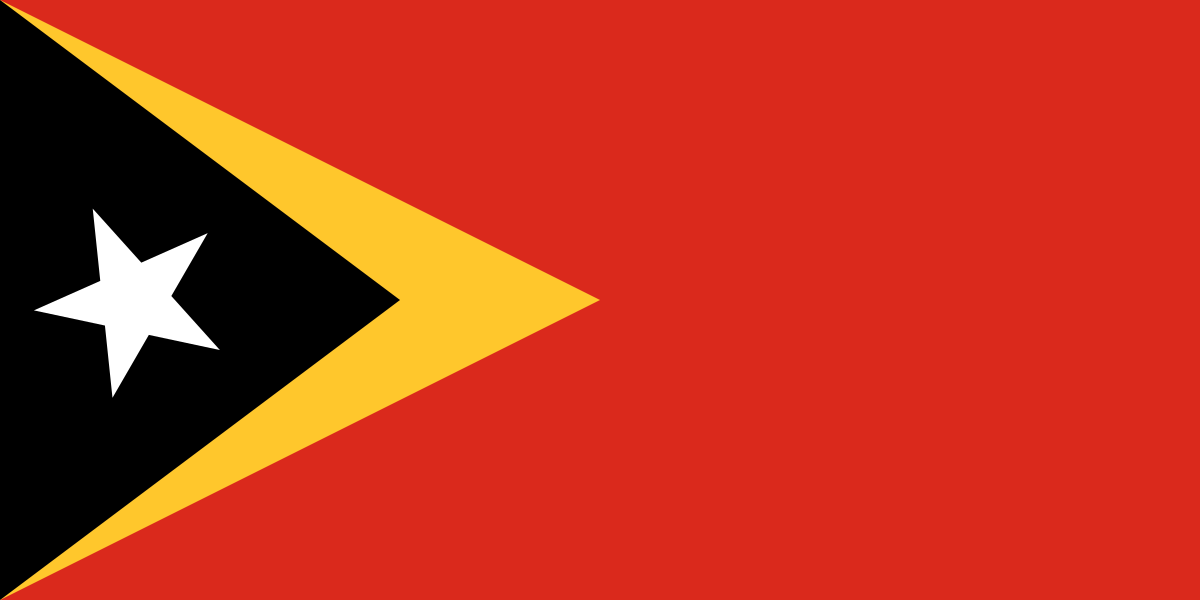

Timor-Leste in the World

Timor-Leste - Introduction 2015
top of pageBackground:
TThe Portuguese began to trade with the island of Timor in the early 16th century and colonized it in mid-century. Skirmishing with the Dutch in the region eventually resulted in an 1859 treaty in which Portugal ceded the western portion of the island. Imperial Japan occupied Portuguese Timor from 1942 to 1945 but Portugal resumed colonial authority after the Japanese defeat in World War II. East Timor declared itself independent from Portugal on 28 November 1975 and was invaded and occupied by Indonesian forces nine days later. It was incorporated into Indonesia in July 1976 as the province of Timor Timur (East Timor). An unsuccessful campaign of pacification followed over the next two decades during which an estimated 100,000 to 250,000 people died. In an August 1999 UN-supervised popular referendum an overwhelming majority of the people of Timor-Leste voted for independence from Indonesia. However in the next three weeks anti-independence Timorese militias - organized and supported by the Indonesian military - commenced a large-scale scorched-earth campaign of retribution. The militias killed approximately 1400 Timorese and forced 300,000 people into western Timor as refugees. Most of the country's infrastructure including homes irrigation systems water supply systems and schools and nearly all of the country's electrical grid were destroyed. On 20 September 1999 Australian-led peacekeeping troops deployed to the country and brought the violence to an end. On 20 May 2002 Timor-Leste was internationally recognized as an independent state.
In 2006 internal tensions threatened the new nation's security when a military strike led to violence and a breakdown of law and order. At Dili's request an Australian-led International Stabilization Force (ISF) deployed to Timor-Leste and the UN Security Council established the UN Integrated Mission in Timor-Leste (UNMIT) which included an authorized police presence of over 1600 personnel. The ISF and UNMIT restored stability allowing for presidential and parliamentary elections in 2007 in a largely peaceful atmosphere. In February 2008 a rebel group staged an unsuccessful attack against the president and prime minister. The ringleader was killed in the attack and most of the rebels surrendered in April 2008. Since the attack the government has enjoyed one of its longest periods of post-independence stability including successful 2012 elections for both the parliament and president. In late 2012 the UN Security Council ended its peacekeeping mission in Timor-Leste and both the ISF and UNMIT departed the country.
In 2006 internal tensions threatened the new nation's security when a military strike led to violence and a breakdown of law and order. At Dili's request an Australian-led International Stabilization Force (ISF) deployed to Timor-Leste and the UN Security Council established the UN Integrated Mission in Timor-Leste (UNMIT) which included an authorized police presence of over 1600 personnel. The ISF and UNMIT restored stability allowing for presidential and parliamentary elections in 2007 in a largely peaceful atmosphere. In February 2008 a rebel group staged an unsuccessful attack against the president and prime minister. The ringleader was killed in the attack and most of the rebels surrendered in April 2008. Since the attack the government has enjoyed one of its longest periods of post-independence stability including successful 2012 elections for both the parliament and president. In late 2012 the UN Security Council ended its peacekeeping mission in Timor-Leste and both the ISF and UNMIT departed the country.
Area
Total: 14,874 km²
Land: 14,874 km²
Water: 0 km²
Rank: 160
Comparative: slightly larger than Connecticut
Elevation
Extremes lowest point: Timor Sea Savu Sea and Banda Sea 0 m
Extremes highest point: Foho Tatamailau 2,963 m
Land use
Agricultural land: 25.1%
arable land: 10.1%
permanent crops: 4.9%
permanent pasture: 10.1%
permanent crops: 4.9%
permanent pasture: 10.1%
Forest: 49.1%
Other: 25.8%
Geography
Note: Timor comes from the Malay word for 'East'; the island of Timor is part of the Malay Archipelago and is the largest and easternmost of the Lesser Sunda Islands
Timor-Leste - People 2015
top of pagePopulation: 1,231,116
Note: other estimates range as low as 800,000
Rank: 160
Growth rate: 2.42% (2015 est.)
Growth rate rank: 30
Below poverty line: 37% (2011 est.)
Languages: Tetum (official) Portuguese (official) Indonesian English
Note: there are about 16 indigenous languages; Tetum Galole Mambae and Kemak are spoken by a significant portion of the population
Age structure
0-14 years: 41.82%
15-24 years: 20.02%
25-54 years: 29.59%
55-64 years: 4.84%
65 years and over: 3.73% (2015 est.)
Dependency ratios
Total dependency ratio: 92.3%
Youth dependency ratio: 81.5%
Elderly dependency ratio: 10.7%
Potential support ratio: 9.3%
Urbanization
Urban population: 32.8% of total population
Rate of urbanization: 3.75% annual rate of change
Environment
Current issues: widespread use of slash and burn agriculture has led to deforestation and soil erosion
International agreements party to: Biodiversity Climate Change Climate Change-Kyoto Protocol Desertification
International agreements signed but not ratified: none of the selected agreements
Sex ratio
At birth: 1.07 male/female
0-14 years: 1.06 male/female
15-24 years: 1.03 male/female
25-54 years: 0.93 male/female
55-64 years: 1.05 male/female
65 years and over: 0.91 male/female
Total population: 1.01 male/female
Infant mortality rate
Total: 37.54 deaths/1000 live births
Male: 40.5 deaths/1000 live births
Female: 34.39 deaths/1000 live births
Rank: 55
Drinking water source:
urban: 95.2% of population
rural: 60.5% of population
total: 71.9% of population
urban: 4.8% of population
rural: 39.5% of population
total: 28.1% of population (2015 est.)
rural: 60.5% of population
total: 71.9% of population
urban: 4.8% of population
rural: 39.5% of population
total: 28.1% of population (2015 est.)
Sanitation facility access:
urban: 69% of population
rural: 26.8% of population
total: 40.6% of population
urban: 31% of population
rural: 73.2% of population
total: 59.4% of population (2015 est.)
rural: 26.8% of population
total: 40.6% of population
urban: 31% of population
rural: 73.2% of population
total: 59.4% of population (2015 est.)
Major infectious diseases
Degree of risk: very high
Food or waterborne diseases: bacterial diarrhea hepatitis A and typhoid fever
Vectorborne diseases: dengue fever and malaria
Literacy
Definition: age 15 and over can read and write
Total population: 67.5%
Male: 71.5%
Female: 63.4%
Timor-Leste - Government 2015
top of pageCountry name
Conventional long form: Democratic Republic of Timor-Leste
Conventional short form: Timor-Leste
Note: pronounced TEE-mor LESS-tay
Local long form: Republika Demokratika Timor Lorosa'e [Tetum]; Republica Democratica de Timor-Leste [Portuguese]
Local short form: Timor Lorosa'e [Tetum]; Timor-Leste [Portuguese]
Former: East Timor Portuguese Timor
Administrative divisions: 13 administrative districts; Aileu Ainaro Baucau Bobonaro (Maliana) Cova-Lima (Suai) Dili Ermera (Gleno) Lautem (Los Palos) Liquica Manatuto Manufahi (Same) Oecussi (Ambeno) Viqueque
Note: administrative divisions have the same names as their administrative centers
Independence: 28 November 1975 (independence proclaimed from Portugal); note - 20 May 2002 is the official date of international recognition of Timor-Leste's independence
Legal system: civil law system based on the Portuguese model; note - penal and civil law codes to replace the Indonesian codes were passed by Parliament and promulgated in 2009 and 2011 respectively
International law organization participation: accepts compulsory ICJ jurisdiction with reservations; accepts ICCt jurisdiction
Executive branch
Chief of state: President Taur Matan RUAK aka Jose Maria de VASCONCELOS ; note - the president plays a largely symbolic role but is the commander in chief of the military and is able to veto legislation dissolve parliament and call national elections
Head of government: Prime Minister Kay Rala Xanana GUSMAO - formerly Jose Alexandre GUSMAO ; Vice Prime Minister Fernando 'Lasama' de ARAUJO (since 8 August 2012)
Cabinet: Council of Ministers proposed by the prime minister and appointed by the president
Electionsappointments: president directly elected by absolute majority popular vote in 2 rounds if needed for a 5-year term ; election last held on 17 March 2012 with a runoff on 16 April 2012; following parliamentary elections the president appoints the leader of the majority party or majority coalition as the prime minister
Election results: Taur Matan RUAK elected president in runoff; percent of vote - Taur Matan RUAK 61.2% Francisco GUTTERES (Frenti-Mudanca) 38.8%
Legislative branch
Description: unicameral National Parliament
Elections: elections were held on 7 July 2012
Election results: percent of vote by party - CNRT 36% FRETILIN 30% PD 10% Frenti-Mudanca 3% others 21%; seats by party - CNRT 30 FRETILIN 25 PD 8 Frenti-Mudanca 2
Judicial branch
Highest court: Supreme Court of Justice
Judge selection and term of office: Supreme Court president appointed by the president of the republic from among the other court judges to serve a 4-year term; other Supreme Court judges appointed - 1 by the Parliament and the others by the Supreme Council for the Judiciary a body presided by the Supreme Court president and includes mostly presidential and parliamentary appointees; other Supreme Court judge tenure NA
Subordinate courts: Court of Appeal; district courts; magistrates' courts
Note: the UN Justice System Programme launched in 2003 and in 2008 is helping strengthen the country's justice system
Political parties and leaders:
Democratic Party or PD [Fernando 'Lasama' de ARAUJO]
Frenti-Mudanca [Jose Luis GUTERRES]
National Congress for Timorese Reconstruction or CNRT [Kay Rala Xanana GUSMAO]
Revolutionary Front of Independent Timor-Leste or FRETILIN [Mari ALKATIRI]
(only parties in Parliament are listed)
Frenti-Mudanca [Jose Luis GUTERRES]
National Congress for Timorese Reconstruction or CNRT [Kay Rala Xanana GUSMAO]
Revolutionary Front of Independent Timor-Leste or FRETILIN [Mari ALKATIRI]
(only parties in Parliament are listed)
International organization participation: ACP ADB AOSIS ARF ASEAN (observer) CPLP EITI (compliant country) FAO G-77 IBRD ICAO ICCt ICRM IDA IFAD IFC IFRCS ILO IMF IMO Interpol IOC IOM IPU ITU MIGA NAM OPCW PIF (observer) UN UNCTAD UNESCO UNIDO Union Latina UNWTO UPU WCO WHO WMO
Diplomatic representation
In the us chief of mission: Ambassador Domingos Sarmento ALVES
In the us chancery: 4,201 Connecticut Avenue NW Suite 504 Washington DC 20,008
In the us telephone: [1] 966-3,202
In the us FAX: [1] 966-3,205
From the us chief of mission: Ambassador ; Charge d'Affaires Scott TICKNOR (since end of 2013)
From the us embassy: Avenida de Portugal Praia dos Coqueiros Dili
From the us mailing address: US Department of State 8,250 Dili Place Washington DC 20,521-8,250
From the us telephone: 332-4,684
From the us FAX: 331-3,206
Flag description: red with a black isosceles triangle (based on the hoist side) superimposed on a slightly longer yellow arrowhead that extends to the center of the flag; a white star - pointing to the upper hoist-side corner of the flag - is in the center of the black triangle; yellow denotes the colonialism in Timor-Leste's past; black represents the obscurantism that needs to be overcome; red stands for the national liberation struggle; the white star symbolizes peace and serves as a guiding light
National anthem
Name: 'Patria'
Lyrics and music: Fransisco Borja DA COSTA/Afonso DE ARAUJO
Note: adopted 2002; the song was first used as an anthem when Timor-Leste declared its independence from Portugal in 1975; the lyricist Fransisco Borja DA COSTA was killed in the Indonesian invasion just days after independence was declared
Timor-Leste - Economy 2015
top of pageEconomy overview: Since gaining its independence in 1999 Timor-Leste has faced great challenges in rebuilding its infrastructure strengthening the civil administration and generating jobs for young people entering the work force. The development of oil and gas resources in offshore waters has greatly supplemented government revenues. This technology-intensive industry however has done little to create jobs in part because there are no production facilities in Timor-Leste. Gas is currently piped to Australia for processing but Timor-Leste has expressed interest in developing a domestic processing capacity. In June 2005 the National Parliament unanimously approved the creation of a Petroleum Fund to serve as a repository for all petroleum revenues and to preserve the value of Timor-Leste's petroleum wealth for future generations. The Fund held assets of $16.5 billion as of December 2014. Oil accounts for 90% of government revenues and the drop in the price of oil in 2014 has led to concerns about the long-term sustainability of government spending. The Ministry of Finance maintains that the Petroleum Fund is sufficient to sustain government operations for the foreseeable future. Annual government budget expenditures increased markedly between 2009 and 2012 but dropped significantly in 2013 and again in 2014. Historically the government has failed to spend as much as its budget allowed. The government has focused significant resources on basic infrastructure including electricity and roads. Limited experience in procurement and infrastructure building has hampered these projects. The underlying economic policy challenge the country faces remains how best to use oil-and-gas wealth to lift the non-oil economy onto a higher growth path and to reduce poverty.
Real gdp purchasing power parity:
$6.066 billion (2014 est.)
$5.693 billion (2013 est.)
$5.401 billion (2012 est.)
$5.693 billion (2013 est.)
$5.401 billion (2012 est.)
Note: data are in 2014 US dollars
Rank: 163
Real gdp per capita:
$4,900 (2014 est.)
$4,600 (2013 est.)
$4,400 (2012 est.)
$4,600 (2013 est.)
$4,400 (2012 est.)
Note: data are in 2014 US dollars
Rank: 155
Gdp composition by end use
Household consumption: 21.9%
Government consumption: 21.3%
Investment in fixed capital: 21.8%
Investment in inventories: 0%
Exports of goods and services: 81.9%
Imports of goods and services: -46.8%: (2014 est.)
Agriculture products: coffee rice corn cassava (manioc tapioca) sweet potatoes soybeans cabbage mangoes bananas vanilla
Labor force: 247,500 (2012 est.)
Rank: 167
By occupation agriculture: 64%
By occupation industry: 10%
By occupation services: 26%
Budget
Revenues: $400 million
Expenditures: $1.8 billion
Surplus or deficit: -31% of GDP (2014 est.)
Surplus or deficit rank: 214
Commercial bank prime lending rate:
12.8% (31 December 2014 est.)
12.41% (31 December 2013 est.)
12.41% (31 December 2013 est.)
Rank: 61
Stock of narrow money:
$241.4 million (31 December 2014 est.)
$279.5 million (31 December 2013 est.)
$279.5 million (31 December 2013 est.)
Rank: 175
Stock of broad money:
$546.2 million (31 December 2014 est.)
$500.2 million (31 December 2013 est.)
$500.2 million (31 December 2013 est.)
Rank: 176
Stock of domestic credit:
$-500 million (31 December 2014 est.)
$-469 million (31 December 2013 est.)
$-469 million (31 December 2013 est.)
Rank: 185
Exports: $154 million (2012 est.)
Rank: 202
Commodities: oil coffee sandalwood marble
Commodities note: potential for vanilla exports
Imports:
$696.2 million (2013 est.)
$689 million (2011 est.)
$689 million (2011 est.)
Rank: 188
Commodities: food gasoline kerosene machinery
Timor-Leste - Energy 2015
top of pageElectricity
Production: 349.4 million kWh (2012 est.)
Production rank: 197
Consumption: 125.3 million kWh (2012 est.)
Consumption rank: 203
Exports: 0 kWh (2012 est.)
Exports rank: 206
Imports: 0 kWh (2012 est.)
Imports rank: 210
Petroleum
Petroleum total petroleum production: 79,260 bbl/day (2013 est.)
Petroleum total petroleum production rank: 51
Crude oil exports: 77,280 bbl/day (2013 est.)
Crude oil exports rank: 39
Crude oil imports: 0 bbl/day (2010 est.)
Crude oil imports rank: 131
Crude oil proven reserves: 0 bbl (1 January 2014 est.)
Crude oil proven reserves rank: 199
Refined petroleum
Products production: 0 bbl/day (2012 est.)
Products production rank: 201
Products consumption: 1980 bbl/day (2013 est.)
Products consumption rank: 190
Products exports: 0 bbl/day (2010 est.)
Products exports rank: 137
Products imports: 1264 bbl/day (2012 est.)
Products imports rank: 190
Natural gas
Production: 0 m³ (2012 est.)
Production rank: 200
Consumption: 0 m³ (2012 est.)
Consumption rank: 201
Exports: 0 m³ (2012 est.)
Exports rank: 194
Imports: 0 m³ (2012 est.)
Imports rank: 139
Proven reserves: 200 billion m³ (1 January 2006 est.)
Proven reserves rank: 46
Carbon dioxide emissions
From consumption of energy: 496,300 Mt (2012 est.)
From consumption of energy rank: 181
Timor-Leste - Communication 2015
top of pageTelephones
Fixed lines total subscriptions: 3,000
Fixed lines subscriptions per 100 inhabitants: less than 1
Fixed lines rank: 212
Mobile cellular total: 676,900
Mobile cellular subscriptions per 100 inhabitants: 56
Mobile cellular rank: 163
Telephone system
General assessment: rudimentary service in urban and some rural areas which is expanding with the entrance of new competitors
Domestic: system suffered significant damage during the violence associated with independence; limited fixed-line services; mobile-cellular services have been expanding and are now available in urban and most rural areas
International: country code - 670; international service is available
Broadcast media: 1 public TV broadcast station broadcasting nationally and 1 public radio broadcaster with stations in each of the 13 administrative districts; 1 commercial TV broadcast station 3 commercial radio stations and roughly 20 community radio stations (2012)
Timor-Leste - Military 2015
top of pageMilitary service age and obligation: 18 years of age for voluntary military service; 18-month service obligation; no conscription but as of May 2013 introduction of conscription was under discussion (2013)
Timor-Leste - Transportation 2015
top of pageAirports: 6 (2013)
Rank: 176
With paved runways total: 2
With paved runways 2438 to 3047 m: 1
With paved runways 15-24 to 2437 m: 1
With unpaved runways total: 4
With unpaved runways 914 to 1523 m: 2
With unpaved runways: 2 (2013)
Timor-Leste - Transnational issues 2015
top of pageDisputes international: three stretches of land borders with Timor-Leste have yet to be delimited two of which are in the Oecussi exclave area and no maritime or Economic Exclusion Zone boundaries have been established between the countries; maritime boundaries with Indonesia remain unresolved; in 2007 Australia and Timor-Leste signed a 50-year development zone and revenue sharing agreement in lieu of a maritime boundary

🅶🅷🅴🅾🆂.🅲🅾🅼