Statistics Qatar 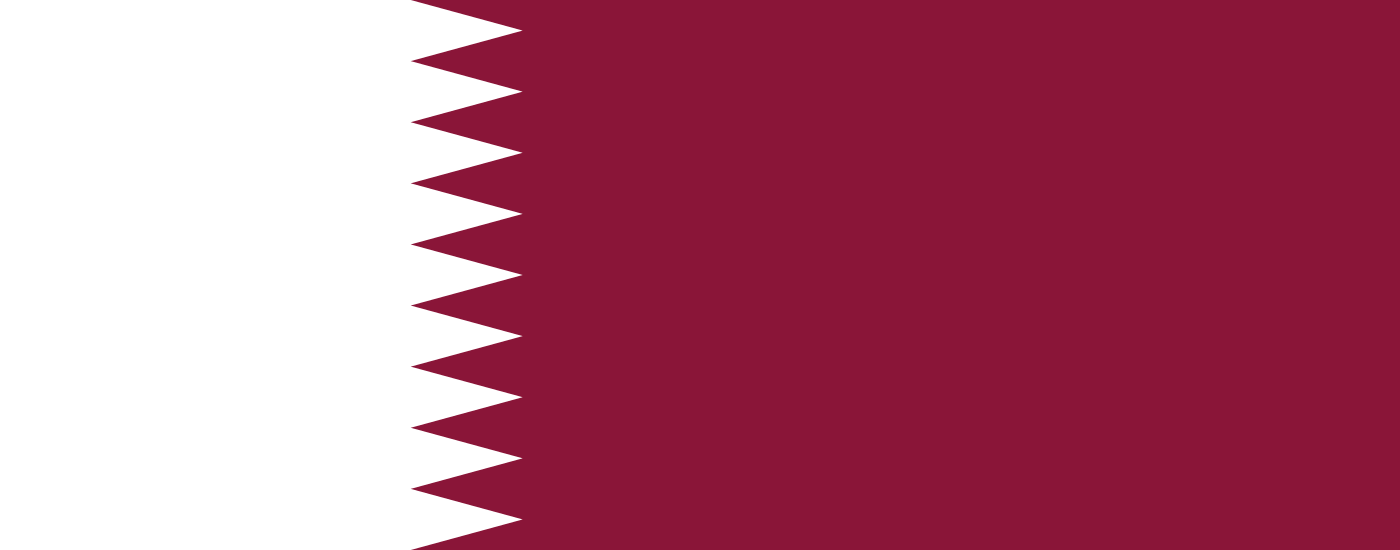

Qatar in the World

Qatar - Introduction 2019
top of pageBackground: Ruled by the Al Thani family since the mid-1800s, Qatar within the last 60 years transformed itself from a poor British protectorate noted mainly for pearling into an independent state with significant oil and natural gas revenues. Former Amir HAMAD bin Khalifa Al Thani, who overthrew his father in a bloodless coup in 1995, ushered in wide-sweeping political and media reforms, unprecedented economic investment, and a growing Qatari regional leadership role, in part through the creation of the pan-Arab satellite news network Al-Jazeera and Qatar's mediation of some regional conflicts. In the 2000s, Qatar resolved its longstanding border disputes with both Bahrain and Saudi Arabia and by 2007 had attained the highest per capita income in the world. Qatar did not experience domestic unrest or violence like that seen in other Near Eastern and North African countries in 2011, due in part to its immense wealth and patronage network. In mid-2013, HAMAD peacefully abdicated, transferring power to his son, the current Amir TAMIM bin Hamad. TAMIM is popular with the Qatari public, for his role in shepherding the country through an economic embargo by some other regional countries, for his efforts to improve the country's healthcare and education systems, and for his expansion of the country's infrastructure in anticipation of Doha's hosting of the 2022 World Cup.
Area
Total: 11,586 km²
Land: 11,586 km²
Water: 0 km²
Rank: 165
Comparative: almost twice the size of Delaware; slightly smaller than Connecticut
Land use
Agricultural land: 5.6% (2011 est.)
arable land: 1.1% (2011 est.)
permanent crops: 0.2% (2011 est.)
permanent pasture: 4.3% (2011 est.)
permanent crops: 0.2% (2011 est.)
permanent pasture: 4.3% (2011 est.)
Forest: 0% (2011 est.)
Other: 94.4% (2011 est.)
Geography
Note: the peninsula occupies a strategic location in the central Persian Gulf near major petroleum deposits
Qatar - People 2019
top of pagePopulation
Distribution: most of the population is clustered in or around the capital of Doha on the eastern side of the peninsula: 2,363,569 (July 2018 est.)
Rank: 143
Growth rate: 1.95% (2018 est.)
Growth rate rank: 50
Below poverty line note: NA
Religions:
Muslim 67.7%, Christian 13.8%, Hindu 13.8%, Buddhist 3.1%, folk religion <.1%, Jewish <.1%, other 0.7%, unaffiliated 0.9% (2010 est.)
MENA religious affiliation:
MENA religious affiliation:
Age structure
0-14 years: 12.7% (male 151,888 /female 148,186)
15-24 years: 12.12% (male 205,242 /female 81,297)
25-54 years: 70.67% (male 1,391,192 /female 279,256)
55-64 years: 3.44% (male 62,683 /female 18,731)
65 years and over: 1.06% (male 16,295 /female 8,799) (2018 est.)
Dependency ratios
Total dependency ratio: 17.5 (2015 est.)
Youth dependency ratio: 16.3 (2015 est.)
Elderly dependency ratio: 1.3 (2015 est.)
Potential support ratio: 78.1 (2015 est.)
Population distribution: most of the population is clustered in or around the capital of Doha on the eastern side of the peninsula
Urbanization
Urban population: 99.2% of total population
Note: (2015-20 est.)
Rate of urbanization: 2.41% annual rate of change
Environment
Current issues: air, land, and water pollution are significant environmental issues; limited natural freshwater resources are increasing dependence on large-scale desalination facilities; other issues include conservation of oil supplies and preservation of the natural wildlife heritage
International agreements party to: Biodiversity, Climate Change, Climate Change-Kyoto Protocol, Desertification, Endangered Species, Hazardous Wastes, Law of the Sea, Ozone Layer Protection, Ship Pollution
International agreements signed but not ratified: none of the selected agreements
Sex ratio
At birth: 1.02 male(s)/female
0-14 years: 1.02 male(s)/female
15-24 years: 2.52 male(s)/female
25-54 years: 4.98 male(s)/female
55-64 years: 3.35 male(s)/female
65 years and over: 1.85 male(s)/female
Total population: 3.41 male(s)/female (2018 est.)
Infant mortality rate
Total: 6 deaths/1000 live births (2018 est.)
Male: 6.3 deaths/1000 live births
Female: 5.7 deaths/1000 live births
Rank: 166
Life expectancy at birth
Total population: 79 years (2018 est.)
Male: 76.9 years
Female: 81.2 years
Rank: 53
Drinking water source
Urban: 0% of population
Rural: 0% of population
Total: 0% of population (2015 est.)
Sanitation facility access
Urban: 2% of population (2015 est.)
Rural: 2% of population (2015 est.)
Total: 2% of population (2015 est.)
Hivaids
Adult prevalence rate: 0.1% (2017 est.)
Adult prevalence rate rank: 133
People living with hivaids note: <500 (2017 est.)
Deaths note: <100 (2017 est.)
Literacy
Definition: age 15 and over can read and write
Total population: 97.3%
Male: 97.4%
Female: 96.8% (2015)
School life expectancy primary to tertiary education
Total: 12 years
Male: 11 years
Female: 14 years (2017)
Qatar - Government 2019
top of pageCountry name
Conventional long form: State of Qatar
Conventional short form: Qatar
Local long form: Dawlat Qatar
Local short form: Qatar
Etymology: the origin of the name is uncertain, but it dates back at least 2,000 years since a term Catharrei was used to describe the inhabitants of the peninsula by Pliny the Elder (1st century A.D.), and a Catara peninsula is depicted on a map by Ptolemy (2nd century A.D.): note: closest approximation of the native pronunciation is gattar or cottar
Capital
Name: Doha
Geographic coordinates: 25 17 N, 51 32 E
Time difference: UTC+3 (8 hours ahead of Washington, DC, during Standard Time): etymology: derives from the Arabic term 'dohat,' meaning 'roundness,' and refers to the small rounded bays along the area's coastline
Administrative divisions: 8 municipalities (baladiyat, singular - baladiyah); Ad Dawhah, Al Khawr wa adh Dhakhirah, Al Wakrah, Ar Rayyan, Ash Shamal, Ash Shihaniyah, Az Za'ayin, Umm Salal
National holiday: National Day, 18 December (1878), anniversary of Al Thani family accession to the throne; Independence Day, 3 September (1971)
Constitution
History: previous 1972 (provisional); latest drafted 2 July 2002, approved by referendum 29 April 2003, endorsed 8 June 2004, effective 9 June 2005
Amendments: proposed by the Amir or by one third of Advisory Council members; passage requires two-thirds majority vote of Advisory Council members and approval and promulgation by the emir; articles pertaining to the rule of state and its inheritance, functions of the emir, and citizen rights and liberties cannot be amended (2016)
Legal system: mixed legal system of civil law and Islamic (sharia) law (in family and personal matters)
International law organization participation: has not submitted an ICJ jurisdiction declaration; non-party state to the ICCt
Citizenship
Citizenship by birth: no
Citizenship by descent only: the father must be a citizen of Qatar
Dual citizenship recognized: no
Residency requirement for naturalization: 20 years; 15 years if an Arab national
Executive branch
Chief of state: Amir TAMIM bin Hamad Al Thani (since 25 June 2013)
Head of government: Prime Minister ABDALLAH bin Nasir bin Khalifa Al Thani (since 26 June 2013); Deputy Prime Minister and Minister of State for Defense Affairs KHALID bin Mohamed AL Attiyah (since 14 November 2017); Deputy Prime Minister and Minister of Foreign Affairs MOHAMED bin Abdulrahman Al Thani (since 14 November 2017)
Cabinet: Council of Ministers appointed by the amir
Electionsappointments: the monarchy is hereditary; prime minister and deputy prime minister appointed by the amir
Legislative branch
Description: unicameral Advisory Council or Majlis al-Shura (45 seats; 30 members directly elected by popular vote for 4-year re-electable terms; 15 members appointed by the monarch to serve until resignation or until relieved; note - legislative drafting authority rests with the Council of Ministers and is reviewed by the Advisory Council or Majlis al-Shura
Elections: last on 17 June 2016 (next in 2019); note - in 2016, the amir extended the Advisory Councils current term an additional 3 years
Election results: NA; composition - men 41, women 4, percent of women 8.9%
Judicial branch
Highest courts: Supreme Court or Court of Cassation (consists of the court president and several judges); Supreme Constitutional Court (consists of the chief justice and 6 members)
Judge selection and term of office: Supreme Court judges nominated by the Supreme Judiciary Council, a 9-member independent body consisting of judiciary heads appointed by the Amir; judges appointed for 3-year renewable terms; Supreme Constitutional Court members nominated by the Supreme Judiciary Council and appointed by the monarch; term of appointment NA
Subordinate courts: Courts of Appeal; Administrative Court; Courts of First Instance; sharia courts; Courts of Justice; Qatar International Court and Dispute Resolution Center, established in 2009, provides dispute resolution services for institutions and bodies in Qatar, as well as internationally
International organization participation: ABEDA, AFESD, AMF, CAEU, CD, CICA (observer), EITI (implementing country), FAO, G-77, GCC, IAEA, IBRD, ICAO, ICC (national committees), ICRM, IDA, IDB, IFAD, IFC, IFRCS, IHO, ILO, IMF, IMO, IMSO, Interpol, IOC, IOM (observer), IPU, ISO, ITSO, ITU, LAS, MIGA, NAM, OAPEC, OAS (observer), OIC, OIF, OPCW, OPEC, PCA, UN, UNCTAD, UNESCO, UNIDO, UNIFIL, UNWTO, UPU, WCO, WHO, WIPO, WMO, WTO
Diplomatic representation
In the us chancery: 2,555 M Street NW, Washington, DC 20,037
In the us telephone: [1] (202) 274-1600
In the us FAX: [1] (202) 237-0682
In the us consulate: Houston, Los Angeles
From the us chief of mission: Ambassador (vacant); Charge dAffaires William GRANT (since 1 August 2018)
From the us telephone: [974] 4,496-6,000
From the us embassy: 22 February Street, Al Luqta District, P. O. Box 2,399, Doha
From the us mailing address: P. O. Box 2,399, Doha
From the us FAX: [974] 4,488-4,298
Flag description:
maroon with a broad white serrated band (nine white points) on the hoist side; maroon represents the blood shed in Qatari wars, white stands for peace; the nine-pointed serrated edge signifies Qatar as the ninth member of the 'reconciled emirates' in the wake of the Qatari-British treaty of 1916
note: the other eight emirates are the seven that compose the UAE and Bahrain; according to some sources, the dominant color was formerly red, but this darkened to maroon upon exposure to the sun and the new shade was eventually adopted
note: the other eight emirates are the seven that compose the UAE and Bahrain; according to some sources, the dominant color was formerly red, but this darkened to maroon upon exposure to the sun and the new shade was eventually adopted
National symbols: a maroon field surmounted by a white serrated band with nine white points; national colors: maroon, white
National anthem
Name: Al-Salam Al-Amiri (The Amiri Salute)
Lyricsmusic: Sheikh MUBARAK bin Saif al-Thani/Abdul Aziz Nasser OBAIDAN: note: adopted 1996; anthem first performed that year at a meeting of the Gulf Cooperative Council hosted by Qatar
Qatar - Economy 2019
top of pageEconomy overview: Qatar’s oil and natural gas resources are the country’s main economic engine and government revenue source, driving Qatar’s high economic growth and per capita income levels, robust state spending on public entitlements, and booming construction spending, particularly as Qatar prepares to host the World Cup in 2022. Although the government has maintained high capital spending levels for ongoing infrastructure projects, low oil and natural gas prices in recent years have led the Qatari Government to tighten some spending to help stem its budget deficit.Qatar’s reliance on oil and natural gas is likely to persist for the foreseeable future. Proved natural gas reserves exceed 25 trillion cubic meters - 13% of the world total and, among countries, third largest in the world. Proved oil reserves exceed 25 billion barrels, allowing production to continue at current levels for about 56 years. Despite the dominance of oil and natural gas, Qatar has made significant gains in strengthening non-oil sectors, such as manufacturing, construction, and financial services, leading non-oil GDP to steadily rise in recent years to just over half the total.Following trade restriction imposed by Saudi Arabia, the UAE, Bahrain, and Egypt in 2017, Qatar established new trade routes with other countries to maintain access to imports.
Real gdp purchasing power parity:
$339.5 billion (2017 est.)
$334.2 billion (2016 est.)
$327.3 billion (2015 est.)
note: data are in 2017 dollars
$334.2 billion (2016 est.)
$327.3 billion (2015 est.)
note: data are in 2017 dollars
Rank: 52
Real gdp per capita:
$124,100 (2017 est.)
$127,700 (2016 est.)
$134,200 (2015 est.)
note: data are in 2017 dollars
$127,700 (2016 est.)
$134,200 (2015 est.)
note: data are in 2017 dollars
Rank: 2
Gross national saving:
50.2% of GDP (2017 est.)
42.4% of GDP (2016 est.)
47.4% of GDP (2015 est.)
42.4% of GDP (2016 est.)
47.4% of GDP (2015 est.)
Rank: 1
Gdp composition by end use
Household consumption: 24.6% (2017 est.)
Government consumption: 17% (2017 est.)
Investment in fixed capital: 43.1% (2017 est.)
Investment in inventories: 1.5% (2017 est.)
Exports of goods and services: 51% (2017 est.)
Imports of goods and services: -37.3% (2017 est.)
Gdp composition by sector of origin
Agriculture: 0.2% (2017 est.)
Industry: 50.3% (2017 est.)
Services: 49.5% (2017 est.)
Industries: liquefied natural gas, crude oil production and refining, ammonia, fertilizer, petrochemicals, steel reinforcing bars, cement, commercial ship repair
Budget
Revenues: 44.1 billion (2017 est.)
Expenditures: 53.82 billion (2017 est.)
Surplus or deficit: -5.8% (of GDP) (2017 est.)
Surplus or deficit rank: 179
Commercial bank prime lending rate:
4.95% (31 December 2017 est.)
4.51% (31 December 2016 est.)
4.51% (31 December 2016 est.)
Rank: 152
Stock of narrow money:
$34.71 billion (31 December 2017 est.)
$36.14 billion (31 December 2016 est.)
$36.14 billion (31 December 2016 est.)
Rank: 59
Stock of broad money:
$34.71 billion (31 December 2017 est.)
$36.14 billion (31 December 2016 est.)
$36.14 billion (31 December 2016 est.)
Rank: 59
Stock of domestic credit:
$246.7 billion (31 December 2017 est.)
$224.2 billion (31 December 2016 est.)
$224.2 billion (31 December 2016 est.)
Rank: 42
Market value of publicly traded shares:
$142.6 billion (31 December 2015 est.)
$185.9 billion (31 December 2014 est.)
$152.6 billion (31 December 2013 est.)
$185.9 billion (31 December 2014 est.)
$152.6 billion (31 December 2013 est.)
Rank: 38
Exports:
$67.5 billion (2017 est.)
$57.25 billion (2016 est.)
$57.25 billion (2016 est.)
Rank: 44
Partners: Japan 17.3%, South Korea 16%, India 12.6%, China 11.2%, Singapore 8.2%, UAE 6.4% (2017)
Commodities: liquefied natural gas (LNG), petroleum products, fertilizers, steel
Imports:
$30.77 billion (2017 est.)
$31.93 billion (2016 est.)
$31.93 billion (2016 est.)
Rank: 68
Commodities: machinery and transport equipment, food, chemicals
Partners: China 10.9%, US 8.9%, UAE 8.5%, Germany 8.1%, UK 5.5%, India 5.4%, Japan 5.3%, Italy 4.3% (2017)
Reserves of foreign exchange and gold:
$15.01 billion (31 December 2017 est.)
$31.89 billion (31 December 2016 est.)
$31.89 billion (31 December 2016 est.)
Rank: 68
Stock of direct foreign investment at home:
$36.29 billion (31 December 2017 est.)
$35.31 billion (31 December 2016 est.)
$35.31 billion (31 December 2016 est.)
Rank: 66
Stock of direct foreign investment abroad:
$59.33 billion (31 December 2017 est.)
$57.63 billion (31 December 2016 est.)
$57.63 billion (31 December 2016 est.)
Rank: 39
Qatar - Energy 2019
top of pageElectricity
Access electrification total population: 100% (2016)
Production: 39.78 billion kWh (2016 est.)
Production rank: 58
Consumption: 37.24 billion kWh (2016 est.)
Consumption rank: 58
Exports: 0 kWh (2016 est.)
Exports rank: 186
Imports: 0 kWh (2016 est.)
Imports rank: 188
Installed generating capacity: 8.796 million kW (2016 est.)
Installed generating capacity rank: 66
Generation sources fossil fuels: 100% of total installed capacity (2016 est.)
Generation sources fossil fuels rank: 15
Generation sources nuclear: 0% of total installed capacity (2017 est.)
Generation sources nuclear rank: 169
Generation sources hydroelectricity: 0% of total installed capacity (2017 est.)
Generation sources hydroelectricity rank: 193
Generation sources other renewable sources: 1% of total installed capacity (2017 est.)
Generation sources other renewable sources rank: 163
Petroleum
Petroleum total petroleum production: 1.464 million bbl/day (2018 est.)
Petroleum total petroleum production rank: 17
Crude oil exports: 1.15 million bbl/day (2015 est.)
Crude oil exports rank: 13
Crude oil imports: 0 bbl/day (2015 est.)
Crude oil imports rank: 183
Crude oil proven reserves: 25.24 billion bbl (1 January 2018 est.)
Crude oil proven reserves rank: 13
Refined petroleum
Products production: 273,800 bbl/day (2015 est.)
Products production rank: 46
Products consumption: 277,000 bbl/day (2016 est.)
Products consumption rank: 45
Products exports: 485,000 bbl/day (2015 est.)
Products exports rank: 18
Products imports: 12,300 bbl/day (2015 est.)
Products imports rank: 143
Natural gas
Production: 166.4 billion m³ (2017 est.)
Production rank: 4
Consumption: 39.9 billion m³ (2017 est.)
Consumption rank: 26
Exports: 126.5 billion m³ (2017 est.)
Exports rank: 2
Imports: 0 m³ (2017 est.)
Imports rank: 176
Proven reserves: 24.07 trillion m³ (1 January 2018 est.)
Proven reserves rank: 3
Carbon dioxide emissions
From consumption of energy: 114.2 million Mt (2017 est.)
From consumption of energy rank: 40
Qatar - Communication 2019
top of pageTelephones
Fixed lines total subscriptions: 440,909
Fixed lines subscriptions per 100 inhabitants: 19 (2017 est.)
Fixed lines rank: 100
Mobile cellular total subscriptions: 3,913,809
Mobile cellular subscriptions per 100 inhabitants: 169 (2017 est.)
Mobile cellular rank: 128
Telephone system
General assessment: modern system centered in Doha; notable efforts to deploy 5G wireless technology; steady LTE networks; one of the most connected markets in the Middle East with broadband penetration; ADSL, Fibre-to-the-Home (FttP), wireless and mobile services (2018)
Domestic: fixed-line 19 per 100 and mobile-cellular telephone subscribership 169 telephones per 100 persons (2018)
International: country code - 974; landing points for the Qatar-UAE Submarine Cable System, AAE-1, FOG, GBICS/East North Africa MENA and the FALCON submarine cable network that provides links to Asia, Africa, the Middle East, Europe and Southeast Asia; tropospheric scatter to Bahrain; microwave radio relay to Saudi Arabia and the UAE; satellite earth stations - 2 Intelsat (1 Atlantic Ocean and 1 Indian Ocean) and 1 Arabsat; retains full ownership of two commercial satellites, EshailSat 1 and 2 (2019)
Broadcast media: TV and radio broadcast licensing and access to local media markets are state controlled; home of the satellite TV channel Al-Jazeera, which was originally owned and financed by the Qatari government but has evolved to independent corporate status; Al-Jazeera claims editorial independence in broadcasting; local radio transmissions include state, private, and international broadcasters on FM frequencies in Doha; in August 2013, Qatar's satellite company Es'hailSat launched its first communications satellite Es'hail 1 (manufactured in the US), which entered commercial service in December 2013 to provide improved television broadcasting capability and expand availability of voice and Internet; Es'hailSat launched its second commercial satellite in 2018 with aid of SpaceX (2019)
Internet
Country code: .qa
Users total: 2,129,360
Users percent of population: 94.3% (July 2016 est.)
Users rank: 109
Broadband fixed subscriptions
Total: 256,094
Subscriptions per 100 inhabitants: 11 (2017 est.)
Rank: 101
Qatar - Military 2019
top of pageMilitary and security forces: Qatari Amiri Land Force (QALF, includes Emiri Guard), Qatari Amiri Navy (QAN, includes Coast Guard), Qatari Amiri Air Force (QAAF) (2019)
Military service age and obligation: conscription for males aged 18-35; compulsory service times range from 4 months to up to a year, depending on the cadets educational and professional circumstances; women are permitted to serve in the armed forces, including as uniformed officers and pilots (2019)
Terrorist groups
Foreign based HAMAS: aim(s): continue engagement with the Qatari Governmentarea(s) of operation: maintains a limited office in Doha (2018)
Qatar - Transportation 2019
top of pageNational air transport system
Number of registered air carriers: 2 (2015)
Inventory of registered aircraft operated by air carriers: 199 (2015)
Annual passenger traffic on registered air carriers: 25,263,224 (2015)
Annual freight traffic on registered air carriers: 7,563,307,390
Note: mt-km (2015)
Airports: 6 (2013)
Rank: 174
With paved runways total: 4 (2017)
With paved runways over 3047 m: 3 (2017)
With paved runways 15-24 to 2437 m: 1 (2017)
With unpaved runways total: 2 (2013)
With unpaved runways 914 to 1523 m: 1 (2013)
With unpaved runways under 914 m: 1 (2013)
Pipelines: 288 km condensate, 221 km condensate/gas, 2,383 km gas, 90 km liquid petroleum gas, 745 km oil, 103 km refined products (2013)
Merchant marine
Total: 140
By type: bulk carrier 10, container ship 5, general cargo 6, oil tanker 7, other 112 (2018)
Rank: 73
Qatar - Transnational issues 2019
top of page
🅶🅷🅴🅾🆂.🅲🅾🅼