Statistics Ecuador 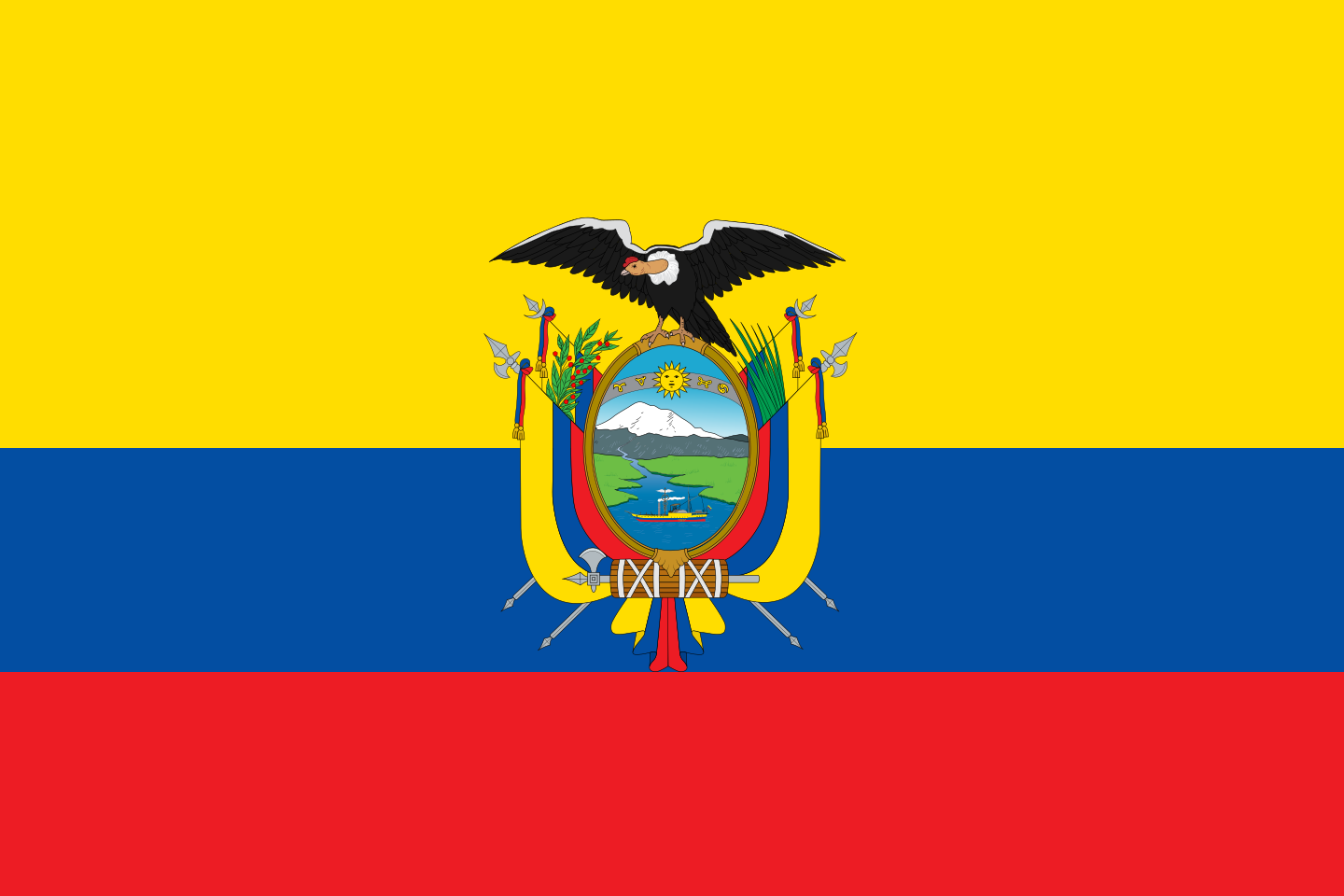

Ecuador in the World

Ecuador - Introduction 2020
top of pageBackground: What is now Ecuador formed part of the northern Inca Empire until the Spanish conquest in 1533. Quito became a seat of Spanish colonial government in 1563 and part of the Viceroyalty of New Granada in 1717. The territories of the Viceroyalty - New Granada (Colombia), Venezuela, and Quito - gained their independence between 1819 and 1822 and formed a federation known as Gran Colombia. When Quito withdrew in 1830, the traditional name was changed in favor of the 'Republic of the Equator.' Between 1904 and 1942, Ecuador lost territories in a series of conflicts with its neighbors. A border war with Peru that flared in 1995 was resolved in 1999. Although Ecuador marked 30 years of civilian governance in 2004, the period was marred by political instability. Protests in Quito contributed to the mid-term ouster of three of Ecuador's last four democratically elected presidents. In late 2008, voters approved a new constitution, Ecuador's 20th since gaining independence. General elections were held in April 2017, and voters elected President Lenin MORENO.
Area
Total: 283,561 km²
Land: 276,841 km²
Water: 6,720 km²
Note: includes Galapagos Islands
Rank: 75
Comparative: slightly smaller than Nevada
Maritime claims
Territorial sea: 200 nm
Exclusive economic zone: 200 nm
Continental shelf: 200 nm
Note: Ecuador has declared its right to extend its continental shelf to 350nm measured from the baselines of the Galapagos Archipelago
Climate: tropical along coast, becoming cooler inland at higher elevations; tropical in Amazonian jungle lowlands
Terrain: coastal plain (costa), inter-Andean central highlands (sierra), and flat to rolling eastern jungle (oriente)
Elevation
Mean elevation: 1117 m
Lowest point: Pacific Ocean 0 m
Highest point: Chimborazo 6,267
Note: because the earth is not a perfect sphere and has an equatorial bulge, the highest point on the planet farthest from its center is Mount Chimborazo not Mount Everest, which is merely the highest peak above sea level
Land use
Agricultural land: 29.7% (2011 est.)
arable land: 4.7% (2011 est.)
permanent crops: 5.6% (2011 est.)
permanent pasture: 19.4% (2011 est.)
permanent crops: 5.6% (2011 est.)
permanent pasture: 19.4% (2011 est.)
Forest: 38.9% (2011 est.)
Other: 31.4% (2011 est.)
Natural hazards: frequent earthquakes; landslides; volcanic activity; floods; periodic droughtsvolcanism: volcanic activity concentrated along the Andes Mountains; Sangay (5,230 m), which erupted in 2010, is mainland Ecuador's most active volcano; other historically active volcanoes in the Andes include Antisana, Cayambe, Chacana, Cotopaxi, Guagua Pichincha, Reventador, Sumaco, and Tungurahua; Fernandina (1,476 m), a shield volcano that last erupted in 2009, is the most active of the many Galapagos volcanoes; other historically active Galapagos volcanoes include Wolf, Sierra Negra, Cerro Azul, Pinta, Marchena, and Santiago
Geography
Note: note 1: Cotopaxi in Andes is highest active volcano in worldnote 2: according to the latest archeological research, the cacao tree, whose seeds are used to make chocolate and which was long thought to have originated in Mesoamerica, was first domesticated in the upper Amazon region of northwest South America - present-day Ecuador - about 3,300 B.C. (2020)
Ecuador - People 2020
top of pagePopulation
Distribution: nearly half of the population is concentrated in the interior in the Andean intermontane basins and valleys, with large concentrations also found along the western coastal strip; the rainforests of the east remain sparsely populated: 16,904,867 (July 2020 est.)
Rank: 70
Growth rate: 1.2% (2020 est.)
Growth rate rank: 88
Below poverty line: 21.5% (December 2017 est.)
Ethnic groups: Mestizo (mixed Amerindian and White) 71.9%, Montubio 7.4%, Amerindian 7%, White 6.1%, Afroecuadorian 4.3%, Mulatto 1.9%, Black 1%, other 0.4% (2010 est.)
Languages: Spanish (Castilian) 93% (official), Quechua 4.1%, other indigenous 0.7%, foreign 2.2% (2010 est.)
Note: (Quechua and Shuar are official languages of intercultural relations; other indigenous languages are in official use by indigenous peoples in the areas they inhabit)
Religions: Roman Catholic 74%, Evangelical 10.4%, Jehovah's Witness 1.2%, other 6.4% (includes Mormon, Buddhist, Jewish, Spiritualist, Muslim, Hindu, indigenous, African American, Pentecostal), atheist 7.9%, agnostic 0.1% (2012 est.)
Note: data represent persons at least 16 years of age from five Ecuadoran cities
Demographic profile: Ecuador's high poverty and income inequality most affect indigenous, mixed race, and rural populations. The government has increased its social spending to ameliorate these problems, but critics question the efficiency and implementation of its national development plan. Nevertheless, the conditional cash transfer program, which requires participants' children to attend school and have medical check-ups, has helped improve educational attainment and healthcare among poor children. Ecuador is stalled at above replacement level fertility and the population most likely will keep growing rather than stabilize.An estimated 2 to 3 million Ecuadorians live abroad, but increased unemployment in key receiving countries - Spain, the United States, and Italy - is slowing emigration and increasing the likelihood of returnees to Ecuador. The first large-scale emigration of Ecuadorians occurred between 1980 and 2000, when an economic crisis drove Ecuadorians from southern provinces to New York City, where they had trade contacts. A second, nationwide wave of emigration in the late 1990s was caused by another economic downturn, political instability, and a currency crisis. Spain was the logical destination because of its shared language and the wide availability of low-skilled, informal jobs at a time when increased border surveillance made illegal migration to the US difficult. Ecuador has a small but growing immigrant population and is Latin America's top recipient of refugees; 98% are neighboring Colombians fleeing violence in their country.
Age structure
0-14 years: 25.82% (male 2,226,240/female 2,138,219)
15-24 years: 17.8% (male 1,531,545/female 1,478,222)
25-54 years: 40.31% (male 3,333,650/female 3,480,262)
55-64 years: 7.92% (male 647,718/female 691,759)
65 years and over: 8.15% (male 648,761/female 728,491) (2020 est.)
Dependency ratios
Total dependency ratio: 53.8
Youth dependency ratio: 42.1
Elderly dependency ratio: 11.7
Potential support ratio: 8.6 (2020 est.)
Population distribution: nearly half of the population is concentrated in the interior in the Andean intermontane basins and valleys, with large concentrations also found along the western coastal strip; the rainforests of the east remain sparsely populated
Urbanization
Urban population: 64.2% of total population
Note: (2015-20 est.)
Rate of urbanization: 1.66% annual rate of change
Environment
Current issues: deforestation; soil erosion; desertification; water pollution; pollution from oil production wastes in ecologically sensitive areas of the Amazon Basin and Galapagos Islands
International agreements party to: Antarctic-Environmental Protocol, Antarctic Treaty, Biodiversity, Climate Change, Climate Change-Kyoto Protocol, Desertification, Endangered Species, Hazardous Wastes, Ozone Layer Protection, Ship Pollution, Tropical Timber 83, Tropical Timber 94, Wetlands
International agreements signed but not ratified: none of the selected agreements
Sex ratio
At birth: 1.05 male(s)/female
0-14 years: 1.04 male(s)/female
15-24 years: 1.04 male(s)/female
25-54 years: 0.96 male(s)/female
55-64 years: 0.94 male(s)/female
65 years and over: 0.89 male(s)/female
Total population: 0.99 male(s)/female (2020 est.)
Infant mortality rate
Total: 15 deaths/1000 live births
Male: 17.8 deaths/1000 live births
Female: 12 deaths/1000 live births (2020 est.)
Rank: 96
Life expectancy at birth
Total population: 77.5 years
Male: 74.5 years
Female: 80.6 years (2020 est.)
Rank: 80
Drinking water source
Urban: 0% of population
Rural: 16.2% of population
Total: 6% of population (2017 est.)
Sanitation facility access
Urban: 0% of population
Rural: 8.1% of population
Total: 2.1% of population (2017 est.)
Hivaids
Adult prevalence rate: 0.4% (2019 est.)
Adult prevalence rate rank: 76
People living with hivaids: 47,000 (2019 est.)
People living with hivaids rank: 62
Deaths note: <1000 (2019 est.)
Major infectious diseases
Degree of risk: high (2020)
Food or waterborne diseases: bacterial diarrhea, hepatitis A, and typhoid fever
Vectorborne diseases: dengue fever and malaria
Literacy
Definition: age 15 and over can read and write
Total population: 92.8%
Male: 93.8%
Female: 92.1% (2017)
School life expectancy primary to tertiary education
Total: 15 years
Male: 15 years
Female: 16 years (2015)
Ecuador - Government 2020
top of pageCountry name
Conventional long form: Republic of Ecuador
Conventional short form: Ecuador
Local long form: Republica del Ecuador
Local short form: Ecuador
Etymology: the countrys position on the globe, straddling the Equator, accounts for its Spanish name
Capital
Name: Quito
Geographic coordinates: 0 13 S, 78 30 W
Time difference: UTC-5 (same time as Washington, DC, during Standard Time): note: Ecuador has two time zones, including the Galapagos Islands (UTC-6)etymology: named after the Quitus, a Pre-Columbian indigenous people credited with founding the city
Administrative divisions: 24 provinces (provincias, singular - provincia); Azuay, Bolivar, Canar, Carchi, Chimborazo, Cotopaxi, El Oro, Esmeraldas, Galapagos, Guayas, Imbabura, Loja, Los Rios, Manabi, Morona-Santiago, Napo, Orellana, Pastaza, Pichincha, Santa Elena, Santo Domingo de los Tsachilas, Sucumbios, Tungurahua, Zamora-Chinchipe
Constitution
History: many previous; latest approved 20 October 2008
Amendments: proposed by the president of the republic through a referendum, by public petition of at least 1% of registered voters, or by agreement of at least one-third membership of the National Assembly; passage requires two separate readings a year apart and approval by at least two-thirds majority vote of the Assembly, and approval by absolute majority in a referendum; amendments such as changes to the structure of the state, constraints on personal rights and guarantees, or constitutional amendment procedures are not allowed; amended 2011, 2015, 2018; note - a 2015 constitutional amendment lifting presidential term limits was overturned by a February 2018 referendum
Legal system: civil law based on the Chilean civil code with modifications; traditional law in indigenous communities
International law organization participation: has not submitted an ICJ jurisdiction declaration; accepts ICCt jurisdiction
Citizenship
Citizenship by birth: yes
Citizenship by descent only: yes
Dual citizenship recognized: no
Residency requirement for naturalization: 3 years
Suffrage: 18-65 years of age; universal and compulsory; 16-18, over 65, and other eligible voters, voluntary
Executive branch
Chief of state: President Lenin MORENO Garces (since 24 May 2017); Vice President María Alejandra MUNOZ (since 17 July 2020); the president is both chief of state and head of government
Head of government: President Lenin MORENO Garces (since 24 May 2017); Vice President (vacant)
Cabinet: Cabinet appointed by the president
Electionsappointments: president and vice president directly elected on the same ballot by absolute majority popular vote in 2 rounds if needed for a 4-year term (eligible for a second term); election last held on 19 February 2017 with a runoff on 2 April 2017 (next to be held in 2021)
Election results: Lenin MORENO Garces elected president in second round; percent of vote - Lenin MORENO Garces (Alianza PAIS Movement) 51.1%, Guillermo LASSO (CREO) 48.9%
Legislative branch
Description: unicameral National Assembly or Asamblea Nacional (137 seats; 116 members directly elected in single-seat constituencies by simple majority vote, 15 members directly elected in a single nationwide constituency by proportional representation vote, and 6 directly elected in multi-seat constituencies for Ecuadorians living abroad by simple majority vote; members serve 4-year terms)
Elections: last held on 19 February 2017 (next to be held on 7 February 2021)
Election results: percent of vote by party - PAIS 39.1%, CREO-SUMA 20.1%, PSC 15.9%, ID 3.8%, MUPP 2.7%, other 10.7; seats by party - PAIS 74, CREO-SUMA 34, PSC 15, ID 4, MUPP 4, PSP 2, Fuerza Ecuador 1, independent 3; composition - men 85, women 52, percent of women 38%; note - defections by members of National Assembly are commonplace, resulting in frequent changes in the numbers of seats held by the various parties
Judicial branch
Highest courts: National Court of Justice or Corte Nacional de Justicia (consists of 21 judges, including the chief justice and organized into 5 specialized chambers); Constitutional Court or Corte Constitucional (consists of 9 judges)
Judge selection and term of office: justices of National Court of Justice elected by the Judiciary Council, a 9-member independent body of law professionals; judges elected for 9-year, non-renewable terms, with one-third of the membership renewed every 3 years; Constitutional Court judges appointed by the executive, legislative, and Citizen Participation branches of government; judges appointed for 9-year non-renewable terms with one-third of the membership renewed every 3 years
Subordinate courts: Fiscal Tribunal; Election Dispute Settlement Courts, provincial courts (one for each province); cantonal courts
Political parties and leaders: Alianza PAIS movement [Lenin Voltaire MORENO Garces]Avanza Party or AVANZA [Ramiro GONZALEZ]Citizen Revolution Movement or MRC [Rafael CORREA]Creating Opportunities Movement or CREO [Guillermo LASSO]Democratic Left or IDForward Ecuador Movement [Alvaro NOBOA]Fuerza Ecuador [Abdala BUCARAM] (successor to Roldosist Party)Pachakutik Plurinational Unity Movement or MUPP [Marlon Rene SANTI Gualinga]Patriotic Society Party or PSP [Gilmar GUTIERREZ Borbua]Popular Democracy Movement or MPD [Luis VILLACIS]Social Christian Party or PSC [Pascual DEL CIOPPO]Socialist Party [Patricio ZABRANO]Society United for More Action or SUMA [Mauricio RODAS]
International organization participation: CAN, CD, CELAC, FAO, G-11, G-77, IADB, IAEA, IBRD, ICAO, ICC (national committees), ICCt, ICRM, IDA, IFAD, IFC, IFRCS, IHO, ILO, IMF, IMO, Interpol, IOC, IOM, IPU, ISO, ITSO, ITU, ITUC (NGOs), LAES, LAIA, Mercosur (associate), MIGA, MINUSTAH, NAM, OAS, OPANAL, OPCW, OPEC, Pacific Alliance (observer), PCA, SICA (observer), UN, UNAMID, UNASUR, UNCTAD, UNESCO, UNHCR, UNIDO, Union Latina, UNISFA, UNMIL, UNMISS, UNOCI, UNWTO, UPU, WCO, WFTU (NGOs), WHO, WIPO, WMO, WTO
Diplomatic representation
In the us chief of mission: Ambassador Francisco Benjamin Esteban CARRION Mena (since 24 January 2018)
In the us chancery: 2,535 15th Street NW, Washington, DC 20,009
In the us telephone: [1] (202) 234-7,200
In the us FAX: [1] (202) 667-3,482
In the us consulate: Atlanta, Chicago, Houston, Los Angeles, Miami, Minneapolis, New Haven (CT), New Orleans, New York, Newark (NJ), Phoenix, San Francisco
From the us chief of mission: Ambassador Michael J. FITZPATRICK (since 18 June 2019)
From the us telephone: [593] (2) 398-5,000
From the us embassy: Avenida Avigiras E12-170 y Avenida Eloy Alfaro, Quito
From the us mailing address: Avenida Guayacanes N52-205 y Avenida Avigiras
From the us FAX: [593] (2) 398-5,100
From the us consulate: Guayaquil
Flag description: three horizontal bands of yellow (top, double width), blue, and red with the coat of arms superimposed at the center of the flag; the flag retains the three main colors of the banner of Gran Colombia, the South American republic that broke up in 1830; the yellow color represents sunshine, grain, and mineral wealth, blue the sky, sea, and rivers, and red the blood of patriots spilled in the struggle for freedom and justice
Note: similar to the flag of Colombia, which is shorter and does not bear a coat of arms
National anthem
Name: Salve, Oh Patria! (We Salute You, Our Homeland)
Lyricsmusic: Juan Leon MERA/Antonio NEUMANE
Note: adopted 1948; Juan Leon MERA wrote the lyrics in 1865; only the chorus and second verse are sung
Ecuador - Economy 2020
top of pageReal gdp purchasing power parity
Real:
$173.729 billion (2019 est.)
$173.636 billion (2018 est.)
$171.426 billion (2017 est.)
$173.636 billion (2018 est.)
$171.426 billion (2017 est.)
Real note: data are in 2010 dollars
Real gdp per capita:
$5,097 (2019 est.)
$5,181 (2018 est.)
$5,206 (2017 est.)
$5,181 (2018 est.)
$5,206 (2017 est.)
Note: data are in 2010 dollars
Rank: 157
Gross national saving:
25.9% of GDP (2017 est.)
26.4% of GDP (2016 est.)
24.7% of GDP (2015 est.)
26.4% of GDP (2016 est.)
24.7% of GDP (2015 est.)
Rank: 51
Gdp composition by end use
Household consumption: 60.7% (2017 est.)
Government consumption: 14.4% (2017 est.)
Investment in fixed capital: 24.3% (2017 est.)
Investment in inventories: 1% (2017 est.)
Exports of goods and services: 20.8% (2017 est.)
Imports of goods and services: -21.3% (2017 est.)
Gdp composition by sector of origin
Agriculture: 6.7% (2017 est.)
Industry: 32.9% (2017 est.)
Services: 60.4% (2017 est.)
Agriculture products: bananas, coffee, cocoa, rice, potatoes, cassava (manioc, tapioca), plantains, sugarcane; cattle, sheep, pigs, beef, pork, dairy products; fish, shrimp; balsa wood
Labor force: 8.086 million (2017 est.)
Rank: 59
By occupation agriculture: 26.1%
By occupation industry: 18.4%
By occupation services: 55.5% (2017 est.)
Household income or consumption by percentage share
Lowest 10: 1.4%
Highest 10: 35.4% (2012 est.)
Note: data are for urban households only
Budget
Revenues: 33.43 billion (2017 est.)
Expenditures: 38.08 billion (2017 est.)
Surplus or deficit: -4.5% (of GDP) (2017 est.)
Surplus or deficit rank: 164
Exports:
$25.446 billion (2019 est.)
$24.183 billion (2018 est.)
$23.907 billion (2017 est.)
$24.183 billion (2018 est.)
$23.907 billion (2017 est.)
Rank: 73
Partners: US 31.5%, Vietnam 7.6%, Peru 6.7%, Chile 6.5%, Panama 4.9%, Russia 4.4%, China 4% (2017)
Commodities: petroleum, bananas, cut flowers, shrimp, cacao, coffee, wood, fish
Imports:
$26.096 billion (2019 est.)
$25.677 billion (2018 est.)
$24.594 billion (2017 est.)
$25.677 billion (2018 est.)
$24.594 billion (2017 est.)
Rank: 73
Commodities: industrial materials, fuels and lubricants, nondurable consumer goods
Partners: US 22.8%, China 15.4%, Colombia 8.7%, Panama 6.4%, Brazil 4.4%, Peru 4.2% (2017)
Reserves of foreign exchange and gold:
$2.395 billion (31 December 2017 est.)
$4.259 billion (31 December 2016 est.)
$4.259 billion (31 December 2016 est.)
Rank: 116
Exchange rates:
25,000 (2020 est.)
25,000 (2019 est.)
25,000 (2018 est.)
the US dollar became Ecuador's currency in 2001
25,000 (2019 est.)
25,000 (2018 est.)
the US dollar became Ecuador's currency in 2001
Ecuador - Energy 2020
top of pageElectricity
Access electrification total population: 97% (2019)
Access electrification urban areas: 100% (2019)
Access electrification rural areas: 93% (2019)
Production: 26.5 billion kWh (2016 est.)
Production rank: 71
Consumption: 22.68 billion kWh (2016 est.)
Consumption rank: 70
Exports: 211 million kWh (2015 est.)
Exports rank: 75
Imports: 82 million kWh (2016 est.)
Imports rank: 102
Installed generating capacity: 8.192 million kW (2016 est.)
Installed generating capacity rank: 69
Generation sources fossil fuels: 43% of total installed capacity (2016 est.)
Generation sources fossil fuels rank: 162
Generation sources nuclear: 0% of total installed capacity (2017 est.)
Generation sources nuclear rank: 81
Generation sources hydroelectricity: 54% of total installed capacity (2017 est.)
Generation sources hydroelectricity rank: 32
Generation sources other renewable sources: 2% of total installed capacity (2017 est.)
Generation sources other renewable sources rank: 138
Petroleum
Petroleum total petroleum production: 517,000 bbl/day (2018 est.)
Petroleum total petroleum production rank: 28
Crude oil exports: 383,500 bbl/day (2017 est.)
Crude oil exports rank: 22
Crude oil imports: 0 bbl/day (2015 est.)
Crude oil imports rank: 119
Crude oil proven reserves: 8.273 billion bbl (1 January 2018 est.)
Crude oil proven reserves rank: 17
Refined petroleum
Products production: 137,400 bbl/day (2015 est.)
Products production rank: 62
Products consumption: 265,000 bbl/day (2016 est.)
Products consumption rank: 48
Products exports: 25,870 bbl/day (2015 est.)
Products exports rank: 66
Products imports: 153,900 bbl/day (2015 est.)
Products imports rank: 40
Natural gas
Production: 477.8 million m³ (2017 est.)
Production rank: 73
Consumption: 453.1 million m³ (2017 est.)
Consumption rank: 100
Exports: 0 m³ (2017 est.)
Exports rank: 97
Imports: 0 m³ (2017 est.)
Imports rank: 118
Proven reserves: 10.9 billion m³ (1 January 2018 est.)
Proven reserves rank: 78
Carbon dioxide emissions
From consumption of energy: 37.54 million Mt (2017 est.)
From consumption of energy rank: 69
Ecuador - Communication 2020
top of pageTelephones
Fixed lines total subscriptions: 2,111,291
Fixed lines subscriptions per 100 inhabitants: 12.64 (2019 est.)
Fixed lines rank: 52
Mobile cellular total subscriptions: 15,241,719
Mobile cellular subscriptions per 100 inhabitants: 91.25 (2019 est.)
Mobile cellular rank: 67
Broadcast media: about 60 media outlets are recognized as national; the Ecuadorian Government controls 12 national outlets and multiple radio stations; there are multiple TV networks and many local channels, as well as more than 300 radio stations; many TV and radio stations are privately owned; broadcast media is required by law to give the government free airtime to broadcast programs produced by the state; the Ecuadorian Government is the biggest advertiser and grants advertising contracts to outlets that provide favorable coverage; an antimonopoly law and communication law limit ownership and investment in the media by non-media businesses (2019)
Internet
Country code: .ec
Users total: 9,448,692
Users percent of population: 57.27% (July 2018 est.)
Users rank: 55
Broadband fixed subscriptions
Total: 1,953,607
Subscriptions per 100 inhabitants: 12 (2018 est.)
Rank: 54
Ecuador - Military 2020
top of pageMilitary expenditures:
2.3% of GDP (2019)
2.4% of GDP (2018)
2.4% of GDP (2017)
2.5% of GDP (2016)
2.6% of GDP (2015)
2.4% of GDP (2018)
2.4% of GDP (2017)
2.5% of GDP (2016)
2.6% of GDP (2015)
Rank: 39
Military and security forces: Ecuadorian Armed Forces: Ecuadorian Land Force (Fuerza Terrestre Ecuatoriana, FTE), Ecuadorian Navy (Fuerza Naval del Ecuador, FNE, includes naval infantry, naval aviation, coast guard), Ecuadorian Air Force (Fuerza Aerea Ecuatoriana, FAE) (2020)
Military service age and obligation: 18 years of age for selective conscript military service; conscription has been suspended; 18 years of age for voluntary military service; Air Force 18-22 years of age, Ecuadorian birth requirement; 1-year service obligation (2013)
Ecuador - Transportation 2020
top of pageNational air transport system
Number of registered air carriers: 7 (2020)
Inventory of registered aircraft operated by air carriers: 35
Annual passenger traffic on registered air carriers: 5,365,261 (2018)
Annual freight traffic on registered air carriers: 64.2 million
Note: mt-km (2018)
Airports: 432 (2013)
Rank: 18
With paved runways total: 104 (2017)
With paved runways over 3047 m: 4 (2017)
With paved runways 2438 to 3047 m: 5 (2017)
With paved runways 15-24 to 2437 m: 18 (2017)
With paved runways 914 to 1523 m: 26 (2017)
With paved runways under 914 m: 51 (2017)
With unpaved runways total: 328 (2013)
With unpaved runways 914 to 1523 m: 37 (2013)
With unpaved runways under 914 m: 291 (2013)
Railways
Total: 965 km (2017)
Narrow gauge: 965 km
Note:
1.067-m gauge (2017)
passenger service limited to certain sections of track, mostly for tourist trains
passenger service limited to certain sections of track, mostly for tourist trains
Rank: 91
Merchant marine
Total: 137
By type: bulk carrier 1, general cargo 7, oil tanker 28, other 101 (2019)
Rank: 76
Ports and terminals
Major seaport: Esmeraldas, Manta, Puerto Bolivar
Container port: Guayaquil (1,871,591) (2017)
River port: Guayaquil (Guayas)
Ecuador - Transnational issues 2020
top of pageDisputes international: organized illegal narcotics operations in Colombia penetrate across Ecuador's shared border
Refugees and internally displaced persons
Refugees: 102,928 (Colombia) (2019); 207,324 (Venezuela) (economic and political crisis; includes Venezuelans who have claimed asylum, are recognized as refugees, or have received alternative legal stay) (2020)
Illicit drugs: significant transit country for cocaine originating in Colombia and Peru, with much of the US-bound cocaine passing through Ecuadorian Pacific waters; importer of precursor chemicals used in production of illicit narcotics; attractive location for cash-placement by drug traffickers laundering money because of dollarization and weak anti-money-laundering regime; increased activity on the northern frontier by trafficking groups and Colombian insurgents

🅶🅷🅴🅾🆂.🅲🅾🅼