Statistics Saint-Barthélemy 
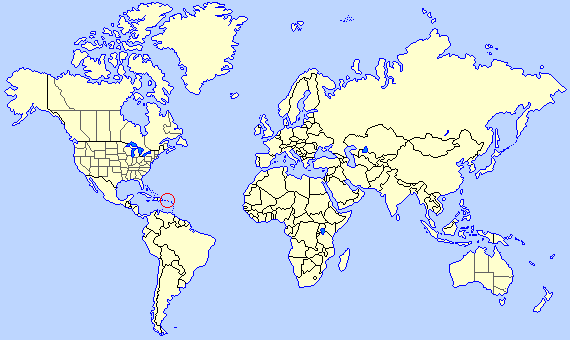
Saint-Barthélemy in the World
Saint-Barthélemy - Introduction 2020
top of pageBackground: Discovered in 1493 by Christopher COLUMBUS who named it for his brother Bartolomeo, Saint Barthelemy was first settled by the French in 1648. In 1784, the French sold the island to Sweden, which renamed the largest town Gustavia, after the Swedish King GUSTAV III, and made it a free port; the island prospered as a trade and supply center during the colonial wars of the 18th century. France repurchased the island in 1877 and took control the following year. It was placed under the administration of Guadeloupe. Saint Barthelemy retained its free port status along with various Swedish appellations such as Swedish street and town names, and the three-crown symbol on the coat of arms. In 2003, the islanders voted to secede from Guadeloupe, and in 2007, the island became a French overseas collectivity. In 2012, it became an overseas territory of the EU, allowing it to exert local control over the permanent and temporary immigration of foreign workers including non-French European citizens.
Geography
Note: a 1,200-hectare marine nature reserve, the Reserve Naturelle, is made up of five zones around the island that form a network to protect the island's coral reefs, seagrass, and endangered marine species
Saint-Barthélemy - People 2020
top of pagePopulation
Distribution: most of the populace concentrated in and around the capital of Gustavia, but scattered settlements exist around the island periphery: 7,122 (July 2020 est.)
Rank: 225
Growth rate: -0.25% (2020 est.)
Growth rate rank: 213
Age structure
0-14 years: 15.16% (male 555/female 525)
15-24 years: 7.34% (male 275/female 248)
25-54 years: 41.86% (male 1618/female 1363)
55-64 years: 16.29% (male 630/female 530)
65 years and over: 19.35% (male 690/female 688) (2020 est.)
Population distribution: most of the populace concentrated in and around the capital of Gustavia, but scattered settlements exist around the island periphery
Environment
Current issues: land-based pollution; urbanization; with no natural rivers or streams, fresh water is in short supply, especially in summer, and is provided by the desalination of sea water, the collection of rain water, or imported via water tanker; overfishing
Sex ratio
At birth: 1.06 male(s)/female
0-14 years: 1.06 male(s)/female
15-24 years: 1.11 male(s)/female
25-54 years: 1.19 male(s)/female
55-64 years: 1.19 male(s)/female
65 years and over: 1 male(s)/female
Total population: 1.12 male(s)/female (2020 est.)
Infant mortality rate
Total: 5.6 deaths/1000 live births
Male: 6.4 deaths/1000 live births
Female: 4.8 deaths/1000 live births (2020 est.)
Rank: 168
Life expectancy at birth
Total population: 80.2 years
Male: 77 years
Female: 83.4 years (2020 est.)
Rank: 46
Saint-Barthélemy - Government 2020
top of pageCountry name
Conventional long form: Overseas Collectivity of Saint Barthelemy
Conventional short form: Saint Barthelemy
Local long form: Collectivite doutre mer de Saint-Barthelemy
Local short form: Saint-Barthelemy
Abbreviation: Saint-Barth (French); St. Barts or St. Barths (English)
Etymology: explorer Christopher COLUMBUS named the island in honor of his brother Bartolomeos namesake saint in 1493
Capital
Name: Gustavia
Geographic coordinates: 17 53 N, 62 51 W
Time difference: UTC-4 (1 hour ahead of Washington, DC, during Standard Time): etymology: named in honor of King Gustav III (1746-1792) of Sweden during whose reign the island was obtained from France in 1784; the name was retained when in 1878 the island was sold back to France
National holiday: Fete de la Federation, 14 July (1790); note - local holiday is St. Barthelemy Day, 24 August (1572)
Constitution
History: 4 October 1958 (French Constitution)
Amendments: amendment procedures of Frances constitution apply
Executive branch
Chief of state: President Emmanuel MACRON (since 14 May 2017), represented by Prefect Serge GOUTEYRON (since 25 November 2020)
Head of government: President of Territorial Council Bruno MAGRAS (since 16 July 2007)
Cabinet: Executive Council elected by the Territorial Council; note - there is also an advisory, economic, social, and cultural council
Electionsappointments: French president directly elected by absolute majority popular vote in 2 rounds if needed for a 5-year term (eligible for a second term); prefect appointed by the French president on the advice of French Ministry of Interior; president of Territorial Council indirectly elected by its members for a 5-year term; election last held on 2 April 2017 (next to be held in 2022)
Election results: Bruno MAGRAS (SBA) reelected president; Territorial Council vote - NA
Legislative branch
Description: unicameral Territorial Council (19 seats; members elected by absolute majority vote in the first round vote and proportional representation vote in the second round; members serve 5-year terms); Saint Barthelemy indirectly elects 1 senator to the French Senate by an electoral college for a 6-year term and directly elects 1 deputy (shared with Saint Martin) to the French National Assembly
Elections: Territorial Council - last held on 19 March 2017 (next to be held in September 2022) French Senate - election last held 24 September 2017 (next to be held in September 2020) French National Assembly - election last held on 11 and 18 June 2017 (next to be held by June 2022)
Election results: Territorial Council - percent of vote by party - SBA 53.7%, United for Saint Barth 20.6%, Saint Barth Essential 18.1%, All for Saint Barth 7.7%; seats by party - SBA 14, United for Saint Barth 2, Saint Barth Essential 2, All for Saint Barth 1; composition - men 9, women 10, percent of women 52.6%; French Senate - percent of vote by party NA; seats by party UMP 1 French National Assembly - percent of vote by party NA; seats by party UMP 1
Political parties and leaders: All for Saint Barth (Tous pour Saint-Barth) [Bettina COINTRE]Saint Barth Essential (Saint-Barth Autrement) [Marie-Helene BERNIER]Saint Barth First! (Saint-Barth d'Abord!) or SBA [Bruno MAGRAS]Saint Barth United (Unis pour Saint-Barthelemy) [Xavier LEDEE]
Diplomatic representation
In the us: none (overseas collectivity of France)
From the us: none (overseas collectivity of France)
National anthem
Name: LHymne a St. Barthelemy (Hymn to St. Barthelemy)
Lyricsmusic: Isabelle Massart DERAVIN/Michael VALENTI
Note: local anthem in use since 1999; as a collectivity of France, 'La Marseillaise' is official (see France)
Saint-Barthélemy - Economy 2020
top of pageSaint-Barthélemy - Energy 2020
top of pageSaint-Barthélemy - Communication 2020
top of pageInternet
Country code: .bl; note - .gp, the Internet country code for Guadeloupe, and .fr, the Internet country code for France, might also be encountered
Saint-Barthélemy - Military 2020
top of pageSaint-Barthélemy - Transportation 2020
top of pageSaint-Barthélemy - Transnational issues 2020
top of page
🅶🅷🅴🅾🆂.🅲🅾🅼