Statistical information Sudan 1991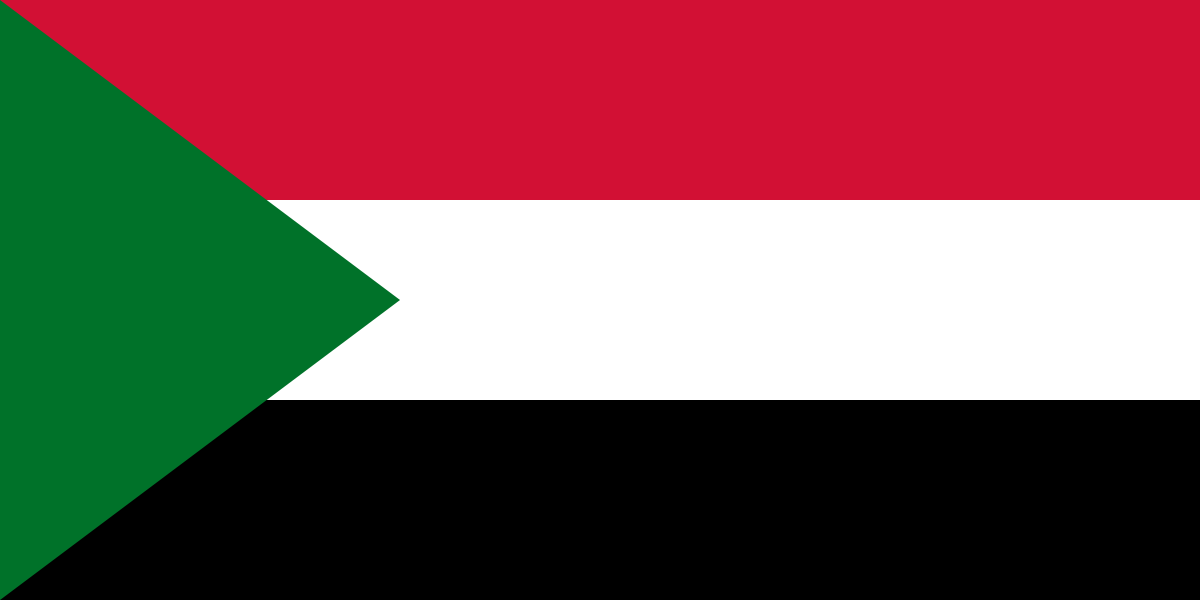

Sudan in the World

Sudan - Introduction 1991
top of pageBackground: Military dictatorships promulgating an Islamic government have mostly run the country since independence from the UK in 1956. Over the past two decades a civil war pitting black Christians and animists in the south against the Arab-Muslims of the north has cost at least 1.5 million lives in war and famine-related deaths as well as the displacement of millions of others.
Sudan - Geography 1991
top of pageLocation
Geographic coordinates
Map reference
Area
Land boundaries:
7,697 km total
Central African Republic 1,165 km, Chad 1,360 km, Egypt 1,273 km, Ethiopia 2,221 km, Kenya 232 km, Libya 383 km, Uganda 435 km, Democratic Republic of the Congo 628 km
Central African Republic 1,165 km, Chad 1,360 km, Egypt 1,273 km, Ethiopia 2,221 km, Kenya 232 km, Libya 383 km, Uganda 435 km, Democratic Republic of the Congo 628 km
Coastline: 853 km
Maritime claims
Contiguous zone: 18 nm
Continental shelf: 200 m (depth) or to depth of exploitation
Territorial sea: 12 nm
Climate: tropical in south; arid desert in north; rainy season (April to October)
Terrain: generally flat, featureless plain; mountains in east and west
Elevation
Natural resources: small reserves of crude oil, iron ore, copper, chromium ore, zinc, tungsten, mica, silver, crude oil
Land use
Land use: arable land: 5%; permanent crops: NEGL%; meadows and pastures 24%; forest and woodland 20%; other 51%; includes irrigated 1%
Irrigated land
Major rivers
Major watersheds area km²
Total water withdrawal
Total renewable water resources
Natural hazards
Geography
Note: largest country in Africa geoad2
Sudan - People 1991
top of pagePopulation: 27,220,088 (July 1991), growth rate 3.0% (1991)
Nationality: noun--Sudanese (sing. and pl.; adjective--Sudanese
Ethnic groups: black 52%, Arab 39%, Beja 6%, foreigners 2%, other 1%
Languages: Arabic (official), Nubian, Ta Bedawie, diverse dialects of Nilotic, Nilo-Hamitic, and Sudanic languages, English; program of Arabization in process
Religions: Sunni Muslim (in north) 70%, indigenous beliefs 20%, Christian (mostly in south and Khartoum) 5%
Demographic profile
Age structure
Age structure
Dependency ratios
Median age
Population growth rate
Birth rate: 44 births/1000 population (1991)
Death rate: 13 deaths/1000 population (1991)
Net migration rate: - 1 migrants/1000 population (1991)
Population distribution
Urbanization
Major urban areas
Environment
Current issues: dominated by the Nile and its tributaries; dust storms; desertification
Air pollutants
Sex ratio
Mothers mean age at first birth
Maternal mortality ratio
Infant mortality rate: 85 deaths/1000 live births (1991)
Life expectancy at birth: 52 years male, 54 years female (1991)
Total fertility rate: 6.4 children born/woman (1991)
Contraceptive prevalence rate
Drinking water source
Current health expenditure
Physicians density
Hospital bed density
Sanitation facility access
Hiv/Aids
Major infectious diseases
Obesity adult prevalence rate
Alcohol consumption
Tobacco use
Children under the age of 5 years underweight
Education expenditures
Literacy: 27% (male 43%, female 12%) age 15 and over can read and write (1990 est.)
School life expectancy primary to tertiary education
Youth unemployment
Sudan - Government 1991
top of pageCountry name: conventional long form: Republic of the Sudan
Government type: military; civilian government suspended and martial law imposed after 30 June 1989 coup
Capital: Khartoum
Administrative divisions: 9 states (wilayat, singular--wilayat or wilayah*; Aali an Nil, Al Wusta*, Al Istiwaiyah*, Al Khartum, Ash Shamaliyah*, Ash Sharqiyah*, Bahr al Ghazal, Darfur, Kurdufan
Dependent areas
Independence: 1 January 1956 (from Egypt and UK; formerly Anglo-Egyptian Sudan)
National holiday: Independence Day, 1 January (1956)
Constitution: 12 April 1973, suspended following coup of 6 April 1985; interim constitution of 10 October 1985 suspended following coup of 30 June 1989
Legal system: based on English common law and Islamic law; as of 20 January 1991, the Revolutionary Command Council imposed Islamic law in the six northern states of Al Wusta, Al Khartum, Ash Shamaliyah, Ash Sharqiyah, Darfur, and Kurdufan; the council is still studying criminal provisions under Islamic law; Islamic law will apply to all residents of the six northern states regardless of their religion; some separate religious courts; accepts compulsory ICJ jurisdiction, with reservations
International law organization participation
Citizenship
Suffrage: none
Executive branch: Chief of State and Head of Government--Revolutionary Command Council Chairman and Prime Minister Lt. Gen. Umar Hasan Ahmad al-BASHIR (since 30 June 1989; Deputy Chairman of the Command Council and Deputy Prime Minister Maj. Gen. al-Zubayr Muhammad SALIH Ahmed (since 9 July 1989)
Legislative branch: Army, Navy, Air Force, Air Defense Force
Judicial branch: Supreme Court, Special Revolutionary Courts
Political parties and leaders
International organization participation: ABEDA, ACP, AfDB, AFESD, AL, AMF, CAEU, CCC, ECA, FAO, G-77, IAEA, IBRD, ICAO, IDA, IDB, IFAD, IFC, IGADD, ILO, IMF, IMO, INTELSAT, INTERPOL, IOC, ISO, ITU, LORCS, NAM, OAU, OIC, PCA, UN, UNCTAD, UNESCO, UNHCR, UNIDO, UPU, WFTU, WHO, WIPO, WMO, WTO
Diplomatic representation
In the us: Ambassador Abdallah Ahmad ABDALLAH; Chancery at 2,210 Massachusetts Avenue NW, Washington DC 20,008; telephone (202) 338-8,565 through 8,570; there is a Sudanese Consulate General in New York; US--Ambassador James R. CHEEK; Embassy at Shar'ia Ali Abdul Latif, Khartoum (mailing address is P. O. Box 699, Khartoum, or APO New York 9,668; telephone 74,700 or 74,611
Flag description: three equal horizontal bands of red (top), white, and black with a green isosceles triangle based on the hoist side Sudan SudanSudan
National symbols
National anthem
National heritage
Sudan - Economy 1991
top of pageEconomy overview: Sudan, one of the world's poorest countries, is buffeted by civil war, chronic political instability, adverse weather, and counterproductive economic policies. The economy is dominated by governmental entities that account for more than 70% of new investment. The private sector's main areas of activity are agriculture and trading, with most private industrial investment predating 1980. The economy's base is agriculture, which employs 80% of the work force. Industry mainly processes agricultural items. Sluggish economic performance over the past decade, attributable largely to declining annual rainfall, has reduced levels of per capita income and consumption. A high foreign debt and huge arrearages continue to cause difficulties. In 1990 the International Monetary Fund took the unusual step of declaring Sudan noncooperative on account of its nonpayment of arrearages to the Fund.
Real gdp purchasing power parity
Real gdp growth rate
Real gdp per capita
Gross national saving
Gdp composition by sector of origin
Gdp composition by end use
Gdp composition by sector of origin
Agriculture products: accounts for 35% of GNP and 80% of labor force; water shortages; two-thirds of land area suitable for raising crops and livestock; major products--cotton, oilseeds, sorghum, millet, wheat, gum arabic, sheep; marginally self-sufficient in most foods
Industries: cotton ginning, textiles, cement, edible oils, sugar, soap distilling, shoes, petroleum refining
Industrial production growth rate: 0.7% (FY89; accounts for 11% of GDP
Labor force: 6,500,000; agriculture 80%, industry and commerce 10%, government 6%; labor shortages for almost all categories of skilled employment (1983 est.), 52% of population of working age (1985)
Labor force
Unemployment rate: NA
Youth unemployment
Population below poverty line
Gini index
Household income or consumption by percentage share
Distribution of family income gini index
Budget: revenues $514 million; expenditures $1.3 billion, including capital expenditures of $183 million (FY89 est.)
Taxes and other revenues
Public debt
Revenue
Fiscal year: 1 July-30 June
Inflation rate consumer prices
Central bank discount rate
Commercial bank prime lending rate
Stock of narrow money
Stock of broad money
Stock of domestic credit
Market value of publicly traded shares
Current account balance
Exports: $465 million (f.o.b., FY90 est.)
Commodities: cotton 52%, sesame, gum arabic, peanuts
Partners: Western Europe 46%, Saudi Arabia 14%, Eastern Europe 9%, Japan 9%, US 3% (FY88)
Imports: $1.0 billion (c.i.f., FY90 est.)
Commodities: petroleum products 28%, manufactured goods, machinery and equipment, medicines and chemicals
Partners: Western Europe 32%, Africa and Asia 15%, US 13%, Eastern Europe 3% (FY88)
Reserves of foreign exchange and gold
Debt external: $12.3 billion (December 1990 est.)
Stock of direct foreign investment at home
Stock of direct foreign investment abroad
Exchange rates: official rate--Sudanese pounds (5Sd) per US$1--4.5004 (fixed rate since 1987), 2.8121 (1987), 2.5000 (1986), 2.2883 (1985; note--commercial exchange rate 12.2 (May 1990)
Sudan - Energy 1991
top of pageElectricity
Capacity: 606,000 kW capacity; 900 million kWh produced, 37 kWh per capita (1989)
Coal
Petroleum
Crude oil
Refined petroleum
Natural gas
Carbon dioxide emissions
Energy consumption per capita
Sudan - Communication 1991
top of pageTelephones
Telephone system
Broadcast media
Internet
Broadband fixed subscriptions
Sudan - Military 1991
top of pageMilitary expenditures
Percent of gdp: $610 million, 7.2% of GDP (1989 est)
Military and security forces
Military service age and obligation
Space program
Terrorist groups
Sudan - Transportation 1991
top of pageNational air transport system
Civil aircraft registration country code prefix
Airports: 78 total, 66 usable; 8 with permanent-surface runways; none with runways over 3,659 m; 4 with runways 2,440-3,659 m; 30 with runways 1,220-2,439 m
Heliports
Pipelines: refined products, 815 km
Railways
Roadways
Waterways: 5,310 km navigable
Merchant marine: 5 ships (1,000 GRT or over) totaling 42,277 GRT/59,588 DWT; includes 3 cargo, 2 roll-on/roll-off cargo
Ports and terminals
Sudan - Transnational issues 1991
top of pageDisputes international: administrative boundary with Kenya does not coincide with international boundary; administrative boundary with Egypt does not coincide with international boundary
Refugees and internally displaced persons
Illicit drugs