Statistical information Jordan 1993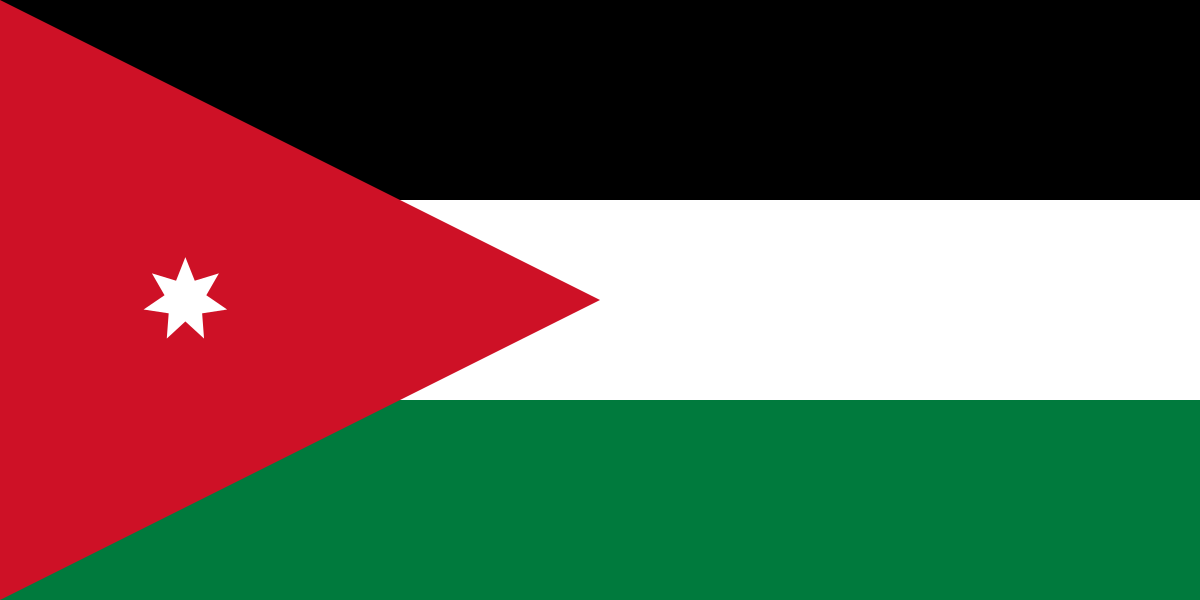

Jordan in the World
Jordan - Introduction 1993
top of pageBackground: For most of its history since independence from British administration in 1946 Jordan was ruled by King HUSSEIN (1953-1993). A pragmatic ruler he successfully navigated competing pressures from the major powers (US USSR and UK) various Arab states Israel and a large internal Palestinian population through several wars and coup attempts. In 1989 he resumed parliamentary elections and gradually permitted political liberalization.
Jordan - Geography 1993
top of pageLocation: Middle East, between Israel and Saudi Arabia
Geographic coordinates
Map reference: Africa, Middle East, Standard Time Zones of the World
Area
Total: 89,213 km²
Land: 88,884 km²
Land boundaries: total 1,619 km, Iraq 181 km, Israel 238 km, Saudi Arabia 728 km, Syria 375 km, West Bank 97 km
Coastline: 26 km
Territorial sea: 3 nm
Maritime claims
Climate: mostly arid desert; rainy season in west (November to April)
Terrain:
mostly desert plateau in east, highland area in west; Great Rift
Valley separates East and West Banks of the Jordan River
Valley separates East and West Banks of the Jordan River
Elevation
Natural resources: phosphates, potash, shale oil
Land use
Land use
Arable land: 4%
Permanent crops: 0.5%
Meadows and pastures: 1%
Other: 94%
Irrigated land: 570 km² (1989 est.)
Major rivers
Major watersheds area km²
Total water withdrawal
Total renewable water resources
Natural hazards
Geography
Jordan - People 1993
top of pagePopulation: 3,823,636 (July 1993 est.)
Growth rate: 3.57% (1993 est.)
Nationality
Noun: Jordanian(s)
Adjective: Jordanian
Ethnic groups: Arab 98%, Circassian 1%, Armenian 1%
Languages: Arabic (official), English widely understood among upper and middle classes
Religions: Sunni Muslim 92%, Christian 8%
Demographic profile
Age structure
Age structure
Dependency ratios
Median age
Population growth rate: 3.57% (1993 est.)
Birth rate: 39.48 births/1000 population (1993 est.)
Death rate: 4.32 deaths/1000 population (1993 est.)
Net migration rate: 0.51 migrant(s)/1000 population (1993 est.)
Population distribution
Urbanization
Major urban areas
Environment
Current issues: lack of natural water resources; deforestation; overgrazing; soil erosion; desertification
Air pollutants
Sex ratio
Mothers mean age at first birth
Maternal mortality ratio
Infant mortality rate: 33.3 deaths/1000 live births (1993 est.)
Life expectancy at birth
Total population: 71.61 years
Male: 69.83 years
Female: 73.51 years (1993 est.)
Total fertility rate: 5.79 children born/woman (1993 est.)
Contraceptive prevalence rate
Drinking water source
Current health expenditure
Physicians density
Hospital bed density
Sanitation facility access
Hiv/Aids
Major infectious diseases
Obesity adult prevalence rate
Alcohol consumption
Tobacco use
Children under the age of 5 years underweight
Education expenditures
Literacy: age 15 and over can read and write (1990)
Total population: 80%
Male: 89%
Female: 70%
School life expectancy primary to tertiary education
Youth unemployment
Jordan - Government 1993
top of pageCountry name
Conventional short form: Jordan
Local long form: Al Mamlakah al Urduniyah al Hashimiyah
Local short form: Al Urdun
Former: Transjordan
Government type: constitutional monarchy
Capital: Amman
Administrative divisions:
8 governorates (muhafazat, singular - muhafazah); Al Balqa', Al Karak, Al Mafraq, 'Amman, At Tafilah, Az Zarqa',
Irbid, Ma'an
Irbid, Ma'an
Dependent areas
Independence: 25 May 1946 (from League of Nations mandate under British administration)
National holiday: Independence Day, 25 May (1946)
Constitution: 8 January 1952
Legal system: based on Islamic law and French codes; judicial review of legislative acts in a specially provided High Tribunal; has not accepted compulsory ICJ jurisdiction
International law organization participation
Citizenship
Suffrage: 20 years of age; universal
Executive branch: monarch, prime minister, deputy prime minister, Cabinet
Legislative branch: bicameral National Assembly (Majlis al-'Umma) consists of an upper house or House of Notables (Majlis al-A'ayan) and a lower house or House of Representatives (Majlis al-Nuwaab; note - the House of Representatives has been convened and dissolved by the King several times since 1974 and in November 1989 the first parliamentary elections in 22 years were held
Judicial branch: Court of Cassation Chief of State: King HUSSEIN Ibn Talal Al Hashemi (since 11 August 1952) Head of Government: Prime Minister Zayd bin SHAKIR (since 21 November 1991)
Political parties and leaders
International organization participation:
ABEDA, ACC, AFESD, AL, AMF, CAEU, CCC, ESCWA, FAO, G-77, IAEA,
IBRD, ICAO, ICC, IDA, IDB, IFAD, IFC, ILO, IMF, IMO, INTELSAT, INTERPOL, IOC,
IOM (observer), ISO (correspondent), ITU, LORCS, NAM, OIC, PCA, UN, UNAVEM II,
UNCTAD, UNESCO, UNIDO, UNOSOM, UNRWA, UNPROFOR, UPU, WFTU, WHO, WIPO, WMO, WTO
IBRD, ICAO, ICC, IDA, IDB, IFAD, IFC, ILO, IMF, IMO, INTELSAT, INTERPOL, IOC,
IOM (observer), ISO (correspondent), ITU, LORCS, NAM, OIC, PCA, UN, UNAVEM II,
UNCTAD, UNESCO, UNIDO, UNOSOM, UNRWA, UNPROFOR, UPU, WFTU, WHO, WIPO, WMO, WTO
Diplomatic representation
In the us chief of mission: Ambassador Fayez A. TARAWNEH
In the us chancery: 3,504 International Drive NW, Washington, DC 20,008
In the us telephone: (202) 966-2,664
From the us chief of mission: Ambassador Roger Gram HARRISON
From the us embassy: Jebel Amman, Amman
From the us mailing address: P. O. Box 354, Amman, or APO AE 9,892
From the us telephone: 962 (6) 644-371
Flag description: three equal horizontal bands of black (top), white, and green with a red isosceles triangle based on the hoist side bearing a small white seven-pointed star; the seven points on the star represent the seven fundamental laws of the Koran
National symbols
National anthem
National heritage
Jordan - Economy 1993
top of pageEconomy overview: Jordan benefited from increased Arab aid during the oil boom of the late 1970s and early 1980s, when its annual GNP growth averaged more than 10%. In the remainder of the 1980s, however, reductions in both Arab aid and worker remittances slowed economic growth to an average of roughly 2% per year. Imports - mainly oil, capital goods, consumer durables, and food - have been outstripping exports, with the difference covered by aid, remittances, and borrowing. In mid-1989, the Jordanian Government began debt-rescheduling negotiations and agreed to implement an IMF program designed to gradually reduce the budget deficit and implement badly needed structural reforms. The Persian Gulf crisis that began in August 1990, however, aggravated Jordan's already serious economic problems, forcing the government to shelve the IMF program, stop most debt payments, and suspend rescheduling negotiations. Aid from Gulf Arab states and worker remittances have plunged, and refugees have flooded the country, straining government resources. Economic recovery is unlikely without substantial foreign aid, debt relief, and economic reform.
Real gdp purchasing power parity
Real gdp growth rate: 3% (1991 est.)
Real gdp per capita: $1,100 (1991 est.)
Gross national saving
Gdp composition by sector of origin
Gdp composition by end use
Gdp composition by sector of origin
Agriculture products: accounts for about 7% of GDP; principal products are wheat, barley, citrus fruit, tomatoes, melons, olives; livestock - sheep, goats, poultry; large net importer of food
Industries: phosphate mining, petroleum refining, cement, potash, light manufacturing
Industrial production growth rate: growth rate 1% (1991 est.), accounts for 20% of GDP
Labor force: 572,000 (1988)
By occupation agriculture: 20%
By occupation manufacturing and mining: 20% (1987est.)
Labor force
Unemployment rate: 40% (1991 est.) expenditures of $440 million (1992 est.)
Youth unemployment
Population below poverty line
Gini index
Household income or consumption by percentage share
Distribution of family income gini index
Budget
Taxes and other revenues
Public debt
Revenue
Fiscal year: calendar year
Inflation rate consumer prices
Central bank discount rate
Commercial bank prime lending rate
Stock of narrow money
Stock of broad money
Stock of domestic credit
Market value of publicly traded shares
Current account balance
Exports: $1.0 billion (f.o.b., 1991 est.)
Commodoties: phosphates, fertilizers, potash, agricultural products, manufactures
Partners: India, Iraq, Saudi Arabia, Indonesia, Ethiopia, UAE, China
Imports: $2.3 billion (c.i.f., 1991 est.)
Commodoties: crude oil, machinery, transport equipment, food, live animals, manufactured goods
Partners: EC countries, US, Iraq, Saudi Arabia, Japan, Turkey
Reserves of foreign exchange and gold
Debt external
Stock of direct foreign investment at home
Stock of direct foreign investment abroad
Exchange rates: Jordanian dinars (JD) per US$1 - 0.6890 (January 1993), 0.6797 (1992), 0.6808 (1991), 0.6636 (1990), 0.5704 (1989), 0.3709 (1988)
Jordan - Energy 1993
top of pageElectricity
Production: 1,030,000 kW capacity; 3,814 million kWh produced, 1,070 kWh per capita (1992)
Coal
Petroleum
Crude oil
Refined petroleum
Natural gas
Carbon dioxide emissions
Energy consumption per capita
Jordan - Communication 1993
top of pageTelephones
Telephone system
Broadcast media
Internet
Broadband fixed subscriptions
Jordan - Military 1993
top of pageMilitary expenditures
Percent of gdp:
exchange rate conversion - $434.8 million, 7.9% of
GDP (1993 est.)
GDP (1993 est.)
Military and security forces
Military service age and obligation
Space program
Terrorist groups
Jordan - Transportation 1993
top of pageNational air transport system
Civil aircraft registration country code prefix
Airports: 19
With permanentsurface runways: 14
With runways over 3659 m: 1
With runways 2440-3659 m: 13
With runways 1220-2439 m: 0
Heliports
Pipelines: crude oil 209 km
Railways
Roadways
Waterways
Merchant marine:
2 ships (1,000 GRT or over) totaling 60,378 GRT/113,557
DWT; includes 1 cargo and 1 oil tanker
DWT; includes 1 cargo and 1 oil tanker
Ports and terminals
Jordan - Transnational issues 1993
top of pageDisputes international: differences with Israel over the location of the 1949 Armistice Line that separates the two countries; water-sharing issues with Israel
Refugees and internally displaced persons
Illicit drugs

You found a piece of the puzzle
Please click here to complete it
Please click here to complete it
