Statistical information Mozambique 1997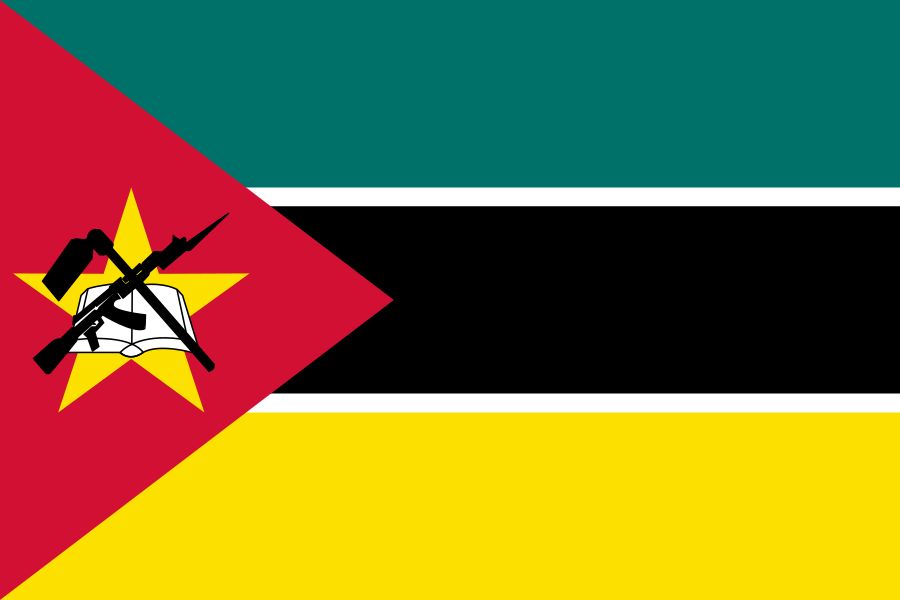

Mozambique in the World

Mozambique - Introduction 1997
top of pageBackground: Almost five centuries as a Portuguese colony came to a close with independence in 1975. Large-scale emigration by whites economic dependence on South Africa a severe drought and a prolonged civil war hindered the country's development. The ruling party formally abandoned Marxism in 1989 and a new constitution the following year provided for multiparty elections and a free market economy. A UN-negotiated peace agreement with rebel forces ended the fighting in 1992.
Mozambique - Geography 1997
top of pageLocation: Southern Africa, bordering the Mozambique Channel, between South Africa and Tanzania
Geographic coordinates: 18 15 S, 35 00 E
Map reference: Africa
Area
Total: 801,590 km²
Land: 784,090 km²
Water: 17,500 km²
Comparative: slightly less than twice the size of California
Land boundaries
Total: 4,571 km
Border countries: (6) Malawi 1,569 km; , South Africa 491 km; , Swaziland 105 km; , Tanzania 756 km; , Zambia 419 km; , Zimbabwe 1,231 km
Coastline: 2,470 km
Maritime claims
Exclusive economic zone: 200 nm
Territorial sea: 12 nm
Climate: tropical to subtropical
Terrain: mostly coastal lowlands, uplands in center, high plateaus in northwest, mountains in west
Elevation
Extremes lowest point: Indian Ocean 0 m
Extremes highest point: Monte Binga 2,436 m
Natural resources: coal, titanium, natural gas
Land use
Land use
Arable land: 4%
Permanent crops: 0%
Permanent pastures: 56%
Forests and woodland: 18%
Other: 22% (1993 est.)
Irrigated land: 1,180 km² (1993 est.)
Major rivers
Major watersheds area km²
Total water withdrawal
Total renewable water resources
Natural hazards: severe droughts and floods occur in central and southern provinces; devastating cyclones
Geography
Mozambique - People 1997
top of pagePopulation: 18,165,476 (July 1997 est.)
Growth rate: 2.6% (1997 est.)
Nationality
Noun: Mozambican(s)
Adjective: Mozambican
Ethnic groups: indigenous tribal groups 99.66% (Shangaan, Chokwe, Manyika, Sena, Makua, and others), Europeans 0.06%, Euro-Africans 0.2%, Indians 0.08%
Languages: Portuguese (official), indigenous dialects
Religions: indigenous beliefs 50%, Christian 30%, Muslim 20%
Demographic profile
Age structure
Age structure
0-14 years: 45% (male 4,021,791; female 4,136,853)
15-64 years: 53% (male 4,678,819; female 4,910,085)
65 years and over: 2% (male 173,177; female 244,751) (July 1997 est.)
Dependency ratios
Median age
Population growth rate: 2.6% (1997 est.)
Birth rate: 44.33 births/1000 population (1997 est.)
Death rate: 18.31 deaths/1000 population (1997 est.)
Net migration rate: 0 migrant(s)/1000 population (1997 est.)
Population distribution
Urbanization
Major urban areas
Environment
Current issues: a long civil war and recurrent drought in the hinterlands have resulted in increased migration of the population to urban and coastal areas with adverse environmental consequences; desertification; pollution of surface and coastal waters
Air pollutants
Sex ratio
At birth: 1.03 male(s)/female
Under 15 years: 0.97 male(s)/female
15-64 years: 0.95 male(s)/female
65 years and over: 0.71 male(s)/female
Total population: 0.96 male(s)/female (1997 est.)
Mothers mean age at first birth
Maternal mortality ratio
Infant mortality rate: 122.9 deaths/1000 live births (1997 est.)
Life expectancy at birth
Total population: 44.85 years
Male: 43.71 years
Female: 46.02 years (1997 est.)
Total fertility rate: 6.11 children born/woman (1997 est.)
Contraceptive prevalence rate
Drinking water source
Current health expenditure
Physicians density
Hospital bed density
Sanitation facility access
Hiv/Aids
Major infectious diseases
Obesity adult prevalence rate
Alcohol consumption
Tobacco use
Children under the age of 5 years underweight
Education expenditures
Literacy
Definition: age 15 and over can read and write
Total population: 40.1%
Male: 57.7%
Female: 23.3% (1995 est.)
School life expectancy primary to tertiary education
Youth unemployment
Mozambique - Government 1997
top of pageCountry name
Conventional long form: Republic of Mozambique
Conventional short form: Mozambique
Local long form: Republica Popular de Mocambique
Local short form: Mocambique
Government type: republic
Capital: Maputo
Administrative divisions: 10 provinces (provincias, singular - provincia; Cabo Delgado, Gaza, Inhambane, Manica, Maputo, Nampula, Niassa, Sofala, Tete, Zambezia
Dependent areas
Independence: 25 June 1975 (from Portugal)
National holiday: Independence Day, 25 June (1975)
Constitution: 30 November 1990
Legal system: based on Portuguese civil law system and customary law
International law organization participation
Citizenship
Suffrage: 18 years of age; universal
Executive branch
Chief of state: President Joaquim Alberto CHISSANO (since 6 November 1986); note - before being popularly elected, CHISSANO was elected president by FRELIMO's Central Committee 4 November 1986 (reelected by the Committee 30 July 1989)
Head of government: Prime Minister Pascoal MOCUMBI (since NA December 1994)
Cabinet: Cabinet
Elections: president elected by popular vote for a five-year term; election last held 27 October 1994 (next to be held NA 1999); prime minister appointed by the president
Election results: Joaquim Alberto CHISSANO elected president; percent of vote - Joaquim CHISSANO 53.3%, Afonso DHLAKAMA 33.3%
Legislative branch: unicameral Assembly of the Republic or Assembleia da Republica (250 seats; members are directly elected by popular vote on a secret ballot to serve five-year terms)
Elections: last held 27-29 October 1994 (next to be held NA October 1999)
Election results: percent of vote by party - Frelimo 44.33%, RENAMO 33.78%, Democratic Union 5.15%, other 16.74%; seats by party - Frelimo 129, RENAMO 112, Democratic Union 9
Note: the presidential and legislative elections took place as called for in the 1992 peace accords; RENAMO participated in the elections
Judicial branch: Supreme Court, judges appointed by the president and judges elected by the Assembly
Political parties and leaders
International organization participation: ACP, AfDB, C, CCC, ECA, FAO, G-77, IBRD, ICAO, ICFTU, ICRM, IDA, IDB, IFAD, IFC, IFRCS, ILO, IMF, IMO, Inmarsat, Intelsat, Interpol, IOC, IOM (observer), ISO (correspondent), ITU, NAM, OAU, OIC, SADC, UN, UNCTAD, UNESCO, UNIDO, UPU, WFTU, WHO, WIPO, WMO, WToO, WTrO
Diplomatic representation
In the us chief of mission: Ambassador Marcos Geraldo NAMASHULUA
In the us chancery: Suite 570, 1990 M Street NW, Washington, DC 20,036
In the us telephone: [1] (202) 293-7,146
In the us FAX: [1] (202) 835-0245
From the us chief of mission: Ambassador (vacant); Charge d'Affaires Peter Michael McKINLEY
From the us embassy: Avenida Kenneth Kuanda 193, Maputo
From the us mailing address: P. O. Box 783, Maputo
From the us telephone: [258] (1) 492,797
From the us FAX: [258] (1) 490,114
Flag description: three equal horizontal bands of green (top), black, and yellow with a red isosceles triangle based on the hoist side; the black band is edged in white; centered in the triangle is a yellow five-pointed star bearing a crossed rifle and hoe in black superimposed on an open white book
National symbols
National anthem
National heritage
Mozambique - Economy 1997
top of pageEconomy overview: One of Africa's poorest countries, Mozambique has failed to exploit the economic potential of its sizable agricultural, hydropower, and transportation resources. Agricultural output is at only 75% of its 1981 level, and grain has to be imported. Industry operates at only 20%-40% of capacity. Foreign assistance programs supply the foreign exchange required to pay for imports of goods and services. The peace accord, signed in October 1992, has improved Mozambique's prospects. The restoration of electrical transmission lines to South Africa and the completion of a new transmission line to Zimbabwe (permitting the giant Cahora Bassa hydropower plant to export large amounts of electricity), proposed construction of a natural gas pipeline to South Africa, and reform of transportation services will greatly improve foreign exchange receipts. The Mozambique and South African governments are developing the Maputo corridor, linking the port of Maputo with Witbank, South Africa. In the past few years, more than 500 state enterprises have been privatized, including the country's largest commercial bank and a number of sizable manufacturing firms. Other pending reform measures are the privatization of customs operations, the reform of tax collection, and the facilitation of private enterprise in the transportation, energy, and telecommunications sectors.
Real gdp purchasing power parity
Real gdp growth rate: 3% (1995 est.)
Real gdp per capita: purchasing power parity - $670 (1995 est.)
Gross national saving
Gdp composition by sector of origin
Gdp composition by end use
Gdp composition by sector of origin
Agriculture: 33%
Industry: 12%
Services: 55% (1994 est.)
Agriculture products: cotton, cashew nuts, sugarcane, tea, cassava (tapioca), corn, rice, tropical fruits; beef, poultry
Industries: food, beverages, chemicals (fertilizer, soap, paints), petroleum products, textiles, cement, glass, asbestos, tobacco
Industrial production growth rate: 5.8% (1993 est.)
Labor force: NA
By occupation: 80% engaged in agriculture
Note: in 1993, 47% of the wage earners were employed in industry, 28% in transportation and communication; traditionally, a large number of Mozambicans work abroad
Labor force
Unemployment rate: 50% (1989 est.)
Youth unemployment
Population below poverty line
Gini index
Household income or consumption by percentage share
Distribution of family income gini index
Budget
Revenues: $252 million
Expenditures: $607 million, including capital expenditures of $N/A (1992 est.)
Taxes and other revenues
Public debt
Revenue
Fiscal year: calendar year
Inflation rate consumer prices
Central bank discount rate
Commercial bank prime lending rate
Stock of narrow money
Stock of broad money
Stock of domestic credit
Market value of publicly traded shares
Current account balance
Exports
Total value: $169 million (f.o.b., 1995)
Commodities: shrimp 40%, cashews, cotton, sugar, copra, citrus
Partners: Spain, South Africa, US, Portugal, Japan
Imports
Total value: $784 million (c.i.f., 1995)
Commodities: food, clothing, farm equipment, petroleum
Partners: South Africa 44%, UK, France, Japan, Portugal
Reserves of foreign exchange and gold
Debt external: $5.5 billion (1995)
Stock of direct foreign investment at home
Stock of direct foreign investment abroad
Exchange rates: meticais (Mt) per US$1 - 11,455.0 (December 1996), 11,293.8 (1996), 9,024.3 (1995), 6,038.6 (1994), 3,874.2 (1993), 2,516.5 (1992)
Mozambique - Energy 1997
top of pageElectricity
Capacity: 2.36 million kW (1994)
Production: 490 million kWh (1994)
Consumption per capita: 45 kWh (1993)
Coal
Petroleum
Crude oil
Refined petroleum
Natural gas
Carbon dioxide emissions
Energy consumption per capita
Mozambique - Communication 1997
top of pageTelephones: 59,000 (1983 est.)
Telephone system: fair system of tropospheric scatter, open-wire lines, and microwave radio relay
Domestic: microwave radio relay and tropospheric scatter
International: satellite earth stations - 5 Intelsat (2 Atlantic Ocean and 3 Indian Ocean)
Broadcast media
Internet
Broadband fixed subscriptions
Mozambique - Military 1997
top of pageMilitary expenditures
Dollar figure: $84 million (1994)
Percent of gdp: 5.3% (1994)
Military and security forces
Military service age and obligation
Space program
Terrorist groups
Mozambique - Transportation 1997
top of pageNational air transport system
Civil aircraft registration country code prefix
Airports: 129 (1996 est.)
With paved runways total: 85
With paved runways over 3047 m: 1
With paved runways 2438 to 3047 m: 4
With paved runways 15-24 to 2437 m: 10
With paved runways 914 to 1523 m: 5
With paved runways under 914 m: 65 (1996 est.)
With unpaved runways total: 44
With unpaved runways 15-24 to 2437 m: 12
With unpaved runways 914 to 1523 m: 32 (1996 est.)
Heliports
Pipelines: crude oil (not operating) 306 km; petroleum products 289 km
Railways
Total: 3,131 km
Narrow gauge: 2,988 km 1.067-m gauge; 143 km 0.762-m gauge (1994)
Roadways
Waterways: about 3,750 km of navigable routes
Merchant marine: total:4 cargo ships (1,000 GRT or over) totaling 5,694 GRT/9,724 DWT (1996 est.)
Ports and terminals
Mozambique - Transnational issues 1997
top of pageDisputes international: none
Refugees and internally displaced persons
Illicit drugs: Southern African transit hub for South American cocaine probably destined for the European and US markets; producer of hashish and methaqualone

You found a piece of the puzzle
Please click here to complete it
Please click here to complete it