Statistical information Ecuador 2003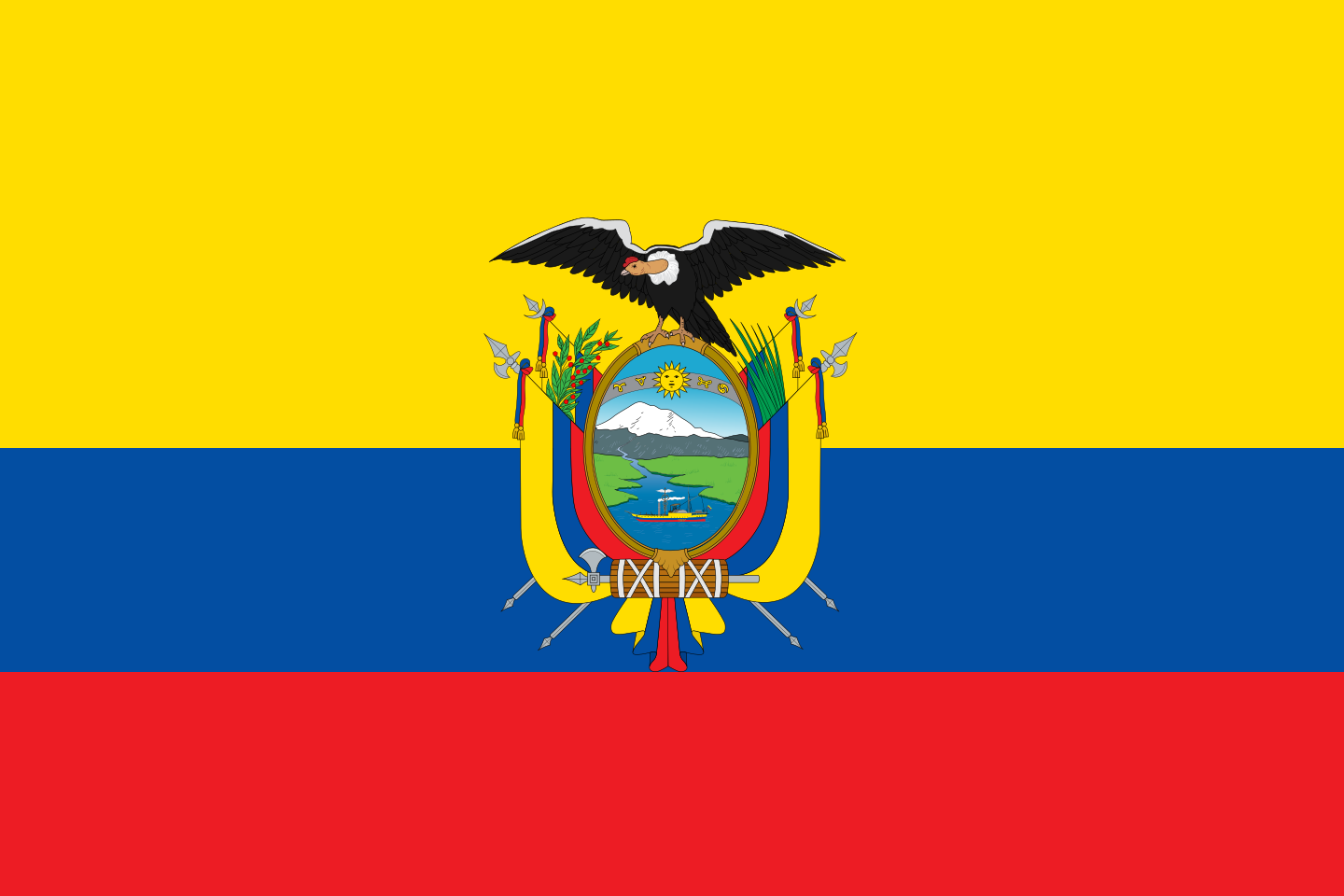

Ecuador in the World
Ecuador - Introduction 2003
top of pageBackground: The 'Republic of the Equator' was one of three countries that emerged from the collapse of Gran Colombia in 1830 (the others being Colombia and Venezuela). Between 1904 and 1942 Ecuador lost territories in a series of conflicts with its neighbors. A border war with Peru that flared in 1995 was resolved in 1999.
Ecuador - Geography 2003
top of pageLocation: Western South America bordering the Pacific Ocean at the Equator between Colombia and Peru
Geographic coordinates: 2 00 S 77 30 W
Map reference: South America
Area
Total: 283,560 km²
Note: includes Galapagos Islands
Water: 6,720 km²
Land: 276,840 km²
Comparative: slightly smaller than Nevada
Land boundaries
Total: 2,010 km
Border countries: (2) Colombia 590 km; , Peru 1,420 km
Coastline: 2,237 km
Maritime claims
Continental shelf: claims continental shelf between mainland and Galapagos Islands
Territorial sea: 200 NM
Climate: tropical along coast becoming cooler inland at higher elevations; tropical in Amazonian jungle lowlands
Terrain: coastal plain (costa) inter-Andean central highlands (sierra) and flat to rolling eastern jungle (oriente)
Elevation
Extremes lowest point: Pacific Ocean 0 m
Extremes highest point: Chimborazo 6,267 m
Natural resources: petroleum fish timber hydropower
Land use
Land use
Arable land: 5.69%
Permanent crops: 5.15%
Other: 89.16% (1998 est.)
Irrigated land: 8,650 km² (1998 est.)
Major rivers
Major watersheds area km²
Total water withdrawal
Total renewable water resources
Natural hazards: frequent earthquakes landslides volcanic activity; floods; periodic droughts
Geography
Note: Cotopaxi in Andes is highest active volcano in world
Ecuador - People 2003
top of pagePopulation: 13,710,234 (July 2003 est.)
Growth rate: 1.91% (2003 est.)
Below poverty line: 70% (2001 est.)
Nationality
Noun: Ecuadorian
Adjective: Ecuadorian
Ethnic groups: mestizo (mixed Amerindian and white) 65% Amerindian 25% Spanish and others 7% black 3%
Languages: Spanish (official) Amerindian languages (especially Quechua)
Religions: Roman Catholic 95%
Demographic profile
Age structure
Age structure
0-14 years: 34.9% (male 2,430,303; female 2,351,166)
15-64 years: 60.6% (male 4,116,289; female 4,198,667)
65 years and over: 4.5% (male 284,082; female 329,727) (2003 est.)
Dependency ratios
Median age
Total: 22.5 years
Male: 22 years
Female: 23 years (2002)
Population growth rate: 1.91% (2003 est.)
Birth rate: 24.94 births/1000 population (2003 est.)
Death rate: 5.29 deaths/1000 population (2003 est.)
Net migration rate: -0.52 migrant(s)/1000 population (2003 est.)
Population distribution
Urbanization
Major urban areas
Environment
Current issues: deforestation; soil erosion; desertification; water pollution; pollution from oil production wastes in ecologically sensitive areas of the Galapagos Islands
International agreements party to: Antarctic-Environmental Protocol, Antarctic Treaty, Biodiversity, Climate Change, Climate Change-Kyoto Protocol, Desertification, Endangered Species, Hazardous Wastes, Nuclear Test Ban, Ozone Layer Protection, Ship Pollution, Tropical Timber 83, Tropical Timber 94, Wetlands
International agreements signed but not ratified: none of the selected agreements
Air pollutants
Sex ratio
At birth: 1.05 male/female
Under 15 years: 1.03 male/female
15-64 years: 0.98 male/female
65 years and over: 0.86 male/female
Total population: 0.99 male/female (2003 est.)
Mothers mean age at first birth
Maternal mortality ratio
Infant mortality rate
Total: 31.97 deaths/1000 live births
Female: 26.39 deaths/1000 live births (2003 est.)
Male: 37.28 deaths/1000 live births
Life expectancy at birth
Total population: 71.89 years
Male: 69.06 years
Female: 74.86 years (2003 est.)
Total fertility rate: 2.99 children born/woman (2003 est.)
Contraceptive prevalence rate
Drinking water source
Current health expenditure
Physicians density
Hospital bed density
Sanitation facility access
Hiv/Aids
Adult prevalence rate: 0.3% (2001 est.)
People living with hivaids: 20,000 (2001 est.)
Deaths: 1700 (2001 est.)
Major infectious diseases
Obesity adult prevalence rate
Alcohol consumption
Tobacco use
Children under the age of 5 years underweight
Education expenditures
Literacy
Definition: age 15 and over can read and write
Total population: 92.5%
Male: 94%
Female: 91% (2003 est.)
School life expectancy primary to tertiary education
Youth unemployment
Ecuador - Government 2003
top of pageCountry name
Conventional long form: Republic of Ecuador
Conventional short form: Ecuador
Local short form: Ecuador
Local long form: Republica del Ecuador
Government type: republic
Capital: Quito
Administrative divisions: 22 provinces (provincias singular - provincia); Azuay Bolivar Canar Carchi Chimborazo Cotopaxi El Oro Esmeraldas Galapagos Guayas Imbabura Loja Los Rios Manabi Morona-Santiago Napo Orellana Pastaza Pichincha Sucumbios Tungurahua Zamora-Chinchipe
Dependent areas
Independence: 24 May 1822 (from Spain)
National holiday: Independence Day (independence of Quito) 10 August (1809)
Constitution: 10 August 1998
Legal system: based on civil law system; has not accepted compulsory ICJ jurisdiction
International law organization participation
Citizenship
Suffrage: 18 years of age; universal compulsory for literate persons ages 18-65 optional for other eligible voters
Executive branch
Chief of state: President Lucio GUTIERREZ (since 15 January 2003); Vice President Alfredo PALACIO (since 15 January 2003); note - the president is both the chief of state and head of government
Elections: the president and vice president are elected on the same ticket by popular vote for four-year term (no reelection); election last held 20 October 2002; runoff election held 24 November 2002 (next to be held NA October 2006)
Head of government: President Lucio GUTIERREZ (since 15 January 2003); Vice President Alfredo PALACIO (since 15 January 2003); note - the president is both the chief of state and head of government
Cabinet: Cabinet appointed by the president
Election results: results of the 24 November 2002 runoff election - Lucio GUTIERREZ elected president; percent of vote - Lucio GUTIERREZ 54.3%; Alvaro NOBOA 45.7%
Legislative branch
Elections: last held 20 October 2002 (next to be held NA October 2006)
Election results: percent of vote by party - NA%; seats by party - PSC 25, PRE 15, ID 16, PRIAN 10, PSP 9, Pachakutik Movement 6, MPD 5, DP 4, PS 3, independents 7; note - defections by members of National Congress are commonplace, resulting in frequent changes in the numbers of seats held by the various parties
Judicial branch: Supreme Court or Corte Suprema (new justices are elected by the full Supreme Court)
Political parties and leaders: Concentration of Popular Forces or CFP [Averroes BUCARAM]; Democratic Left or ID [Rodrigo BORJA Cevallos]; National Action Institutional Renewal Party or PRIAN [leader NA]; Pachakutik Movement [Miguel LLUCO]; Patriotic Society Party or PSP [leader NA]; Popular Democracy or DP [Dr. Juan Manuel FUERTES]; Popular Democratic Movement or MPD [Gustavo TERAN Acosta]; Radical Alfarista Front or FRA [Fabian ALARCON director]; Roldosist Party or PRE [Abdala BUCARAM Ortiz director]; Social Christian Party or PSC [Pascual DEL CIOPPO]; Socialist Party or PS [leader NA]
International organization participation: CAN ECLAC FAO G-77 IADB IAEA IBRD ICAO ICC ICCt ICFTU ICRM IDA IFAD IFC IFRCS IHO ILO IMF IMO Interpol IOC IOM ISO ITU LAES LAIA NAM OAS OPANAL OPCW PCA RG UN UNCTAD UNESCO UNHCR UNIDO UPU WCL WCO WFTU WHO WIPO WMO WToO WTrO
Diplomatic representation
In the us chief of mission: Ambassador Raul GANGOTENA Rivadeneira
In the us consulates general: Chicago, Houston, Los Angeles, Miami, New Orleans, New York, Newark, Philadelphia, and San Francisco
In the us fax: [1] (202) 667-3,482
In the us telephone: [1] (202) 234-7,200
In the us chancery: 2,535 15th Street NW, Washington, DC 20,009
From the us chief of mission: Ambassador Kristie Anne KENNEY
From the us embassy: Avenida 12 de Octubre y Avenida Patria, Quito
From the us mailing address: APO AA 34,039
From the us telephone: [593] (2) 256-2,890
From the us fax: [593] (2) 250-2,052
From the us consulates general: Guayaquil
Flag description: three horizontal bands of yellow (top double width) blue and red with the coat of arms superimposed at the center of the flag; similar to the flag of Colombia which is shorter and does not bear a coat of arms
National symbols
National anthem
National heritage
Ecuador - Economy 2003
top of pageEconomy overview: Ecuador has substantial oil resources and rich agricultural areas. Because the country exports primary products such as oil bananas and shrimp fluctuations in world market prices can have a substantial domestic impact. Ecuador joined the World Trade Organization (WTrO) in 1996 but has failed to comply with many of its accession commitments. The aftermath of El Nino and depressed oil market of 1997-98 drove Ecuador's economy into a free-fall in 1999. The beginning of 1999 saw the banking sector collapse which helped precipitate an unprecedented default on external loans later that year. Continued economic instability drove a 70% depreciation of the currency throughout 1999 which forced a desperate government to 'dollarize' the currency regime in 2000. The move stabilized the currency but did not stave off the ouster of the government. Gustavo NOBOA who assumed the presidency in January 2000 has managed to pass substantial economic reforms and mend relations with international financial institutions. Ecuador completed its first standby agreement since 1986 when the IMF Board approved a 10 December 2001 disbursement of $96 million the final installment of a $300 million standby credit agreement. In February 2003 newly installed president Lucio GUTIERREZ faced a budget gap and massive foreign debt. He has pledged to use oil revenues to pay off debt and is seeking additional IMF support.
Real gdp purchasing power parity
Real gdp growth rate: 3.4% (2002 est.)
Real gdp per capita: purchasing power parity - $3,200 (2002 est.)
Gross national saving
Gdp composition by sector of origin
Gdp composition by end use
Gdp composition by sector of origin
Agriculture: 11%
Industry: 33%
Services: 56% (2001 est.)
Agriculture products: bananas coffee cocoa rice potatoes manioc (tapioca) plantains sugarcane; cattle sheep pigs beef pork dairy products; balsa wood; fish shrimp
Industries: petroleum food processing textiles metal work paper products wood products chemicals plastics fishing lumber
Industrial production growth rate: 5.1% (2001 est.)
Labor force: 3.7 million (urban)
By occupation agriculture: 30%
By occupation industry: 25%
By occupation services: 45% (2001 est.)
Labor force
Unemployment rate: 7.7%; note - widespread underemployment (2001 est.)
Youth unemployment
Population below poverty line: 70% (2001 est.)
Gini index
Household income or consumption by percentage share
Lowest 10: 2.2%
Highest 10: 33.8% (1995)
Distribution of family income gini index: 43.7 (1995)
Budget
Revenues: $5.6 billion
Expenditures: planned $5.6 billion, including capital expenditures of $NA (2001 est.)
Taxes and other revenues
Public debt
Revenue
Fiscal year: calendar year
Inflation rate consumer prices: 12.5% (2002 est.)
Central bank discount rate
Commercial bank prime lending rate
Stock of narrow money
Stock of broad money
Stock of domestic credit
Market value of publicly traded shares
Current account balance
Exports: $4.9 billion (2002 est.)
Commodities: petroleum bananas shrimp coffee cocoa cut flowers fish
Partners: US 39% Colombia 5.6% South Korea 5.1% Germany 5% Italy 4.4% (2002)
Imports: $6 billion (2002 est.)
Commodities: machinery and equipment chemicals raw materials fuels; consumer goods
Partners: US 28.6% Colombia 14.4% Japan 6% Chile 4.5% Brazil 4.1% (2002)
Reserves of foreign exchange and gold
Debt external: $14.4 billion (2002)
Stock of direct foreign investment at home
Stock of direct foreign investment abroad
Exchange rates: sucres per US dollar - 25,000 (2002) 25,000 (2001) 24,988 (2000) 11,787 (1999) 5,447 (1998)
Ecuador - Energy 2003
top of pageElectricity
Production: 75.23 billion kWh (2001)
Production by source fossil fuel: 81%
Production by source hydro: 19%
Production by source other: 0% (2001)
Production by source nuclear: 0%
Consumption: 69.96 billion kWh (2001)
Exports: 0 kWh (2001)
Imports: 0 kWh (2001)
Coal
Petroleum
Crude oil
Refined petroleum
Natural gas
Production: 160 million m³ (2001 est.)
Consumption: 160 million m³ (2001 est.)
Exports: 0 m³ (2001 est.)
Imports: 0 m³ (2001 est.)
Proven reserves: 106.5 billion m³ (37,257)
Carbon dioxide emissions
Energy consumption per capita
Ecuador - Communication 2003
top of pageTelephones
Main lines in use: 1,115,272 (1999)
Mobile cellular: 384,000 (1999)
Telephone system
General assessment: generally elementary but being expanded
Domestic: facilities generally inadequate and unreliable
International: satellite earth station - 1 Intelsat (Atlantic Ocean)
Broadcast media
Internet
Country code: .ec
Service providers isps: 31 (2001)
Users: 328,000 (2002)
Broadband fixed subscriptions
Ecuador - Military 2003
top of pageMilitary expenditures
Dollar figure: $720 million (FY98)
Percent of gdp: 3.4% (FY98)
Military and security forces
Military service age and obligation
Space program
Terrorist groups
Ecuador - Transportation 2003
top of pageNational air transport system
Civil aircraft registration country code prefix
Airports: 205 (2002)
With paved runways total: 61
With paved runways over 3047 m: 3
With paved runways 2438 to 3047 m: 4
With paved runways 914 to 1523 m: 18
With paved runways under 914 m: 18 (2002)
With paved runways 15-24 to 2437 m: 18
With unpaved runways total: 144
With unpaved runways 914 to 1523 m: 31
With unpaved runways under 914 m: 113 (2002)
Heliports: 1 (2002)
Pipelines: gas 71 km; oil 1575 km; refined products 1185 km (2003)
Railways
Total: 966 km
Narrow gauge: 966 km 1.067-m gauge (2002)
Roadways
Waterways: 1500 km
Merchant marine
Total: 33 ships (1,000 GRT or over) 239,276 GRT/392,048 DWT
Note: includes some foreign-owned ships registered here as a flag of convenience: Chile 1, Greece 1 (2002 est.)
Ships by type: cargo 2, chemical tanker 3, liquefied gas 1, passenger 3, petroleum tanker 23, specialized tanker 1
Ports and terminals
Ecuador - Transnational issues 2003
top of pageDisputes international: none
Refugees and internally displaced persons
Illicit drugs: significant transit country for cocaine originating in Colombia and Peru; importer of precursor chemicals used in production of illicit narcotics; dollarization may raise the volume of money-laundering activity especially along the border with Colombia; increased activity on the northern frontier by trafficking groups and Colombian insurgents

