Statistical information Ukraine 2003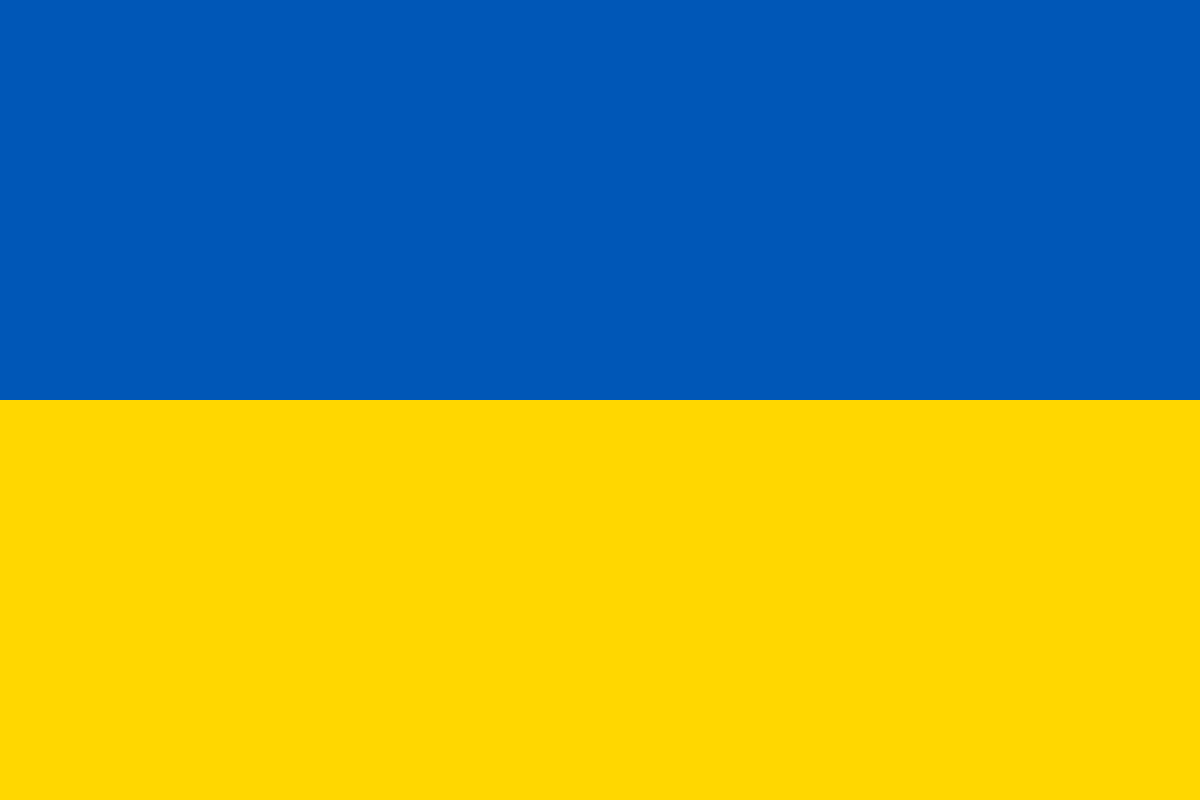

Ukraine in the World

Ukraine - Introduction 2003
top of pageBackground: Ukraine was the center of the first Slavic state Kievan Rus which during the 10th and 11th centuries was the largest and most powerful state in Europe. Weakened by internecine quarrels and Mongol invasions Kievan Rus was incorporated into the Grand Duchy of Lithuania and eventually into the Polish-Lithuanian Commonwealth. The cultural and religious legacy of Kievan Rus laid the foundation for Ukrainian nationalism through subsequent centuries. A new Ukrainian state the Cossack Hetmanate was established during the mid-17th century after an uprising against the Poles. Despite continuous Muscovite pressure the Hetmanate managed to remain autonomous for well over 100 years. During the latter part of the 18th century most Ukrainian ethnographic territory was absorbed by the Russian Empire. Following the collapse of czarist Russia in 1917 Ukraine was able to bring about a short-lived period of independence (1917-1920) but was reconquered and forced to endure a brutal Soviet rule that engineered two artificial famines (1921-22 and 1932-33) in which over 8 million died. In World War II German and Soviet armies were responsible for some 7 to 8 million more deaths. Although independence was achieved in 1991 with the dissolution of the USSR true freedom remains elusive as many of the former Soviet elite remain entrenched stalling efforts at economic reform privatization and civil liberties.
Ukraine - Geography 2003
top of pageLocation: Eastern Europe bordering the Black Sea between Poland and Russia
Geographic coordinates: 49 00 N 32 00 E
Map reference: Asia Europe
Area
Total: 603,700 km²
Water: 0 km²
Land: 603,700 km²
Comparative: slightly smaller than Texas
Land boundaries
Total: 4,663 km
Border countries: (7) Belarus 891 km; , Hungary 103 km; , Moldova 939 km; , Poland 526 km; , Romania (south) 169 km; , Romania (west) 362 km; , Russia 1,576 km; , Slovakia 97 km
Coastline: 2,782 km
Maritime claims
Continental shelf: 200-m or to the depth of exploitation
Exclusive economic zone: 200 NM
Territorial sea: 12 NM
Climate: temperate continental; Mediterranean only on the southern Crimean coast; precipitation disproportionately distributed highest in west and north lesser in east and southeast; winters vary from cool along the Black Sea to cold farther inland; summers are warm across the greater part of the country hot in the south
Terrain: most of Ukraine consists of fertile plains (steppes) and plateaus mountains being found only in the west (the Carpathians) and in the Crimean Peninsula in the extreme south
Elevation
Extremes lowest point: Black Sea 0 m
Extremes highest point: Hora Hoverla 2,061 m
Natural resources: iron ore coal manganese natural gas oil salt sulfur graphite titanium magnesium kaolin nickel mercury timber arable land
Land use
Land use
Arable land: 57.1%
Permanent crops: 1.73%
Other: 41.17% (1998 est.)
Irrigated land: 24,540 km² (1998 est.)
Major rivers
Major watersheds area km²
Total water withdrawal
Total renewable water resources
Natural hazards: NA
Geography
Note: strategic position at the crossroads between Europe and Asia; second-largest country in Europe
Ukraine - People 2003
top of pagePopulation: 48,055,439 (July 2003 est.)
Growth rate: -0.69% (2003 est.)
Below poverty line: 29% (2001 est.)
Nationality
Noun: Ukrainian
Adjective: Ukrainian
Ethnic groups: Ukrainian 77.8% Russian 17.3% Belarusian 0.6% Moldovan 0.5% Crimean Tatar 0.5% Bulgarian 0.4% Hungarian 0.3% Romanian 0.3% Polish 0.3% Jewish 0.2% other 1.8% (2001)
Languages: Ukrainian Russian Romanian Polish Hungarian
Religions: Ukrainian Orthodox - Moscow Patriarchate Ukrainian Orthodox - Kiev Patriarchate Ukrainian Autocephalous Orthodox Ukrainian Catholic (Uniate) Protestant Jewish
Demographic profile
Age structure
Age structure
0-14 years: 16.3% (male 4,004,948; female 3,832,931)
15-64 years: 68.7% (male 15,779,735; female 17,225,103)
65 years and over: 15% (male 2,419,612; female 4,793,110) (2003 est.)
Dependency ratios
Median age
Total: 38 years
Male: 34.8 years
Female: 40.9 years (2002)
Population growth rate: -0.69% (2003 est.)
Birth rate: 9.89 births/1000 population (2003 est.)
Death rate: 16.39 deaths/1000 population (2003 est.)
Net migration rate: -0.41 migrant(s)/1000 population (2003 est.)
Population distribution
Urbanization
Major urban areas
Environment
Current issues: inadequate supplies of potable water; air and water pollution; deforestation; radiation contamination in the northeast from 1986 accident at Chornobyl' Nuclear Power Plant
International agreements party to: Air Pollution, Air Pollution-Nitrogen Oxides, Air Pollution-Sulphur 85, Antarctic-Marine Living Resources, Antarctic Treaty, Biodiversity, Climate Change, Endangered Species, Environmental Modification, Hazardous Wastes, Law of the Sea, Marine Dumping, Ozone Layer Protection, Ship Pollution, Wetlands
International agreements signed but not ratified: Air Pollution-Persistent Organic Pollutants, Air Pollution-Sulphur 94, Air Pollution-Volatile Organic Compounds, Antarctic-Environmental Protocol, Climate Change-Kyoto Protocol
Air pollutants
Sex ratio
At birth: 1.05 male/female
Under 15 years: 1.04 male/female
15-64 years: 0.92 male/female
65 years and over: 0.5 male/female
Total population: 0.86 male/female (2003 est.)
Mothers mean age at first birth
Maternal mortality ratio
Infant mortality rate
Total: 20.87 deaths/1000 live births
Female: 19.48 deaths/1000 live births (2003 est.)
Male: 22.2 deaths/1000 live births
Life expectancy at birth
Total population: 66.5 years
Male: 61.1 years
Female: 72.17 years (2003 est.)
Total fertility rate: 1.34 children born/woman (2003 est.)
Contraceptive prevalence rate
Drinking water source
Current health expenditure
Physicians density
Hospital bed density
Sanitation facility access
Hiv/Aids
Adult prevalence rate: 1% (2001 est.)
People living with hivaids: 250,000 (2001 est.)
Deaths: 11,000 (2001 est.)
Major infectious diseases
Obesity adult prevalence rate
Alcohol consumption
Tobacco use
Children under the age of 5 years underweight
Education expenditures
Literacy
Definition: age 15 and over can read and write
Total population: 99.7%
Male: 99.8%
Female: 99.6% (2003 est.)
School life expectancy primary to tertiary education
Youth unemployment
Ukraine - Government 2003
top of pageCountry name
Conventional long form: none
Conventional short form: Ukraine
Local long form: none
Former: Ukrainian National Republic, Ukrainian State, Ukrainian Soviet Socialist Republic
Local short form: Ukrayina
Government type: republic
Capital: Kiev (Kyyiv)
Administrative divisions
Note: oblasts have the administrative center name following in parentheses
Dependent areas
Independence: 24 August 1991 (from the Soviet Union)
National holiday: Independence Day 24 August (1991); the date of 22 January (1918) the day Ukraine first declared its independence (from Soviet Russia) is now celebrated as Unity Day
Constitution: adopted 28 June 1996
Legal system: based on civil law system; judicial review of legislative acts
International law organization participation
Citizenship
Suffrage: 18 years of age; universal
Executive branch
Chief of state: President Leonid D. KUCHMA (since 19 July 1994)
Head of government: Prime Minister Viktor YANUKOVYCH (since 21 November 2002); First Deputy Prime Minister Mykola AZAROV (since 26 November 2002)
Cabinet: Cabinet of Ministers appointed by the president and approved by the Supreme Council
Elections: president elected by popular vote for a five-year term; election last held 31 October and 14 November 1999 (next to be held NA October 2004); prime minister and deputy prime ministers appointed by the president and approved by the Supreme Council
Election results: Leonid D. KUCHMA elected president; percent of vote - Leonid KUCHMA 57.7%, Petro SYMONENKO 38.8%
Note: there is also a National Security and Defense Council or NSDC originally created in 1992 as the National Security Council, but significantly revamped and strengthened under President KUCHMA; the NSDC staff is tasked with developing national security policy on domestic and international matters and advising the president; a Presidential Administration that helps draft presidential edicts and provides policy support to the president; and a Council of Regions that serves as an advisory body created by President KUCHMA in September 1994 that includes chairmen of the Kiev (Kyyiv) and Sevastopol' municipalities and chairmen of the oblasti
Legislative branch
Election results: percent of vote by party - Our Ukraine 24%, CPU 20%, United Ukraine 12%, United Social Democratic Party 6%, SPU 7%, Yuliya Tymoshenko Bloc 7%, other 24%; seats by party - Our Ukraine 102, CPU 60, Regions of Ukraine 42, Working Ukraine-Industrialists and Entrepreneurs 41, United Social Democratic Party 39, Democratic Initiatives 22, SPU 20, People's Power 19, European Choice 18, Yuliya Tymoshenko Bloc 18, Agrarian Party 17, People's Democratic Party 16, People's Choice 15, others 21
Note: following the election, United Ukraine splintered into the Agrarian Party, European Choice, People's Choice, People's Democratic Party, Regions of Ukraine, and Working Ukraine-Industrialists and Entrepreneurs
Elections: last held 31 March 2002 (next to be held NA 2006)
Judicial branch: Supreme Court; Constitutional Court
Political parties and leaders
Note: and numerous smaller parties
International organization participation: BSEC CE CEI CIS EAPC EBRD ECE GUUAM IAEA IBRD ICAO ICC ICCt (signatory) ICRM IFC IFRCS IHO ILO IMF IMO Interpol IOC IOM ISO ITU MONUC NAM (observer) NSG OAS (observer) OPCW OSCE PCA PFP UN UNAMSIL UNCTAD UNESCO UNIDO UNIFIL UNMEE UNMIBH UNMIK UNMOP UNMOT UNMOVIC UPU WCL WCO WFTU WHO WIPO WMO WToO WTrO (observer) ZC
Diplomatic representation
In the us chief of mission: Ambassador (vacant); Charge d'Affaires Sergiy KORSUNSKYI
In the us fax: [1] (202) 333-0817
In the us consulates general: Chicago and New York
In the us telephone: [1] (202) 349-2,920
In the us chancery: 3,350 M Street NW, Washington, DC 20,007
From the us chief of mission: Ambassador Carlos E. PASCUAL
From the us embassy: 10 Yurii Kotsiubynskyi Street, Kiev 01901
From the us mailing address: 5,850 Kiev Place, Washington, DC 20,521-5,850
From the us telephone: [380] (44) 490-4,000
From the us fax: [380] (44) 244-7,350
Flag description: two equal horizontal bands of azure (top) and golden yellow represent grainfields under a blue sky
National symbols
National anthem
National heritage
Ukraine - Economy 2003
top of pageEconomy overview: After Russia the Ukrainian republic was far and away the most important economic component of the former Soviet Union producing about four times the output of the next-ranking republic. Its fertile black soil generated more than one-fourth of Soviet agricultural output and its farms provided substantial quantities of meat milk grain and vegetables to other republics. Likewise its diversified heavy industry supplied the unique equipment (for example large diameter pipes) and raw materials to industrial and mining sites (vertical drilling apparatus) in other regions of the former USSR. Ukraine depends on imports of energy especially natural gas to meet some 85% of its annual energy requirements. Shortly after independence in December 1991 the Ukrainian Government liberalized most prices and erected a legal framework for privatization but widespread resistance to reform within the government and the legislature soon stalled reform efforts and led to some backtracking. Output by 1999 had fallen to less than 40% of the 1991 level. Loose monetary policies pushed inflation to hyperinflationary levels in late 1993. Ukraine's dependence on Russia for energy supplies and the lack of significant structural reform have made the Ukrainian economy vulnerable to external shocks. Now in his second term President KUCHMA has pledged to reduce the number of government agencies streamline the regulatory process create a legal environment to encourage entrepreneurs and enact a comprehensive tax overhaul. Reforms in the more politically sensitive areas of structural reform and land privatization are still lagging. Outside institutions - particularly the IMF - have encouraged Ukraine to quicken the pace and scope of reforms. GDP in 2000 showed strong export-based growth of 6% - the first growth since independence - and industrial production grew 12.9%. The economy continued to expand in 2001 as real GDP rose 9% and industrial output grew by over 14%. Growth of 4.1% in 2002 was more moderate in part a reflection of faltering growth in the developed world. In general growth has been undergirded by strong domestic demand low inflation and solid consumer and investor confidence. Growth was a sturdy 6% in 2003 despite a loss of mementum in needed economic reforms.
Real gdp purchasing power parity
Real gdp growth rate: 4.8% (2002 est.)
Real gdp per capita: purchasing power parity - $4,500 (2002 est.)
Gross national saving
Gdp composition by sector of origin
Gdp composition by end use
Gdp composition by sector of origin
Agriculture: 23%
Industry: 42%
Services: 35% (2001 est.)
Agriculture products: grain sugar beets sunflower seeds vegetables; beef milk
Industries: coal electric power ferrous and nonferrous metals machinery and transport equipment chemicals food processing (especially sugar)
Industrial production growth rate: 6% (2002 est.)
Labor force: 22.8 million (yearend 1997)
By occupation industry: 32%
By occupation agriculture: 24%
By occupation services: 44% (1996)
Labor force
Unemployment rate: 3.8% officially registered; large number of unregistered or underemployed workers (2002)
Youth unemployment
Population below poverty line: 29% (2001 est.)
Gini index
Household income or consumption by percentage share
Lowest 10: 3.7%
Highest 10: 23.2% (1999)
Distribution of family income gini index: 29 (1999)
Budget
Revenues: $10.2 billion
Expenditures: $11.1 billion, including capital expenditures of $NA (2002 est.)
Taxes and other revenues
Public debt
Revenue
Fiscal year: calendar year
Inflation rate consumer prices: -1.2% (2002 est.)
Central bank discount rate
Commercial bank prime lending rate
Stock of narrow money
Stock of broad money
Stock of domestic credit
Market value of publicly traded shares
Current account balance
Exports: $18.1 billion (2002 est.)
Commodities: ferrous and nonferrous metals fuel and petroleum products chemicals machinery and transport equipment food products
Partners: Russia 18.6% Italy 7.4% Turkey 5.6% Germany 4.1% China 4.1% (2002)
Imports: $18 billion (2002 est.)
Commodities: energy machinery and equipment chemicals
Partners: Russia 32.3% Germany 11.7% Turkmenistan 7.4% Poland 6% Italy 4% (2002)
Reserves of foreign exchange and gold
Debt external: $14.2 billion (2002)
Stock of direct foreign investment at home
Stock of direct foreign investment abroad
Exchange rates: hryvnia per US dollar - 5.33 (2002) 5.37 (2001) 5.44 (2000) 4.13 (1999) 2.45 (1998)
Ukraine - Energy 2003
top of pageElectricity
Production: 164.7 billion kWh (2001)
Production by source fossil fuel: 48.6%
Production by source hydro: 7.9%
Production by source other: 0% (2001)
Production by source nuclear: 43.5%
Consumption: 152.4 billion kWh (2001)
Exports: 800 million kWh (2001)
Imports: 0 kWh (2001)
Coal
Petroleum
Crude oil
Refined petroleum
Natural gas
Production: 18.2 billion m³ (2001 est.)
Consumption: 74.1 billion m³ (2001 est.)
Exports: 0 m³ (2001 est.)
Imports: 55.9 billion m³ (2001 est.)
Proven reserves: 560.7 billion m³ (37,257)
Carbon dioxide emissions
Energy consumption per capita
Ukraine - Communication 2003
top of pageTelephones
Main lines in use: 9.45 million (April 1999)
Mobile cellular: 236,000 (1998)
Telephone system
General assessment: Ukraine's telecommunication development plan, running through 2005, emphasizes improving domestic trunk lines, international connections, and the mobile cellular system
Domestic: at independence in December 1991, Ukraine inherited a telephone system that was antiquated, inefficient, and in disrepair; more than 3.5 million applications for telephones could not be satisfied; telephone density is now rising slowly and the domestic trunk system is being improved; the mobile cellular telephone system is expanding at a high rate
International: two new domestic trunk lines are a part of the fiber-optic Trans-Asia-Europe (TAE) system and three Ukrainian links have been installed in the fiber-optic Trans-European Lines (TEL) project which connects 18 countries; additional international service is provided by the Italy-Turkey-Ukraine-Russia (ITUR) fiber-optic submarine cable and by earth stations in the Intelsat, Inmarsat, and Intersputnik satellite systems
Broadcast media
Internet
Country code: .ua
Service providers isps: 260 (2001)
Users: 750,000 (2001)
Broadband fixed subscriptions
Ukraine - Military 2003
top of pageMilitary expenditures
Dollar figure: $617.9 million (FY02)
Percent of gdp: 1.4% (FY02)
Military and security forces
Military service age and obligation
Space program
Terrorist groups
Ukraine - Transportation 2003
top of pageNational air transport system
Civil aircraft registration country code prefix
Airports: 790 (2002)
With paved runways total: 182
With paved runways over 3047 m: 13
With paved runways 2438 to 3047 m: 51
With paved runways 15-24 to 2437 m: 31
With paved runways 914 to 1523 m: 6
With paved runways under 914 m: 81 (2002)
With unpaved runways total: 608
With unpaved runways over 3047 m: 14
With unpaved runways 2438 to 3047 m: 36
With unpaved runways 15-24 to 2437 m: 50
With unpaved runways 914 to 1523 m: 42
With unpaved runways under 914 m: 466 (2002)
Heliports
Pipelines: gas 20,069 km; oil 4,435 km; refined products 4,098 km (2003)
Railways
Total: 22,473 km
Broad gauge: 22,473 km 1.524-m gauge (9,250 km electrified) (2002)
Roadways
Waterways
Note: 1,672 km are on the Pryp'yat' and Dniester (Dnister) (1990)
Merchant marine
Total: 131 ships (1,000 GRT or over) 633,932 GRT/640,743 DWT
Ships by type: bulk 7, cargo 89, container 5, liquefied gas 2, passenger 14, passenger/cargo 1, petroleum tanker 10, railcar carrier 2, short-sea passenger 1
Note: includes some foreign-owned ships registered here as a flag of convenience: Cyprus 1, Greece 1, Panama 1, Russia 4, Saint Vincent and the Grenadines 1 (2002 est.)
Ports and terminals
Ukraine - Transnational issues 2003
top of pageDisputes international: 1997 boundary treaty with Belarus remains unratified over unresolved financial claims preventing demarcation and encouraging illegal cross-border activities; land delimitation of boundary with Russia is complete but maritime regime of the Sea of Azov and Kerch Strait remains unresolved; difficulties in the Transnistria region of Moldova complicate border crossing and customs facilitating smuggling arms transfers and other illegal activities; has not resolved Romanian claims to Ukrainian-administered Zmiyinyy (Snake) Island and Black Sea maritime boundary despite ongoing talks based on 1997 friendship treaty to find a solution in two years
Refugees and internally displaced persons
Illicit drugs: limited cultivation of cannabis and opium poppy mostly for CIS consumption; some synthetic drug production for export to the West; limited government eradication program; used as transshipment point for opiates and other illicit drugs from Africa Latin America and Turkey to Europe and Russia; drug-related money laundering a minor but growing problem; lax anti-money-laundering regime

You found a piece of the puzzle
Please click here to complete it
Please click here to complete it
