Statistical information Myanmar 2006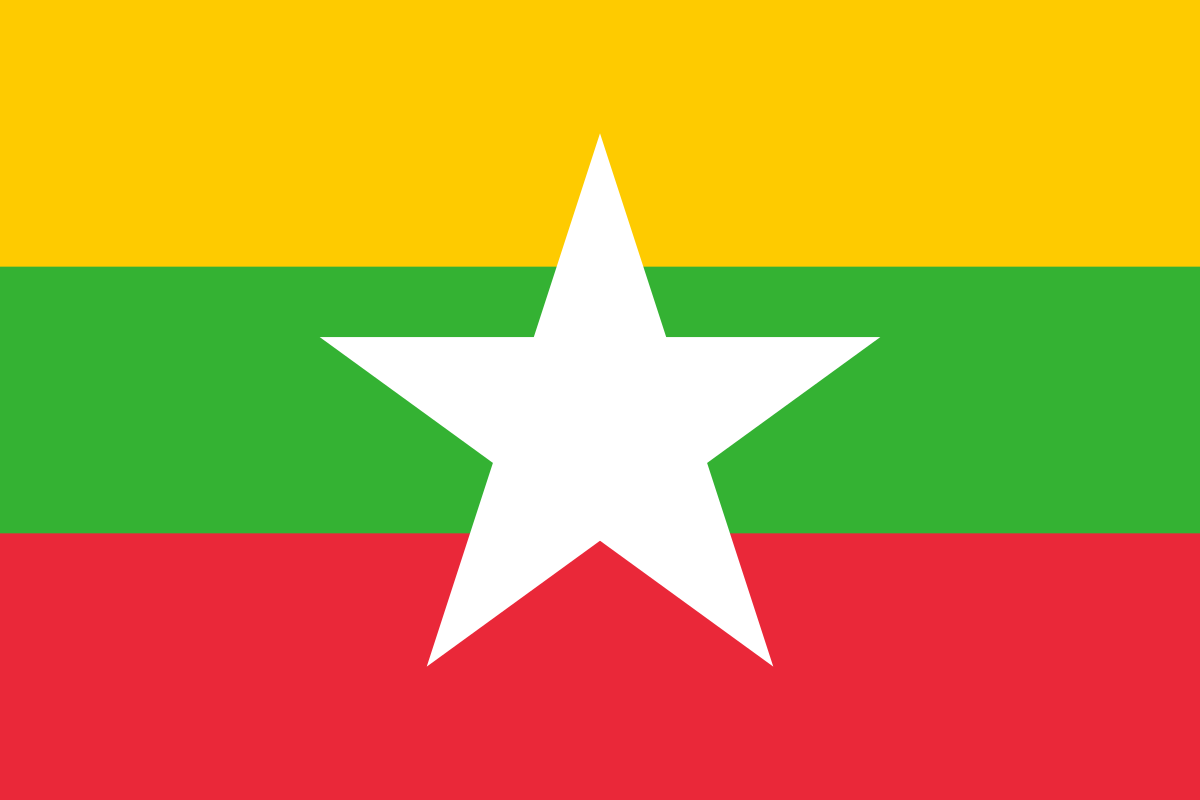

Myanmar in the World

Myanmar - Introduction 2006
top of pageBackground: Britain conquered Burma over a period of 62 years (1824-1886) and incorporated it into its Indian Empire. Burma was administered as a province of India until 1937 when it became a separate self-governing colony; independence from the Commonwealth was attained in 1948. Gen. NE WIN dominated the government from 1962 to 1988 first as military ruler then as self-appointed president and later as political kingpin. Despite multiparty legislative elections in 1990 that resulted in the main opposition party - the National League for Democracy (NLD) - winning a landslide victory the ruling junta refused to hand over power. NLD leader and Nobel Peace Prize recipient AUNG SAN SUU KYI who was under house arrest from 1989 to 1995 and 2000 to 2002 was imprisoned in May 2003 and subsequently transferred to house arrest where she remains virtually incommunicado. In February 2006 the junta extended her detention for another year. Her supporters as well as all those who promote democracy and improved human rights are routinely harassed or jailed.
Myanmar - Geography 2006
top of pageLocation: Southeastern Asia bordering the Andaman Sea and the Bay of Bengal between Bangladesh and Thailand
Geographic coordinates: 22 00 N 98 00 E
Map reference: Southeast Asia
Area
Total: 678,500 km²
Land: 657,740 km²
Water: 20,760 km²
Comparative: slightly smaller than Texas
Land boundaries
Total: 5,876 km
Border countries: (5) Bangladesh 193 km; , China 2,185 km; , India 1,463 km; , Laos 235 km; , Thailand 1,800 km
Coastline: 1930 km
Maritime claims
Territorial sea: 12 nm
Contiguous zone: 24 nm
Exclusive economic zone: 200 nm
Continental shelf: 200 nm or to the edge of the continental margin
Climate: tropical monsoon; cloudy rainy hot humid summers (southwest monsoon June to September); less cloudy scant rainfall mild temperatures lower humidity during winter (northeast monsoon December to April)
Terrain: central lowlands ringed by steep rugged highlands
Elevation
Extremes lowest point: Andaman Sea 0 m
Extremes highest point: Hkakabo Razi 5,881 m
Natural resources: petroleum timber tin antimony zinc copper tungsten lead coal some marble limestone precious stones natural gas hydropower
Land use
Land use
Arable land: 14.92%
Permanent crops: 1.31%
Other: 83.77% (2005)
Irrigated land: 18,700 km² (2003)
Major rivers
Major watersheds area km²
Total water withdrawal
Total renewable water resources
Natural hazards: destructive earthquakes and cyclones; flooding and landslides common during rainy season (June to September); periodic droughts
Geography
Note: strategic location near major Indian Ocean shipping lanes
Myanmar - People 2006
top of pagePopulation
Note: estimates for this country take into account the effects of excess mortality due to AIDS; this can result in lower life expectancy, higher infant mortality and death rates, lower population growth rates, and changes in the distribution of population by age and sex than would otherwise be expected (July 2006 est.)
Growth rate: 0.81% (2006 est.)
Nationality
Noun: Burmese (singular and plural)
Adjective: Burmese
Ethnic groups: Burman 68% Shan 9% Karen 7% Rakhine 4% Chinese 3% Indian 2% Mon 2% other 5%
Languages: Burmese minority ethnic groups have their own languages
Religions: Buddhist 89% Christian 4% (Baptist 3% Roman Catholic 1%) Muslim 4% animist 1% other 2%
Demographic profile
Age structure
Age structure
0-14 years: 26.4% (male 6,335,236/female 6,181,216)
15-64 years: 68.5% (male 16,011,723/female 16,449,626)
65 years and over: 5.1% (male 1,035,853/female 1,368,979) (2006 est.)
Dependency ratios
Median age
Total: 27 years
Male: 26.4 years
Female: 27.6 years (2006 est.)
Population growth rate: 0.81% (2006 est.)
Birth rate: 17.91 births/1000 population (2006 est.)
Death rate: 9.83 deaths/1000 population (2006 est.)
Net migration rate: 0 migrant(s)/1000 population (2006 est.)
Population distribution
Urbanization
Major urban areas
Environment
Current issues: deforestation; industrial pollution of air soil and water; inadequate sanitation and water treatment contribute to disease
International agreements party to: Biodiversity, Climate Change, Climate Change-Kyoto Protocol, Desertification, Endangered Species, Law of the Sea, Ozone Layer Protection, Ship Pollution, Tropical Timber 83, Tropical Timber 94
International agreements signed but not ratified: none of the selected agreements
Air pollutants
Sex ratio
At birth: 1.06 male/female
Under 15 years: 1.02 male/female
15-64 years: 0.97 male/female
65 years and over: 0.76 male/female
Total population: 0.97 male/female (2006 est.)
Mothers mean age at first birth
Maternal mortality ratio
Infant mortality rate
Total: 61.85 deaths/1000 live births
Male: 72.68 deaths/1000 live births
Female: 50.38 deaths/1000 live births (2006 est.)
Life expectancy at birth
Total population: 60.97 years
Male: 58.07 years
Female: 64.03 years (2006 est.)
Total fertility rate: 1.98 children born/woman (2006 est.)
Contraceptive prevalence rate
Drinking water source
Current health expenditure
Physicians density
Hospital bed density
Sanitation facility access
Hiv/Aids
Adult prevalence rate: 1.2% (2003 est.)
People living with hivaids: 330,000 (2003 est.)
Deaths: 20,000 (2003 est.)
Major infectious diseases
Degree of risk: very high
Food or waterborne diseases: bacterial and protozoal diarrhea, hepatitis A, and typhoid fever
Vectorborne diseases: dengue fever and malaria are high risks in some locations (2005)
Obesity adult prevalence rate
Alcohol consumption
Tobacco use
Children under the age of 5 years underweight
Education expenditures
Literacy
Definition: age 15 and over can read and write
Total population: 85.3%
Male: 89.2%
Female: 81.4% (2002)
School life expectancy primary to tertiary education
Youth unemployment
Myanmar - Government 2006
top of pageCountry name
Conventional long form: Union of Burma
Conventional short form: Burma
Local long form: Pyidaungzu Myanma Naingngandaw (translated by the US Government as Union of Myanma and by the Burmese as Union of Myanmar)
Local short form: Myanma Naingngandaw
Former: Socialist Republic of the Union of Burma
Note: since 1989 the military authorities in Burma have promoted the name Myanmar as a conventional name for their state; this decision was not approved by any sitting legislature in Burma, and the US Government did not adopt the name, which is a derivative of the Burmese short-form name Myanma Naingngandaw
Government type: military junta
Capital
Name: Rangoon (Yangon)
Geographic coordinates: 16 47 N, 96 10 E
Time difference: UTC+6.5 (11.5 hours ahead of Washington, DC during Standard Time)
Administrative divisions
Dependent areas
Independence
National holiday
Constitution
Legal system
International law organization participation
Citizenship
Suffrage
Executive branch
Legislative branch
Judicial branch
Political parties and leaders
International organization participation
Diplomatic representation
Flag description
National symbols
National anthem
National heritage
Myanmar - Economy 2006
top of pageEconomy overview
Real gdp purchasing power parity
Real gdp growth rate
Real gdp per capita
Gross national saving
Gdp composition by sector of origin
Gdp composition by end use
Gdp composition by sector of origin
Agriculture products
Industries
Industrial production growth rate
Labor force
Labor force
Unemployment rate
Youth unemployment
Population below poverty line
Gini index
Household income or consumption by percentage share
Distribution of family income gini index
Budget
Taxes and other revenues
Public debt
Revenue
Fiscal year: 1 April - 31 March
Inflation rate consumer prices
Central bank discount rate
Commercial bank prime lending rate
Stock of narrow money
Stock of broad money
Stock of domestic credit
Market value of publicly traded shares
Current account balance: $700 million (2005 est.)
Exports
Note: official export figures are grossly underestimated due to the value of timber, gems, narcotics, rice, and other products smuggled to Thailand, China, and Bangladesh (2004)
Commodities: clothing gas wood products pulses beans fish rice
Partners: Thailand 44.3% India 12.3% China 6.8% Japan 5% (2005)
Imports
Note: import figures are grossly underestimated due to the value of consumer goods, diesel fuel, and other products smuggled in from Thailand, China, Malaysia, and India (2004)
Commodities: fabric petroleum products plastics machinery transport equipment construction materials crude oil; food products
Partners: China 28.8% Thailand 21.8% Singapore 18.3% Malaysia 7.6% (2005)
Reserves of foreign exchange and gold: $763 million (2005 est.)
Debt external: $6.99 billion (2005 est.)
Stock of direct foreign investment at home
Stock of direct foreign investment abroad
Exchange rates
Note: these are official exchange rates; unofficial exchange rates ranged in 2004 from 815 kyat/US dollar to nearly 970 kyat/US dollar, and by year-end 2005, the unofficial exchange rate was 1,075 kyat/US dollar
Myanmar - Energy 2006
top of pageElectricity
Coal
Petroleum
Crude oil
Refined petroleum
Natural gas
Carbon dioxide emissions
Energy consumption per capita
Myanmar - Communication 2006
top of pageTelephones
Main lines in use: 476,200 (2005)
Mobile cellular: 183,400 (2005)
Telephone system
General assessment: barely meets minimum requirements for local and intercity service for business and government; international service is fair
Domestic: NA
International: country code - 95; satellite earth station - 2, Intelsat (Indian Ocean), and ShinSat
Broadcast media
Internet
Country code: .mm
Hosts: 42 (2006)
Users: 78,000 (2005)
Broadband fixed subscriptions
Myanmar - Military 2006
top of pageMilitary expenditures
Percent of gdp: 2.1% (FY97)
Military and security forces
Military service age and obligation: 18 years of age for voluntary military service for both sexes (2004)
Space program
Terrorist groups
Myanmar - Transportation 2006
top of pageNational air transport system
Civil aircraft registration country code prefix
Airports: 85 (2006)
With paved runways total: 21
With paved runways over 3047 m: 8
With paved runways 2438 to 3047 m: 7
With paved runways 15-24 to 2437 m: 4
With paved runways 914 to 1523 m: 1
With paved runways under 914 m: 1 (2006)
With unpaved runways total: 64
With unpaved runways over 3047 m: 1
With unpaved runways 15-24 to 2437 m: 13
With unpaved runways 914 to 1523 m: 18
With unpaved runways under 914 m: 32 (2006)
Heliports: 1 (2006)
Pipelines: gas 2,224 km; oil 558 km (2006)
Railways
Total: 3,955 km
Narrow gauge: 3,955 km 1.000-m gauge (2005)
Roadways
Total: 27,000 km
Paved: 3,200 km
Unpaved: 23,800 km (2005)
Waterways: 12,800 km (2005)
Merchant marine
Total: 34 ships (1000 GRT or over) 402,699 GRT/620,642 DWT
By type: bulk carrier 8, cargo 20, passenger 2, passenger/cargo 3, specialized tanker 1
Foreign owned: 9 (Germany 5, Japan 4) (2006)
Ports and terminals: Moulmein Rangoon Sittwe
Myanmar - Transnational issues 2006
top of pageDisputes international: over half of Burma's population consists of diverse ethnic groups with substantial numbers of kin beyond its borders; despite continuing border committee talks significant differences remain with Thailand over boundary alignment and the handling of ethnic rebels refugees and illegal cross-border activities; ethnic Karens flee into Thailand to escape fighting between Karen rebels and Burmese troops; in 2005 Thailand sheltered about 121,000 Burmese refugees; Karens also protest Thai support for a Burmese hydroelectric dam on the Salween River near the border; environmentalists in Burma and Thailand continue to voice concern over China's construction of hydroelectric dams upstream on the Nujiang/Salween River in Yunnan Province; India seeks cooperation from Burma to keep Indian Nagaland separatists from hiding in remote Burmese uplands
Refugees and internally displaced persons
Idps: 550,000-1,000,000 (government offensives against ethnic insurgent groups near borders; most IDPs are ethnic Karen, Karenni, Shan, Tavoyan, and Mon) (2005)
Illicit drugs: remains world's second largest producer of illicit opium (estimated production in 2004 - 292 metric tons down 40% from 2003 due to eradication efforts and drought; cultivation in 2004 - 30,900 hectares a 34% decline from 2003); lack of government will to take on major narcotrafficking groups and lack of serious commitment against money laundering continues to hinder the overall antidrug effort; major source of methamphetamine and heroin for regional consumption; currently under Financial Action Task Force countermeasures due to continued failure to address its inadequate money-laundering controls (2005)
