Statistical information Jordan 2007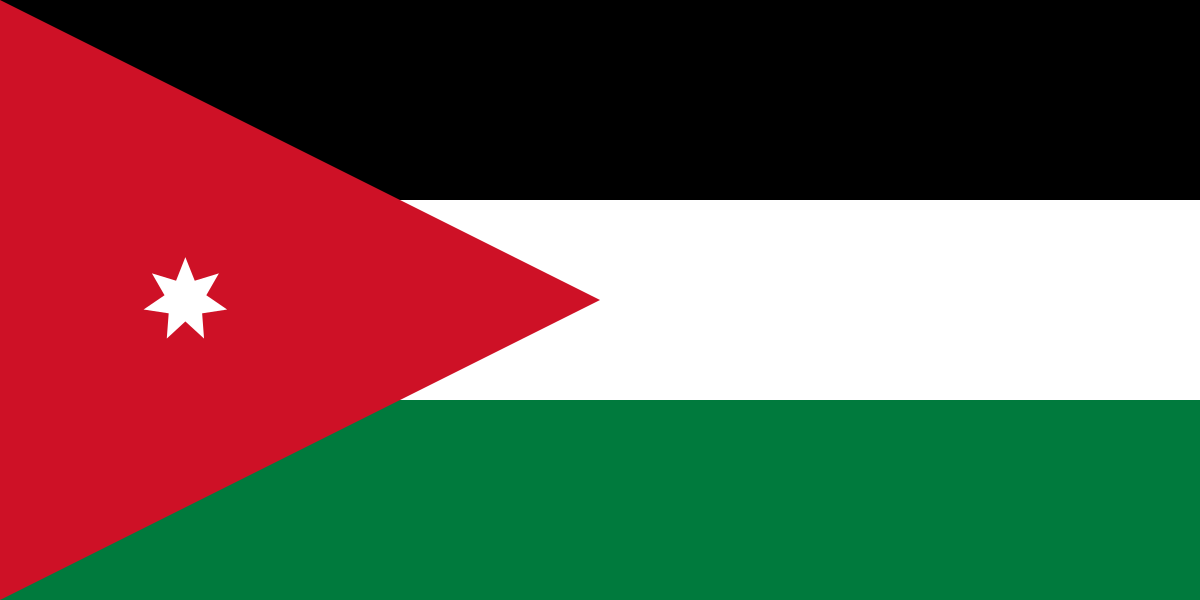

Jordan in the World

Jordan - Introduction 2007
top of pageBackground: Following World War I and the dissolution of the Ottoman Empire the UK received a mandate to govern much of the Middle East. Britain separated out a semi-autonomous region of Transjordan from Palestine in the early 1920s and the area gained its independence in 1946; it adopted the name of Jordan in 1950. The country's long-time ruler was King HUSSEIN (1953-99). A pragmatic leader he successfully navigated competing pressures from the major powers (US USSR and UK) various Arab states Israel and a large internal Palestinian population despite several wars and coup attempts. In 1989 he reinstituted parliamentary elections and gradual political liberalization; in 1994 he signed a peace treaty with Israel. King ABDALLAH II the son of King HUSSEIN assumed the throne following his father's death in February 1999. Since then he has consolidated his power and undertaken an aggressive economic reform program. Jordan acceded to the World Trade Organization in 2000 and began to participate in the European Free Trade Association in 2001. After a two-year delay parliamentary and municipal elections took place in the summer of 2003. The prime minister appointed in November 2005 stated the government would focus on political reforms improving conditions for the poor and fighting corruption.
Jordan - Geography 2007
top of pageLocation: Middle East northwest of Saudi Arabia
Geographic coordinates: 31 00 N 36 00 E
Map reference: Middle East
Area
Total: 92,300 km²
Land: 91,971 km²
Water: 329 km²
Comparative: slightly smaller than Indiana
Land boundaries
Total: 1,635 km
Border countries: (5) Iraq 181 km; , Israel 238 km; , Saudi Arabia 744 km; , Syria 375 km; , West Bank 97 km
Coastline: 26 km
Maritime claims
Territorial sea: 3 nm
Climate: mostly arid desert; rainy season in west (November to April)
Terrain: mostly desert plateau in east highland area in west; Great Rift Valley separates East and West Banks of the Jordan River
Elevation
Extremes lowest point: Dead Sea -408 m
Extremes highest point: Jabal Ram 1,734 m
Natural resources: phosphates potash shale oil
Land use
Land use
Arable land: 3.32%
Permanent crops: 1.18%
Other: 95.5% (2005)
Irrigated land: 750 km² (2003)
Major rivers
Major watersheds area km²
Total water withdrawal
Total renewable water resources
Natural hazards: droughts; periodic earthquakes
Geography
Note: strategic location at the head of the Gulf of Aqaba and as the Arab country that shares the longest border with Israel and the occupied West Bank
Jordan - People 2007
top of pagePopulation: 6,053,193 (July 2007 est.)
Growth rate: 2.412% (2007 est.)
Below poverty line: 14.2% (2002)
Nationality
Noun: Jordanian
Adjective: Jordanian
Ethnic groups: Arab 98% Circassian 1% Armenian 1%
Languages: Arabic (official) English widely understood among upper and middle classes
Religions: Sunni Muslim 92% Christian 6% (majority Greek Orthodox but some Greek and Roman Catholics Syrian Orthodox Coptic Orthodox Armenian Orthodox and Protestant denominations) other 2% (several small Shi'a Muslim and Druze populations) (2001 est.)
Demographic profile
Age structure
Age structure
0-14 years: 33% (male 1,018,934/female 977,645)
15-64 years: 63% (male 2,037,550/female 1,777,361)
65 years and over: 4% (male 117,279/female 124,424) (2007 est.)
Dependency ratios
Median age
Total: 23.5 years
Male: 24.1 years
Female: 22.8 years (2007 est.)
Population growth rate: 2.412% (2007 est.)
Birth rate: 20.69 births/1000 population (2007 est.)
Death rate: 2.68 deaths/1000 population (2007 est.)
Net migration rate: 6.11 migrant(s)/1000 population (2007 est.)
Population distribution
Urbanization
Major urban areas
Environment
Current issues: limited natural fresh water resources; deforestation; overgrazing; soil erosion; desertification
International agreements party to: Biodiversity, Climate Change, Climate Change-Kyoto Protocol, Desertification, Endangered Species, Hazardous Wastes, Law of the Sea, Marine Dumping, Ozone Layer Protection, Wetlands
International agreements signed but not ratified: none of the selected agreements
Air pollutants
Sex ratio
At birth: 1.06 male/female
Under 15 years: 1.042 male/female
15-64 years: 1.146 male/female
65 years and over: 0.943 male/female
Total population: 1.102 male/female (2007 est.)
Mothers mean age at first birth
Maternal mortality ratio
Infant mortality rate
Total: 16.16 deaths/1000 live births
Male: 19.33 deaths/1000 live births
Female: 12.81 deaths/1000 live births (2007 est.)
Life expectancy at birth
Total population: 78.55 years
Male: 76.04 years
Female: 81.22 years (2007 est.)
Total fertility rate: 2.55 children born/woman (2007 est.)
Contraceptive prevalence rate
Drinking water source
Current health expenditure
Physicians density
Hospital bed density
Sanitation facility access
Hiv/Aids
Adult prevalence rate: less than 0.1% (2001 est.)
People living with hivaids: 600 (2003 est.)
Deaths: less than 500 (2003 est.)
Major infectious diseases
Obesity adult prevalence rate
Alcohol consumption
Tobacco use
Children under the age of 5 years underweight
Education expenditures
Literacy
Definition: age 15 and over can read and write
Total population: 89.9%
Male: 95.1%
Female: 84.7% (2003 est.)
School life expectancy primary to tertiary education
Youth unemployment
Jordan - Government 2007
top of pageCountry name
Conventional long form: Hashemite Kingdom of Jordan
Conventional short form: Jordan
Local long form: Al Mamlakah al Urduniyah al Hashimiyah
Local short form: Al Urdun
Former: Transjordan
Government type: constitutional monarchy
Capital
Name: Amman
Geographic coordinates: 31 57 N, 35 56 E
Time difference: UTC+2 (7 hours ahead of Washington, DC during Standard Time)
Daylight saving time: +1hr, begins last Thursday in March; ends last Friday in September
Administrative divisions: 12 governorates (muhafazat singular - muhafazah); Ajlun Al 'Aqabah Al Balqa' Al Karak Al Mafraq 'Amman At Tafilah Az Zarqa' Irbid Jarash Ma'an Madaba
Dependent areas
Independence: 25 May 1946 (from League of Nations mandate under British administration)
National holiday: Independence Day 25 May (1946)
Constitution: 1 January 1952; amended many times
Legal system: based on Islamic law and French codes; judicial review of legislative acts in a specially provided High Tribunal; has not accepted compulsory ICJ jurisdiction
International law organization participation
Citizenship
Suffrage: 18 years of age; universal
Executive branch
Chief of state: King ABDALLAH II (since 7 February 1999); Prince HUSSEIN (born 1994), eldest son of King ABDALLAH, is first in line to inherit the throne
Head of government: Prime Minister Nadir al-DAHABI (since 22 November 2007); Deputy Prime Minister Ziad FARIZ (since 24 November 2005)
Cabinet: Cabinet appointed by the prime minister in consultation with the monarch
Elections: none; the monarch is hereditary; prime minister appointed by the monarch
Legislative branch
Elections: Chamber of Deputies - last held 20 November 2007 (next to be held in 2011)
Election results: Chamber of Deputies - percent of vote by party - NA; seats by party - independents 104, IAF 6
Judicial branch: Court of Cassation; Supreme Court (court of final appeal)
Political parties and leaders: al-Ahd Party; Arab Islamic Democratic Movement [Yusuf ABU BAKR]; Arab Land Party [Dr. Ayishah Salih HIJAZAYN]; Arab Socialist Ba'th Party [Taysir al-HIMSI]; Ba'th Arab Progressive Party [Fu'ad DABBUR]; Freedom Party; Future Party; Islamic Action Front or IAF [Zaki Sa'ed BANI IRSHEID]; Islamic Center Party [Marwan al-FAURI]; Jordanian Arab Ansar Party; Jordanian Arab New Dawn Party; Jordanian Arab Party; Jordanian Citizens' Rights Movement; Jordanian Communist Party [Munir HAMARINAH]; Jordanian Communist Workers Party; Jordanian Democratic Left Party [Musa MA'AYTEH]; Jordanian Democratic Popular Unity Party [Sa'id Dhiyab Ali MUSTAFA]; Jordanian Generations Party [Muhammad KHALAYLEH]; Jordanian Green Party [Muhammad BATAYNEH]; Jordanian Labor Party [Dr. Mazin Sulayman Jiryis HANNA]; Jordanian Peace Party; Jordanian People's Committees Movement; Jordanian People's Democratic Party (Hashd) [Ahmad YUSUF]; Jordanian Rafah Party; Jordanian Renaissance Party; Mission Party; Nation Party [Ahmad al-HANANDEH]; National Action Party (Haqq) [Tariq al-KAYYALI]; National Constitutional Party [Abdul Hadi MAJALI]; National Popular Democratic Movement [Mahmud al-NUWAYHI]; Progressive Party [Fawwaz al-ZUBI]
International organization participation: ABEDA AFESD AMF CAEU FAO G-77 IAEA IBRD ICAO ICC ICCt ICRM IDA IDB IFAD IFC IFRCS ILO IMF IMO Interpol IOC IOM IPU ISO ITSO ITU ITUC LAS MIGA MINUSTAH MONUC OIC ONUB OPCW OSCE (partner) PCA UN UNCTAD UNESCO UNHCR UNIDO UNMEE UNMIL UNMIS UNOCI UNOMIG UNRWA UNWTO UPU WCO WFTU WHO WIPO WMO WTO
Diplomatic representation
In the us chief of mission: Ambassador ZEID Ra'ad Zeid al-Hussein, Prince
In the us chancery: 3,504 International Drive NW, Washington, DC 20,008
In the us telephone: [1] (202) 966-2,664
In the us fax: [1] (202) 966-3,110
From the us chief of mission: Ambassador David M. HALE
From the us embassy: Abdoun, Amman
From the us mailing address: P. O. Box 354, Amman 11,118 Jordan; Unit 70,200, Box 5, APO AE 9,892-0200
From the us telephone: [962] (6) 590-6,000
From the us fax: [962] (6) 592-0121
Flag description: three equal horizontal bands of black (top) representing the Abbassid Caliphate white representing the Ummayyad Caliphate and green representing the Fatimid Caliphate; a red isosceles triangle on the hoist side representing the Great Arab Revolt of 1916 and bearing a small white seven-pointed star symbolizing the seven verses of the opening Sura (Al-Fatiha) of the Holy Koran; the seven points on the star represent faith in One God humanity national spirit humility social justice virtue and aspirations; design is based on the Arab Revolt flag of World War I
National symbols
National anthem
National heritage
Jordan - Economy 2007
top of pageEconomy overview: Jordan is a small Arab country with insufficient supplies of water oil and other natural resources. Poverty unemployment and inflation are fundamental problems but King ABDALLAH since assuming the throne in 1999 has undertaken some broad economic reforms in a long-term effort to improve living standards. Since Jordan's graduation from its most recent IMF program in 2002 Amman has continued to follow IMF guidelines practicing careful monetary policy and making substantial headway with privatization. In 2006 Jordan reduced its debt to GDP ratio significantly. The government also has liberalized the trade regime sufficiently to secure Jordan's membership in the WTO (2000) a free trade accord with the US (2001) and an association agreement with the EU (2001). These measures have helped improve productivity and have put Jordan on the foreign investment map. Jordan imported most of its oil from Iraq but the US-led war in Iraq in 2003 made Jordan more dependent on oil from other Gulf nations and has forced the Jordanian Government to raise retail petroleum product prices and the sales tax base. Jordan's export market which is heavily dependent on exports to Iraq was also affected by the war but recovered quickly while contributing to the Iraq recovery effort. The main challenges facing Jordan are reducing dependence on foreign grants reducing the budget deficit and attracting investment to promote job creation.
Real gdp purchasing power parity: $30.03 billion (2006 est.)
Real gdp growth rate: 6.4% (2006 est.)
Real gdp per capita: $5,100 (2006 est.)
Gross national saving
Gdp composition by sector of origin
Gdp composition by end use
Gdp composition by sector of origin
Agriculture: 3.9%
Industry: 10.3%
Services: 85.8% (2006 est.)
Agriculture products: citrus tomatoes cucumbers olives; sheep poultry stone fruits strawberries dairy
Industries: clothing phosphate mining fertilizers pharmaceuticals petroleum refining cement potash inorganic chemicals light manufacturing tourism
Industrial production growth rate: 4.6% (2006 est.)
Labor force: 1.512 million (2006 est.)
By occupation agriculture: 5%
By occupation industry: 12.5%
By occupation services: 82.5% (2001 est.)
Labor force
Unemployment rate: 15.4% official rate; unofficial rate is approximately 30% (2006 est.)
Youth unemployment
Population below poverty line: 14.2% (2002)
Gini index
Household income or consumption by percentage share
Lowest 10: 2.7%
Highest 10: 30.6% (2003)
Distribution of family income gini index: 38.8 (2003)
Budget
Revenues: $4.463 billion
Expenditures: $5.491 billion (2006 est.)
Taxes and other revenues
Public debt: 69.8% of GDP (2006 est.)
Revenue
Fiscal year: calendar year
Inflation rate consumer prices: 6.2% (2006 est.)
Central bank discount rate
Commercial bank prime lending rate
Stock of narrow money
Stock of broad money
Stock of domestic credit
Market value of publicly traded shares: $29.73 billion (2006)
Current account balance: $-1.951 billion (2006 est.)
Exports: $5.204 billion f.o.b. (2006 est.)
Commodities: clothing pharmaceuticals potash phosphates fertilizers vegetables manufactures
Partners: US 25.2% Iraq 16.9% India 8% Saudi Arabia 5.8% Syria 4.7% (2006)
Imports: $10.26 billion f.o.b. (2006 est.)
Commodities: crude oil textile fabrics machinery transport equipment manufactured goods
Partners: Saudi Arabia 23.2% Germany 8.2% China 8% US 5.3% (2006)
Reserves of foreign exchange and gold: $6.979 billion (2006 est.)
Debt external: $7.628 billion (2006 est.)
Stock of direct foreign investment at home: $8.154 billion (2006 est.)
Stock of direct foreign investment abroad
Exchange rates: Jordanian dinars per US dollar - 0.709 (2006) 0.709 (2005) 0.709 (2004) 0.709 (2003) 0.709 (2002)
Jordan - Energy 2007
top of pageElectricity
Production: 9.074 billion kWh (2005)
Consumption: 8.49 billion kWh (2005)
Exports: 4 million kWh (2005)
Imports: 741 million kWh (2005)
Coal
Petroleum
Crude oil
Refined petroleum
Natural gas
Production: 268.5 million m³ (2005 est.)
Consumption: 1.496 billion m³ (2005 est.)
Exports: 0 m³ (2005 est.)
Imports: 1.228 billion m³ (2005)
Proven reserves: 5.975 billion m³ (1 January 2006 est.)
Carbon dioxide emissions
Energy consumption per capita
Jordan - Communication 2007
top of pageTelephones
Main lines in use: 614,000 (2006)
Mobile cellular: 4.343 million (2006)
Telephone system
General assessment: service has improved recently with increased use of digital switching equipment; microwave radio relay transmission and coaxial and fiber-optic cable are employed on trunk lines; better access to the fixed-line telephone system is needed in the rural areas and easier access to pay telephones is needed by the urban public
Domestic: 1995 telecommunications law opened all non-fixed-line services to private competition; in 2005, monopoly over fixed-line services terminated and the entire telecommunications sector was opened to competition; mobile-cellular usage is increasing rapidly and teledensity is approaching 75 per 100 persons
International: country code - 962; landing point for the Fiber-Optic Link Around the Globe (FLAG) submarine cable network that provides links to Asia, Middle East, Europe; satellite earth stations - 3 Intelsat, 1 Arabsat, and 29 land and maritime Inmarsat terminals; fiber-optic cable to Saudi Arabia and microwave radio relay link with Egypt and Syria; participant in Medarabtel
Broadcast media
Internet
Country code: .jo
Hosts: 2,500 (2007)
Users: 796,900 (2006)
Broadband fixed subscriptions
Jordan - Military 2007
top of pageMilitary expenditures
Percent of gdp: 8.6% (2006)
Military and security forces
Military service age and obligation: 17 years of age for voluntary military service; conscription at age 18 was suspended in 1999 although all males under age 37 are required to register; women not subject to conscription but can volunteer to serve in non-combat military positions (2004)
Space program
Terrorist groups
Jordan - Transportation 2007
top of pageNational air transport system
Civil aircraft registration country code prefix
Airports: 17 (2007)
With paved runways total: 15
With paved runways over 3047 m: 7
With paved runways 2438 to 3047 m: 6
With paved runways 914 to 1523 m: 1
With paved runways under 914 m: 1 (2007)
With unpaved runways total: 2
With unpaved runways under 914 m: 2 (2007)
Heliports: 1 (2007)
Pipelines: gas 426 km; oil 49 km (2006)
Railways
Total: 505 km
Narrow gauge: 505 km 1.050-m gauge (2006)
Roadways
Total: 7,500 km
Paved: 7,500 km (2004)
Waterways
Merchant marine
Total: 30 ships (1000 GRT or over) 410,472 GRT/564,643 DWT
By type: bulk carrier 2, cargo 11, container 3, passenger/cargo 8, petroleum tanker 2, roll on/roll off 4
Foreign owned: 15 (UAE 15)
Registered in other countries: 15 (Bahamas 2, Panama 11, Syria 2) (2007)
Ports and terminals: Al 'Aqabah
Jordan - Transnational issues 2007
top of pageDisputes international: approximately two million Iraqis have fled the conflict in Iraq with the majority taking refuge in Syria and Jordan; 2004 Agreement settles border dispute with Syria pending demarcation
Refugees and internally displaced persons
Refugees country of origin: 1,835,704 (Palestinian Refugees (UNRWA)), 700,000 - 1,000,000 (Iraq)
Idps: 160,000 (1967 Arab-Israeli War) (2006)
Illicit drugs

You found a piece of the puzzle
Please click here to complete it
Please click here to complete it