Statistical information Mozambique 2010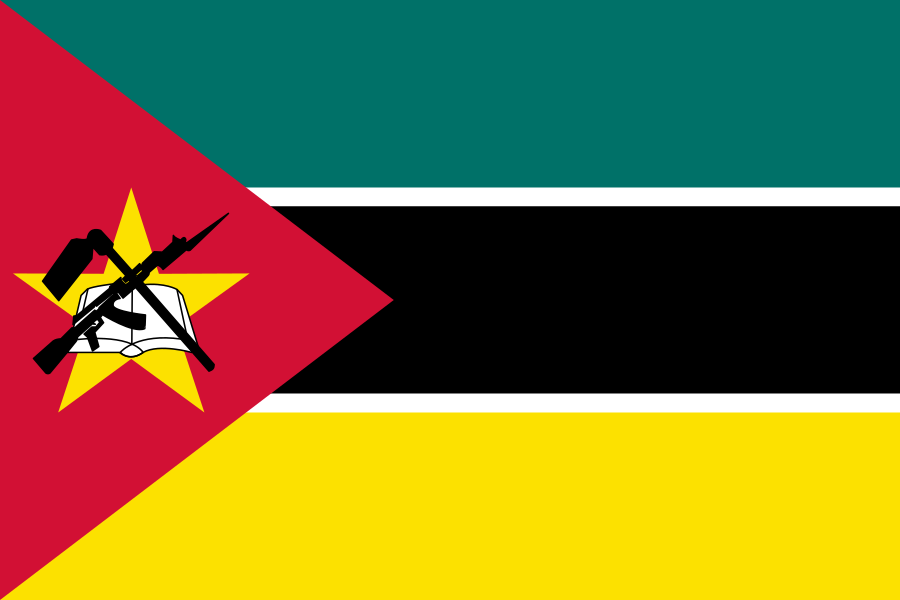

Mozambique in the World

Mozambique - Introduction 2010
top of pageBackground: Almost five centuries as a Portuguese colony came to a close with independence in 1975. Large-scale emigration economic dependence on South Africa a severe drought and a prolonged civil war hindered the country's development until the mid 1990's. The ruling Front for the Liberation of Mozambique (FRELIMO) party formally abandoned Marxism in 1989 and a new constitution the following year provided for multiparty elections and a free market economy. A UN-negotiated peace agreement between FRELIMO and rebel Mozambique National Resistance (RENAMO) forces ended the fighting in 1992. In December 2004 Mozambique underwent a delicate transition as Joaquim CHISSANO stepped down after 18 years in office. His elected successor Armando Emilio GUEBUZA promised to continue the sound economic policies that have encouraged foreign investment.
Mozambique - Geography 2010
top of pageLocation: Southeastern Africa bordering the Mozambique Channel between South Africa and Tanzania
Geographic coordinates: 18 15 S 35 00 E
Map reference: Africa
Area
Total: 799,380 km²
Rank: 35
Land: 786,380 km²
Water: 13,000 km²
Comparative: slightly less than twice the size of California
Land boundaries
Total: 4,571 km
Border countries: (6) Malawi 1569 km; South Africa 491 km; Swaziland 105 km; Tanzania 756 km; Zambia 419 km; Zimbabwe 1231 km
Coastline: 2,470 km
Maritime claims
Territorial sea: 12 nm
Exclusive economic zone: 200 nm
Climate: tropical to subtropical
Terrain: mostly coastal lowlands uplands in center high plateaus in northwest mountains in west
Elevation
Extremes lowest point: Indian Ocean 0 m
Extremes highest point: Monte Binga 2,436 m
Natural resources: coal titanium natural gas hydropower tantalum graphite
Land use
Land use
Arable land: 5.43%
Permanent crops: 0.29%
Other: 94.28% (2005)
Irrigated land: 1180 km² (2003)
Major rivers
Major watersheds area km²
Total water withdrawal
Total renewable water resources: 216 km³ (1992)
Natural hazards: severe droughts; devastating cyclones and floods in central and southern provinces
Geography
Note: the Zambezi flows through the north-central and most fertile part of the country
Mozambique - People 2010
top of pagePopulation: 22,061,451
Rank: 52
Note: estimates for this country explicitly take into account the effects of excess mortality due to AIDS; this can result in lower life expectancy higher infant mortality higher death rates lower population growth rates and changes in the distribution of population by age and sex than would otherwise be expected; the 1997 Mozambican census reported a population of 16,099,246 (July 2010 est.)
Growth rate: 1.797% (2010 est.)
Growth rate rank: 67
Below poverty line: 70% (2001 est.)
Nationality
Noun: Mozambican
Adjective: Mozambican
Ethnic groups: African 99.66% (Makhuwa Tsonga Lomwe Sena and others) Europeans 0.06% Euro-Africans 0.2% Indians 0.08%
Languages: Emakhuwa 26.1% Xichangana 11.3% Portuguese 8.8% (official; spoken by 27% of population as a second language) Elomwe 7.6% Cisena 6.8% Echuwabo 5.8% other Mozambican languages 32% other foreign languages 0.3% unspecified 1.3% (1997 census)
Religions: Catholic 23.8% Muslim 17.8% Zionist Christian 17.5% other 17.8% none 23.1% (1997 census)
Demographic profile
Age structure
Age structure
0-14 years: 44.3%
15-64 years: 52.8% (male 5,605,227/female 5,842,679)
65 years and over: 2.9% (male 257,119/female 361,772) (2010 est.)
Dependency ratios
Median age
Total: 17.5 years
Male: 17.1 years
Female: 17.9 years (2010 est.)
Population growth rate: 1.797% (2010 est.)
Rank: 67
Birth rate: 37.8 births/1000 population (2010 est.)
Rank: 21
Death rate: 19.83 deaths/1000 population (July 2010 est.)
Rank: 2
Net migration rate: 0 migrant(s)/1000 population
Rank: 114
Population distribution
Urbanization
Urban population: 37% of total population
Rate of urbanization: 4.1% annual rate of change (2005-10 est.)
Major urban areas
Environment
Current issues: a long civil war and recurrent drought in the hinterlands have resulted in increased migration of the population to urban and coastal areas with adverse environmental consequences; desertification; pollution of surface and coastal waters; elephant poaching for ivory is a problem
International agreements party to: Biodiversity Climate Change Climate Change-Kyoto Protocol Desertification Endangered Species Hazardous Wastes Law of the Sea Ozone Layer Protection Ship Pollution Wetlands
International agreements signed but not ratified: none of the selected agreements
Air pollutants
Sex ratio
At birth: 1.017 male/female
Under 15 years: 1.01 male(s)/female
15-64 years: 0.96 male(s)/female
65 years and over: 0.71 male(s)/female
Total population: 0.98 male(s)/female (2010 est.)
Mothers mean age at first birth
Maternal mortality ratio
Infant mortality rate
Total: 103.82 deaths/1000 live births
Rank: 6
Male: 106.53 deaths/1000 live births
Female: 101.07 deaths/1000 live births (2010 est.)
Life expectancy at birth
Total population: 41.37 years
Rank: 222
Male: 42.05 years
Female: 40.68 years (2010 est.)
Total fertility rate: 5.13 children born/woman (2010 est.)
Rank: 20
Contraceptive prevalence rate
Drinking water source
Current health expenditure
Physicians density
Hospital bed density
Sanitation facility access
Hiv/Aids
Adult prevalence rate: 12.5% (2007 est.)
Adult prevalence rate rank: 8
People living with hivaids: 1.5 million (2007 est.)
People living with hivaids rank: 5
Deaths: 81,000 (2007 est.)
Deaths rank: 8
Major infectious diseases
Degree of risk: very high
Food or waterborne diseases: bacterial and protozoal diarrhea hepatitis A and typhoid fever
Vectorborne diseases: malaria and plague
Water contact disease: schistosomiasis
Animal contact disease: rabies (2009)
Obesity adult prevalence rate
Alcohol consumption
Tobacco use
Children under the age of 5 years underweight
Education expenditures: 5% of GDP (2006)
Rank: 70
Literacy
Definition: age 15 and over can read and write
Total population: 47.8%
Male: 63.5%
Female: 32.7% (2003 est.)
School life expectancy primary to tertiary education
Total: 8 years
Male: 9 years
Female: 7 years (2005)
Youth unemployment
Mozambique - Government 2010
top of pageCountry name
Conventional long form: Republic of Mozambique
Conventional short form: Mozambique
Local long form: Republica de Mocambique
Local short form: Mocambique
Former: Portuguese East Africa
Government type: republic
Capital
Name: Maputo
Geographic coordinates: 25 57 S 32 35 E
Time difference: UTC+2 (7 hours ahead of Washington DC during Standard Time)
Administrative divisions: 10 provinces (provincias singular - provincia) 1 city (cidade)*; Cabo Delgado Gaza Inhambane Manica Maputo Cidade de Maputo* Nampula Niassa Sofala Tete Zambezia
Dependent areas
Independence: 25 June 1975 (from Portugal)
National holiday: Independence Day 25 June (1975)
Constitution: 30 November 1990
Legal system: based on Portuguese civil law system and customary law; has not accepted compulsory ICJ jurisdiction
International law organization participation
Citizenship
Suffrage: 18 years of age; universal
Executive branch
Chief of state: President Armando GUEBUZA
Head of government: Prime Minister Aires Bonifacio ALI (since 16 January 2010)
Cabinet: Cabinet
Elections: president elected by popular vote for a five-year term (eligible for a second term); election last held on 28 October 2009 (next to be held in 2014); prime minister appointed by the president
Election results: Armando GUEBUZA reelected president; percent of vote - Armando GUEBUZA 76.3% Afonso DHLAKAMA 14.9% Daviz SIMANGO 8.8%
Legislative branch: unicameral Assembly of the Republic or Assembleia da Republica (250 seats; members directly elected by popular vote to serve five-year terms)
Elections: last held on 28 October 2009 (next to be held in 2014)
Election results: percent of vote by party - FRELIMO 74.7% RENAMO 17.7% MDM 3.9% other 3.7%; seats by party - FRELIMO 191 RENAMO 51 MDM 8
Judicial branch: Supreme Court (the court of final appeal; some of its professional judges are appointed by the president and some are elected by the Assembly); other courts include an Administrative Court Constitutional Court customs courts maritime courts courts marshal labor courts
Political parties and leaders: Democratic Movement of Mozambique (Movimento Democratico de Mocambique) or MDM [Daviz SIMANGO]; Front for the Liberation of Mozambique (Frente de Liberatacao de Mocambique) or FRELIMO [Armando Emilio GUEBUZA]; Mozambique National Resistance (Resistencia Nacional Mocambicana) or RENAMO [Afonso DHLAKAMA]
International organization participation: ACP AfDB AU C CPLP FAO G-77 IAEA IBRD ICAO ICRM IDA IDB IFAD IFC IFRCS IHO ILO IMF IMO IMSO Interpol IOC IOM (observer) IPU ISO (correspondent) ITSO ITU ITUC MIGA MONUSCO NAM OIC OIF (observer) OPCW SADC UN UNCTAD UNESCO UNHCR UNIDO Union Latina UNWTO UPU WCO WFTU WHO WIPO WMO WTO
Diplomatic representation
In the us chief of mission: Ambassador Amelia Matos SUMBANA
In the us chancery: 1525 New Hampshire Avenue Washington DC 20,036
In the us telephone: [1] (202) 293-7,146
In the us fax: [1] (202) 835-0245
From the us chief of mission: Ambassador Leslie V. ROWE
From the us embassy: Avenida Kenneth Kuanda 193 Maputo
From the us mailing address: P. O. Box 783 Maputo
From the us telephone: [258] (21) 492,797
From the us fax: [258] (21) 490,114
Flag description: three equal horizontal bands of green (top) black and yellow with a red isosceles triangle based on the hoist side; the black band is edged in white; centered in the triangle is a yellow five-pointed star bearing a crossed rifle and hoe in black superimposed on an open white book; green represents the riches of the land white peace black the African continent yellow the country's minerals and red the struggle for independence; the rifle symbolizes defense and vigilance the hoe refers to the country's agriculture the open book stresses the importance of education and the star represents Marxism and internationalism
National symbols
National anthem
Name: 'Patria Amada'
Lyricsmusic: Salomao J. MANHICA/unknown
Note: adopted 2002
National heritage
Mozambique - Economy 2010
top of pageEconomy overview: At independence in 1975 Mozambique was one of the world's poorest countries. Socialist mismanagement and a brutal civil war from 1977-92 exacerbated the situation. In 1987 the government embarked on a series of macroeconomic reforms designed to stabilize the economy. These steps combined with donor assistance and with political stability since the multi-party elections in 1994 have led to dramatic improvements in the country's growth rate. Fiscal reforms including the introduction of a value-added tax and reform of the customs service have improved the government's revenue collection abilities. In spite of these gains Mozambique remains dependent upon foreign assistance for more than half of its annual budget and the majority of the population remains below the poverty line. Subsistence agriculture continues to employ the vast majority of the country's work force and smallholder agricultural productivity and productivity growth is weak. A substantial trade imbalance persists although the opening of the Mozal aluminum smelter the country's largest foreign investment project to date has increased export earnings. At the end of 2007 and after years of negotiations the government took over Portugal's majority share of the Cahora Bassa Hydroelectricity (HCB) company a dam that was not transferred to Mozambique at independence because of the ensuing civil war and unpaid debts. More power is needed for additional investment projects in titanium extraction and processing and garment manufacturing that could further close the import/export gap. Mozambique's once substantial foreign debt has been reduced through forgiveness and rescheduling under the IMF's Heavily Indebted Poor Countries (HIPC) and Enhanced HIPC initiatives and is now at a manageable level. In July 2007 the Millennium Challenge Corporation (MCC) signed a Compact with Mozambique; the Compact entered into force in September 2008 and will continue for five years. Compact projects will focus on improving sanitation roads agriculture and the business regulation environment in an effort to spur economic growth in the four northern provinces of the country. Mozambique grew at an average annual rate of 9% in the decade up to 2007 one of Africa's strongest performances. However heavy reliance on aluminum which accounts for about one-third of exports subjects the economy to volatile international prices. The sharp decline in aluminum prices during the global economic crisis lowered GDP growth by several percentage points. Despite 8.3% GDP growth in 2010 the increasing cost of living prompted citizens to riot in September 2010 after bread price increases were announced. In an attempt to contain the cost of living the government implemented subsidies decreased taxes and tariffs and instituted other fiscal measures.
Real gdp purchasing power parity:
$20.49 billion (2009 est.)
$19.28 billion (2008 est.)
$19.28 billion (2008 est.)
Rank: 122
Note: data are in 2010 US dollars
Real gdp growth rate:
6.3% (2009 est.)
6.8% (2008 est.)
6.8% (2008 est.)
Rank: 8
Real gdp per capita:
$900 (2009 est.)
$900 (2008 est.)
$900 (2008 est.)
Rank: 218
Note: data are in 2010 US dollars
Gross national saving
Gdp composition by sector of origin
Gdp composition by end use
Gdp composition by sector of origin
Agriculture: 28.8%
Industry: 26%
Services: 45.2% (2010 est.)
Agriculture products: cotton cashew nuts sugarcane tea cassava (tapioca) corn coconuts sisal citrus and tropical fruits potatoes sunflowers; beef poultry
Industries: food beverages chemicals (fertilizer soap paints) aluminum petroleum products textiles cement glass asbestos tobacco
Industrial production growth rate: 8% (2010 est.)
Rank: 31
Labor force: 9.87 million (2010 est.)
Rank: 50
By occupation agriculture: 81%
By occupation industry: 6%
By occupation services: 13% (1997 est.)
Labor force
Unemployment rate: 21% (1997 est.)
Rank: 169
Youth unemployment
Population below poverty line: 70% (2001 est.)
Gini index
Household income or consumption by percentage share
Lowest 10: 2.1%
Highest 10: 39.2% (2003)
Distribution of family income gini index: 39.6 (1997)
Rank: 33
Budget
Taxes and other revenues
Public debt: 33.4% of GDP (2009 est.)
Rank: 67
Revenue
Fiscal year
Inflation rate consumer prices: 3.3% (2009 est.)
Rank: 217
Central bank discount rate: 9.95% (31 December 2008)
Rank: 48
Commercial bank prime lending rate: 18.31% (31 December 2008 est.)
Rank: 25
Stock of narrow money: $2.812 billion (31 December 2009 est)
Rank: 114
Stock of broad money: $4.074 billion (31 December 2009 est.)
Rank: 128
Stock of domestic credit: $2.311 billion (31 December 2009 est.)
Rank: 122
Market value of publicly traded shares: $NA
Current account balance: -$866 million (2009 est.)
Rank: 136
Exports: $1.947 billion (2009 est.)
Rank: 126
Commodities: aluminum prawns cashews cotton sugar citrus timber; bulk electricity
Partners: Netherlands 47.62% South Africa 11.6% (2009)
Imports: $3.059 billion (2009 est.)
Rank: 135
Commodities: machinery and equipment vehicles fuel chemicals metal products foodstuffs textiles
Partners: South Africa 33.54% Netherlands 8.42% India 5.93% China 4.24% (2009)
Reserves of foreign exchange and gold: $1.829 billion (31 December 2009 est.)
Rank: 99
Debt external: $4.246 billion (31 December 2009 est.)
Rank: 107
Stock of direct foreign investment at home
Stock of direct foreign investment abroad
Exchange rates: meticais (MZM) per US dollar - 35 (2010) 26.283 (2009) 24.125 (2008) 26.264 (2007) 25.4 (2006)
Mozambique - Energy 2010
top of pageElectricity
Production: 15.91 billion kWh (2007 est.)
Production rank: 78
Consumption: 10.16 billion kWh (2007 est.)
Consumption rank: 86
Exports: 11.82 billion kWh (2007 est.)
Imports: 8.278 billion kWh (2007 est.)
Coal
Petroleum
Crude oil
Refined petroleum
Natural gas
Production: 3.3 billion m³ (2008 est.)
Production rank: 52
Consumption: 100 million m³ (2008 est.)
Consumption rank: 101
Exports: 3.2 billion m³ (2008 est.)
Exports rank: 32
Imports: 0 m³ (2008 est.)
Imports rank: 151
Proven reserves: 127.4 billion m³ (1 January 2010 est.)
Proven reserves rank: 50
Carbon dioxide emissions
Energy consumption per capita
Mozambique - Communication 2010
top of pageTelephones
Main lines in use: 82,400 (2009)
Main lines in use rank: 147
Mobile cellular: 5.971 million (2009)
Mobile cellular rank: 87
Telephone system
General assessment: a fair telecommunications system that is shackled with a heavy state presence lack of competition and high operating costs and charges
Domestic: stagnation in the fixed-line network contrasts with rapid growth in the mobile-cellular network; mobile-cellular coverage now includes all the main cities and key roads including those from Maputo to the South African and Swaziland borders the national highway through Gaza and Inhambane provinces the Beira corridor and from Nampula to Nacala; extremely low fixed-line teledensity; despite significant growth in mobile-cellular services teledensity remains low at about 25 per 100 persons
International: country code - 258; satellite earth stations - 5 Intelsat (2 Atlantic Ocean and 3 Indian Ocean); landing point for the SEACOM fiber-optic cable
Broadcast media: 1 state-run TV station supplemented by private TV station; Portuguese state TV's African service RTP Africa and Brazilian-owned TV Miramar are available; state-run radio provides nearly 100% territorial coverage and broadcasts in multiple languages; a number of privately-owned and community-operated stations also broadcast; transmissions of multiple international broadcasters are available (2007)
Internet
Country code: .mz
Hosts: 21,172 (2010)
Hosts rank: 109
Users: 613,600 (2009)
Users rank: 113
Broadband fixed subscriptions
Mozambique - Military 2010
top of pageMilitary expenditures: 0.8% of GDP (2006)
Rank: 149
Military and security forces
Military service age and obligation: registration for military service is mandatory for all males and females at 18 years of age; 18-35 years of age for selective compulsory military service; 18 years of age for voluntary service; 2-year service obligation; women may serve as officers or enlisted (2010)
Space program
Terrorist groups
Mozambique - Transportation 2010
top of pageNational air transport system
Civil aircraft registration country code prefix
Airports: 106 (2010)
Rank: 54
With paved runways total: 23
With paved runways over 3047 m: 1
With paved runways 2438 to 3047 m: 3
With paved runways 15-24 to 2437 m: 10
With paved runways 914 to 1523 m: 4
With paved runways under 914 m: 5 (2010)
With unpaved runways total: 83
With unpaved runways 2438 to 3047 m: 1
With unpaved runways 15-24 to 2437 m: 9
With unpaved runways 914 to 1523 m: 34
With unpaved runways under 914 m: 39 (2010)
Heliports
Pipelines: gas 918 km; refined products 278 km (2009)
Railways
Total: 4,787 km
Rank: 37
Narrow gauge: 4,787 km 1.067-m gauge (2008)
Roadways
Total: 30,400 km
Rank: 97
Paved: 5,685 km
Unpaved: 24,715 km (2000)
Waterways: 460 km (Zambezi River navigable to Tete and along Cahora Bassa Lake) (2010)
Rank: 87
Merchant marine
Total: 2
Rank: 145
By type: cargo 2
Foreign owned: 2 (Belgium 2) (2010)
Ports and terminals: Beira Maputo Nacala
Mozambique - Transnational issues 2010
top of pageDisputes international: none
Refugees and internally displaced persons
Illicit drugs: southern African transit point for South Asian hashish and heroin and South American cocaine probably destined for the European and South African markets; producer of cannabis (for local consumption) and methaqualone (for export to South Africa); corruption and poor regulatory capability makes the banking system vulnerable to money laundering but the lack of a well-developed financial infrastructure limits the country's utility as a money-laundering center
