Statistical information Myanmar 2021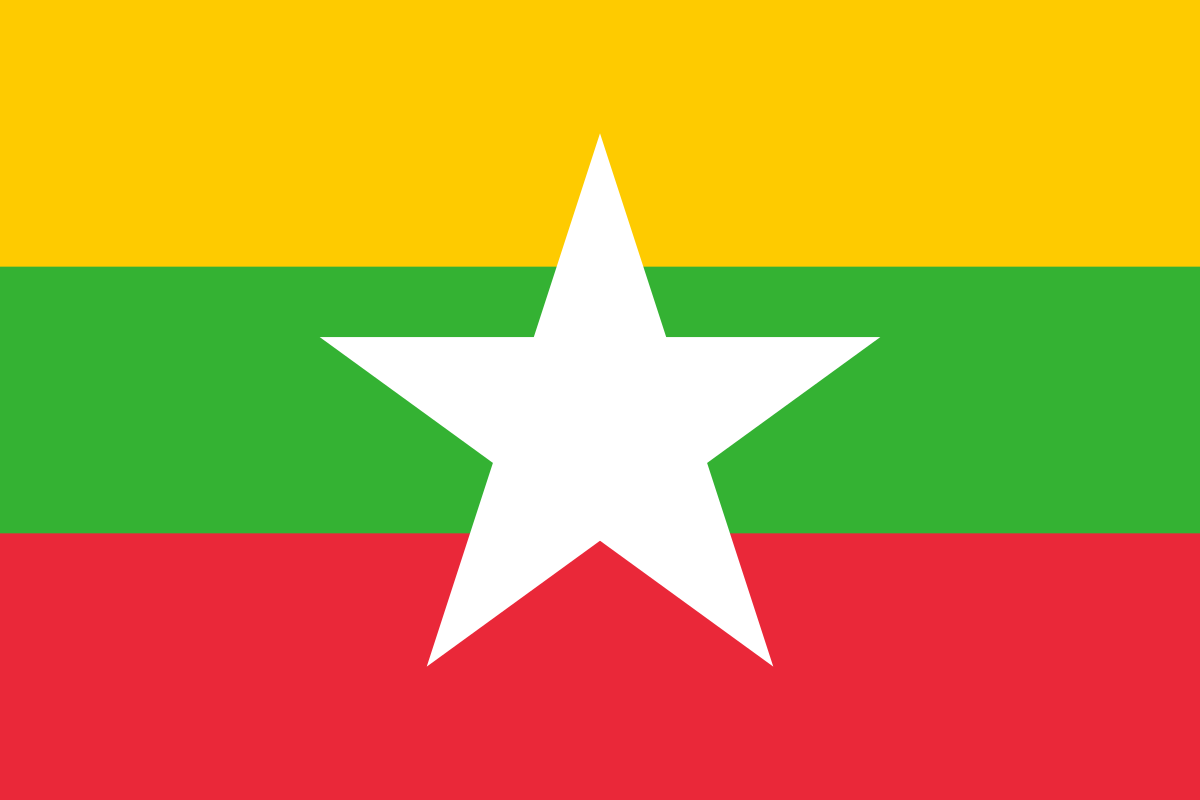

Myanmar in the World

Myanmar - Introduction 2021
top of pageBackground:
Burma, colonized by Britain in the 19th century and granted independence post-World War II, contains scores of ethnic Burman and ethnic minority groups that have resisted external efforts to consolidate control of the country throughout its history, extending to the several minority groups today that possess independent fighting forces and control pockets of territory. Burman and armed ethnic minorities fought off-and-on until military Gen. NE WIN seized power in 1962. He ruled Burma until 1988 when a military junta took control. In 1990, the junta permitted an election but then rejected the results when the main opposition National League for Democracy (NLD) and its leader AUNG SAN SUU KYI won in a landslide. The junta placed AUNG SAN SUU KYI under house arrest for much of the next 20 years, until November 2010. In 2007, rising fuel prices in Burma led prodemocracy activists and Buddhist monks to launch a 'Saffron Revolution' consisting of large protests against the ruling junta, which violently suppressed the movement by killing an unknown number of participants and arresting thousands. The regime prevented new elections until it had drafted a constitution designed to preserve its control; it passed the new constitution in its 2008 referendum, days after Cyclone Nargis killed at least 138,000. The junta conducted an election in 2010, but the NLD boycotted the vote, and the military’s Union Solidarity and Development Party easily won; international observers denounced the election as flawed.
With former or current military officers installed in its most senior positions, Burma began a halting process of political and economic reforms. Officials freed prisoners, brokered minority group cease fires, amended courts, expanded liberties, brought AUNG SAN SUU KYI into government in 2012, and permitted the NLD in 2015 to sweep into power. However, Burma’s first credibly elected civilian government, with AUNG SAN SUU KYI as the de facto head of state, faced strong headwinds after five decades of military dictatorship. The NLD government drew international criticism for blocking investigations of Burma’s military for operations, which the US Department of State determined constituted ethnic cleansing, on its Rohingya population that killed thousands and forced more than 740,000 Rohingya to flee into neighboring Bangladesh. The military did not support an NLD pledge in 2019 to examine reforming the military’s 2008 constitution. When the 2020 elections resulted in further NLD gains, the military denounced them as fraudulent. This challenge led Commander-in-Chief Sr. General MIN AUNG HLAING to launch a coup in February 2021 that has left Burma reeling with the return to authoritarian rule, the detention of AUNG SAN SUU KYI, and a renewal of the brutal repression of protestors, widespread violence, and economic decline.
With former or current military officers installed in its most senior positions, Burma began a halting process of political and economic reforms. Officials freed prisoners, brokered minority group cease fires, amended courts, expanded liberties, brought AUNG SAN SUU KYI into government in 2012, and permitted the NLD in 2015 to sweep into power. However, Burma’s first credibly elected civilian government, with AUNG SAN SUU KYI as the de facto head of state, faced strong headwinds after five decades of military dictatorship. The NLD government drew international criticism for blocking investigations of Burma’s military for operations, which the US Department of State determined constituted ethnic cleansing, on its Rohingya population that killed thousands and forced more than 740,000 Rohingya to flee into neighboring Bangladesh. The military did not support an NLD pledge in 2019 to examine reforming the military’s 2008 constitution. When the 2020 elections resulted in further NLD gains, the military denounced them as fraudulent. This challenge led Commander-in-Chief Sr. General MIN AUNG HLAING to launch a coup in February 2021 that has left Burma reeling with the return to authoritarian rule, the detention of AUNG SAN SUU KYI, and a renewal of the brutal repression of protestors, widespread violence, and economic decline.
Myanmar - Geography 2021
top of pageLocation: Southeastern Asia, bordering the Andaman Sea and the Bay of Bengal, between Bangladesh and Thailand
Geographic coordinates: 22 00 N, 98 00 E
Map reference: Southeast Asia
Area
Total: 676,578 km²
Land: 653,508 km²
Water: 23,070 km²
Comparative: slightly smaller than Texas
Land boundaries
Total: 6,522 km
Border countries: (5) Bangladesh 271 km; , China 2,129 km; , India 1468 km; , Laos 238 km; , Thailand 2,416 km
Coastline: 1,930 km
Maritime claims
Territorial sea: 12 nm
Contiguouszone: 24 nm
Exclusive economic zone: 200 nm
Continental shelf: 200 nm or to the edge of the continental margin
Climate: tropical monsoon; cloudy, rainy, hot, humid summers (southwest monsoon, June to September); less cloudy, scant rainfall, mild temperatures, lower humidity during winter (northeast monsoon, December to April)
Terrain: central lowlands ringed by steep, rugged highlands
Elevation
Highest point: Gamlang Razi 5,870 m
Lowest point: Andaman Sea/Bay of Bengal 0 m
Mean elevation: 702 m
Natural resources: petroleum, timber, tin, antimony, zinc, copper, tungsten, lead, coal, marble, limestone, precious stones, natural gas, hydropower, arable land
Land use
Land use
Agricultural land: 19.2% (2018 est.)
Agricultural land arable land: 16.5% (2018 est.)
Agricultural land permanent crops: 2.2% (2018 est.)
Agricultural land permanent pasture: 0.5% (2018 est.)
Forest: 48.2% (2018 est.)
Other: 32.6% (2018 est.)
Irrigated land: 22,950 km² (2012)
Major rivers
By length in km: Mekong (shared with China [s], Laos, Thailand, Cambodia, and Vietnam [m]) - 4,350 km; Salween river mouth (shared with China [s] and Thailand) - 3,060 km; Irrawaddy river mouth (shared with China [s]) - 2,809 km; Chindwin - 1,158 km
Major watersheds area km²: Indian Ocean drainage: Brahmaputra (651,335 km²), Ganges (1,016,124 km²), Irrawaddy (413,710 km²), Salween (271,914 km²)
Pacific Ocean drainage: Mekong (805,604 km²)
Total water withdrawal
Municipal: 3.323 billion cubic meters (2017 est.)
Industrial: 498.4 million cubic meters (2017 est.)
Agricultural: 29.57 billion cubic meters (2017 est.)
Total renewable water resources: 1,167,800,000,000 cubic meters (2017 est.)
Natural hazards: destructive earthquakes and cyclones; flooding and landslides common during rainy season (June to September); periodic droughts
Geography
Note: strategic location near major Indian Ocean shipping lanes; the north-south flowing Irrawaddy River is the country's largest and most important commercial waterway
Myanmar - People 2021
top of pagePopulation
Distribution: population concentrated along coastal areas and in general proximity to the shores of the Irrawaddy River; the extreme north is relatively underpopulated: 57,069,099 (July 2021 est.)
Growth rate: 0.81% (2021 est.)
Below poverty line: 24.8% (2017 est.)
Nationality
Noun: Burmese (singular and plural)
Adjective: Burmese
Ethnic groups: Burman (Bamar) 68%, Shan 9%, Karen 7%, Rakhine 4%, Chinese 3%, Indian 2%, Mon 2%, other 5%
Note: government recognizes 135 indigenous ethnic groups
Languages: Burmese (official)
Major language samples:
ကမ္ဘာ့အချက်အလက်စာအုပ်- အခြေခံအချက်အလက်တွေအတွက် မရှိမဖြစ်တဲ့ အရင်းအမြစ် (Burmese)
The Gheos World Guide, the indispensable source for basic information.
The Gheos World Guide, the indispensable source for basic information.
Note: minority ethnic groups use their own languages
Religions: Buddhist 87.9%, Christian 6.2%, Muslim 4.3%, Animist 0.8%, Hindu 0.5%, other 0.2%, none 0.1% (2014 est.)
Note: religion estimate is based on the 2014 national census, including an estimate for the non-enumerated population of Rakhine State, which is assumed to mainly affiliate with the Islamic faith; as of December 2019, Muslims probably make up less than 3% of Burma's total population due to the large outmigration of the Rohingya population since 2017
Demographic profile: Burma’s 2014 national census – the first in more than 30 years – revealed that the country’s total population is approximately 51.5 million, significantly lower than the Burmese Government’s prior estimate of 61 million. The Burmese Government assumed that the 2% population growth rate between 1973 and 1983 remained constant and that emigration was zero, ignoring later sample surveys showing declining fertility rates and substantial labor migration abroad in recent decades. These factors reduced the estimated average annual growth rate between 2003 and 2014 to about .9%. Among Southeast Asian countries, Burma’s life expectancy is among the lowest and its infant and maternal mortality rates are among the highest. The large difference in life expectancy between women and men has resulted in older age cohorts consisting of far more women than men.
Age structure
Age structure
0-14 years: 25.97% (male 7,524,869/female 7,173,333)
15-24 years: 17% (male 4,852,122/female 4,769,412)
25-54 years: 42.76% (male 11,861,971/female 12,337,482)
55-64 years: 8.22% (male 2,179,616/female 2,472,681)
65 years and over: 6.04% (male 1,489,807/female 1,928,778) (2020 est.)
Dependency ratios
Total dependency ratio: 46.5
Youth dependency ratio: 37.3
Elderly dependency ratio: 9.1
Potential support ratio: 10.9 (2020 est.)
Median age
Total: 29.2 years
Male: 28.3 years
Female: 30 years (2020 est.)
Population growth rate: 0.81% (2021 est.)
Birth rate: 16.65 births/1000 population (2021 est.)
Death rate: 7.14 deaths/1000 population (2021 est.)
Net migration rate: -1.38 migrant(s)/1000 population (2021 est.)
Population distribution: population concentrated along coastal areas and in general proximity to the shores of the Irrawaddy River; the extreme north is relatively underpopulated
Urbanization
Urban population: 31.4% of total population (2021)
Rate of urbanization: 1.85% annual rate of change (2020-25 est.)
Major urban areas
Population: 5.422 million RANGOON (Yangon) (capital), 1.469 million Mandalay (2021)
Environment
Current issues: deforestation; industrial pollution of air, soil, and water; inadequate sanitation and water treatment contribute to disease; rapid depletion of the country's natural resources
International agreements party to: Biodiversity, Climate Change, Climate Change-Kyoto Protocol, Climate Change-Paris Agreement, Comprehensive Nuclear Test Ban, Desertification, Endangered Species, Hazardous Wastes, Law of the Sea, Nuclear Test Ban, Ozone Layer Protection, Ship Pollution, Tropical Timber 2006, Wetlands
International agreements signed but not ratified: none of the selected agreements
Air pollutants
Particulate matter emissions: 34.69 micrograms per cubic meter (2016 est.)
Carbon dioxide emissions: 25.28 megatons (2016 est.)
Methane emissions: 42.2 megatons (2020 est.)
Sex ratio
At birth: 1.06 male(s)/female
0-14 years: 1.05 male(s)/female
15-24 years: 1.02 male(s)/female
25-54 years: 0.96 male(s)/female
55-64 years: 0.88 male(s)/female
65 years and over: 0.77 male(s)/female
Total population: 0.97 male(s)/female (2020 est.)
Mothers mean age at first birth: 24.7 years (2015/16 est.)
Note: median age at first birth among women 25-49
Maternal mortality ratio: 250 deaths/100,000 live births (2017 est.)
Infant mortality rate
Total: 33.71 deaths/1000 live births
Male: 37.04 deaths/1000 live births
Female: 30.17 deaths/1000 live births (2021 est.)
Life expectancy at birth
Total population: 69.62 years
Male: 67.96 years
Female: 71.39 years (2021 est.)
Total fertility rate: 2.05 children born/woman (2021 est.)
Contraceptive prevalence rate: 52.2% (2015/16)
Drinking water source
Improved urban: 93% of population
Improved rural: 76.9% of population
Improved total: 81.8% of population
Unimproved urban: 7% of population
Unimproved rural: 23.1% of population
Unimproved total: 18.2% of population (2017 est.)
Current health expenditure: 4.8% (2018)
Physicians density: 0.68 physicians/1000 population (2018)
Hospital bed density: 1 beds/1000 population (2017)
Sanitation facility access
Improved urban: 87.6% of population
Improved rural: 67.6% of population
Improved total: 73.7% of population
Unimproved urban: 12.4% of population
Unimproved rural: 32.4% of population
Unimproved total: 26.3% of population (2017 est.)
Hiv/Aids
Adult prevalence rate: 0.6% (2019 est.)
People living with hivaids: 240,000 (2019 est.)
Deaths: 7,700 (2019 est.)
Major infectious diseases
Degree of risk: very high (2020)
Food or water borne diseases: bacterial and protozoal diarrhea, hepatitis A, and typhoid fever
Vector borne diseases: dengue fever, malaria, and Japanese encephalitis
Animalcontactdiseases: rabies
Obesity adult prevalence rate: 5.8% (2016)
Alcohol consumption
Tobacco use
Children under the age of 5 years underweight: 19.1% (2017/18)
Education expenditures: 2% of GDP (2019)
Literacy
Definition: age 15 and over can read and write
Total population: 89.1%
Male: 92.4%
Female: 86.3% (2019)
School life expectancy primary to tertiary education
Total: 11 years
Male: 10 years
Female: 11 years (2018)
Youth unemployment
Rate ages 15-24 total: 1.5%
Rate ages 15-24 male: 1.4%
Rate ages 15-24 female: 1.6% (2019 est.)
Myanmar - Government 2021
top of pageCountry name
Conventional long form: Union of Burma
Conventional short form: Burma
Local long form: Pyidaungzu Thammada Myanma Naingngandaw (translated as the Republic of the Union of Myanmar)
Local short form: Myanma Naingngandaw
Former: Socialist Republic of the Union of Burma, Union of Myanmar
Etymology: both 'Burma' and 'Myanmar' derive from the name of the majority Burman (Bamar) ethnic group
Note: since 1989 the military authorities in Burma and the deposed parliamentary government have promoted the name Myanmar as a conventional name for their state; the US Government has not officially adopted the name
Government type: parliamentary republic
Capital
Name: Rangoon (Yangon); note - Nay Pyi Taw is the administrative capital
Geographic coordinates: 16 48 N, 96 09 E
Time difference: UTC+6.5 (11.5 hours ahead of Washington, DC, during Standard Time)
Etymology: Rangoon (Yangon) is a compound of 'yan' signifying 'enemies' and 'koun' meaning 'to run out of' and so denoting 'End of Strife'; Nay Pyi Taw translates as: 'Great City of the Sun' or 'Abode of Kings'
Administrative divisions: 7 regions (taing-myar, singular - taing), 7 states (pyi ne-myar, singular - pyi ne), 1 union territory
Dependent areas
Independence: 4 January 1948 (from the UK)
National holiday: Independence Day, 4 January (1948); Union Day, 12 February (1947)
Constitution
History: previous 1947, 1974 (suspended until 2008); latest drafted 9 April 2008, approved by referendum 29 May 2008
Amendments: proposals require at least 20% approval by the Assembly of the Union membership; passage of amendments to sections of the constitution on basic principles, government structure, branches of government, state emergencies, and amendment procedures requires 75% approval by the Assembly and approval in a referendum by absolute majority of registered voters; passage of amendments to other sections requires only 75% Assembly approval; amended 2015
Legal system: mixed legal system of English common law (as introduced in codifications designed for colonial India) and customary law
International law organization participation: has not submitted an ICJ jurisdiction declaration; non-party state to the ICCt
Citizenship
Citizenship by birth: no
Citizenship by descentonly: both parents must be citizens of Burma
Dual citizenship recognized: no
Residency requirement for naturalization: none
Note: an applicant for naturalization must be the child or spouse of a citizen
Suffrage: 18 years of age; universal
Executive branch
Chief of state: Prime Minister, SAC Chair, Sr. Gen. MIN AUNG HLAING (since 1 August 2021); note - MIN AUNG HLAING self-appointed himself to the role of prime minister of a “caretaker” provisional government that subsumed the State Administration Council (SAC) on 1 August 2021; the SAC, chaired by MIN AUNG HLAING, served as the executive governing body since 2 February 2021, following the 1 February 2021 military takeover of the government and the declaration of a state of emergency and still exists under the provisional government according to state media; MIN AUNG HLAING pledged to hold elections in 2023
Head of government: Prime Minister, SAC Chair, Sr. Gen. MIN AUNG HLAING (since 1 August 2021); note - MIN AUNG HLAING self-appointed himself to the role of prime minister of a “caretaker” provisional government that subsumed the State Administration Council (SAC) on 1 August 2021; the SAC, chaired by MIN AUNG HLAING, served as the executive governing body since 2 February 2021, following the 1 February 2021 military takeover of the government and the declaration of a state of emergency and still exists under the provisional government according to state media; MIN AUNG HLAING pledged to hold elections in 2023
Cabinet: Cabinet appointments shared by the president and the commander-in-chief; note - after 1 February, the military replaced the cabinet
Elections and appointments: president indirectly elected by simple majority vote by the full Assembly of the Union from among 3 vice-presidential candidates nominated by the Presidential Electoral College (consists of members of the lower and upper houses and military members); the other 2 candidates become vice-presidents (president elected for a 5-year term); election last held on 28 March 2018; MIN AUNG HLAING pledged to hold elections in 2023
Election results: WIN MYINT elected president; Assembly of the Union vote - WIN MYINT (NLD) 403, MYINT SWE (USDP) 211, HENRY VAN THIO (NLD) 18, 4 votes canceled (636 votes cast); note - WIN MYINT was placed under arrest following the military takeover on 1 February 2021
Statecounsellor: State Counselor AUNG SAN SUU KYI (since 6 April 2016); note - under arrest since 1 February 2021; formerly served as minister of foreign affairs and minister for the office of the president
Note: a parliamentary bill creating the position of 'state counsellor' was signed into law by former President HTIN KYAW on 6 April 2016; a state counsellor serves the equivalent term of the president and is similar to a prime minister in that the holder acts as a link between the parliament and the executive branch
Legislative branch
Description: bicameral Assembly of the Union or Pyidaungsu consists of:
House of Nationalities or Amyotha Hluttaw, (224 seats; 168 members directly elected in single-seat constituencies by absolute majority vote with a second round if needed and 56 appointed by the military; members serve 5-year terms)
House of Representatives or Pyithu Hluttaw, (440 seats, currently 433; 330 members directly elected in single-seat constituencies by simple majority vote and 110 appointed by the military; members serve 5-year terms); note - on 1 February, the military dissolved the Assembly of the Union; the State Administration Council governs in place of the Assembly of the Union
Elections: House of Nationalities - last held on on 8 November 2020 (next to be held in 2025)
House of Representatives - last held on 8 November 2020 (next to be held in 2025); note - the military junta overturned the results of the 8 November legislative elections
Election results:
House of Nationalities - percent of vote by party - NLD 61.6%, USDP 3.1%, ANP 1.8%, MUP 1.3%, KSDP 1.3%, other 5.9%, military appointees 25%; seats by party - NLD 138, USDP 7, ANP 4, MUP 3, KSPD 3, SNLD 2, TNP 2, other 2, canceled due to insurgency 7, military appointees 56
House of Representatives - percent of vote by party - NLD 58.6%, USDP 5.9%, SNLD 3.0%, other 7.5%, military 25%; seats by party - NLD 258, USDP 26, SNLD 13, ANP 4, PNO 3, TNP 3, MUP 2, KSPD 2, other 4, canceled due to insurgency 15, military appointees 110
House of Representatives - percent of vote by party - NLD 58.6%, USDP 5.9%, SNLD 3.0%, other 7.5%, military 25%; seats by party - NLD 258, USDP 26, SNLD 13, ANP 4, PNO 3, TNP 3, MUP 2, KSPD 2, other 4, canceled due to insurgency 15, military appointees 110
Judicial branch
Highest courts: Supreme Court of the Union (consists of the chief justice and 7-11 judges)
Judge selection and term of office: chief justice and judges nominated by the president, with approval of the Lower House, and appointed by the president; judges normally serve until mandatory retirement at age 70
Subordinate courts: High Courts of the Region; High Courts of the State; Court of the Self-Administered Division; Court of the Self-Administered Zone; district and township courts; special courts (for juvenile, municipal, and traffic offenses); courts martial
Political parties and leaders: All Mon Region Democracy Party or AMRDP
Arakan National Party or ANP (formed from the 2013 merger of the Rakhine Nationalities Development Party and the Arakan League for Democracy)
National Democratic Force or NDF [KHIN MAUNG SWE]
National League for Democracy or NLD [AUNG SAN SUU KYI]
Kayah State Democratic Party or KySDP
National Unity Party or NUP [THAN TIN]
Pa-O National Organization or PNO [AUNG KHAM HTI]
People's Party [KO KO GYI]
Shan Nationalities Democratic Party or SNDP [SAI AIK PAUNG]
Shan Nationalities League for Democracy or SNLD [KHUN HTUN OO]
Ta'ang National Party or TNP [AIK MONE]
Union Solidarity and Development Party or USDP [THAN HTAY]
Zomi Congress for Democracy or ZCD [PU CIN SIAN THANG]
numerous smaller parties
International organization participation: ADB, ARF, ASEAN, BIMSTEC, CP, EAS, EITI (candidate country), FAO, G-77, IAEA, IBRD, ICAO, ICRM, IDA, IFAD, IFC, IFRCS, IHO, ILO, IMF, IMO, Interpol, IOC, IOM, IPU, ISO (correspondent), ITU, ITUC (NGOs), NAM, OPCW (signatory), SAARC (observer), UN, UNCTAD, UNESCO, UNIDO, UNWTO, UPU, WCO, WHO, WIPO, WMO, WTO
Diplomatic representation
In the us chief of mission: ambassador AUNG LYNN (since 16 September 2016); note - there is no recognized Ambassador from Burma's military regime
In the us chancery: 2,300 S Street NW, Washington, DC 20,008
In the us telephone: [1] (202) 332-3,344; [1] (202) 332-4,250
In the us FAX: [1] (202) 332-4,351
In the us email address and website:
pyi.thayar@verizon.net; washington-embassy@mofa.gov.mm
[link]
[link]
From the us chief of mission: Ambassador Thomas J. VAJDA (since 19 January 2021)
From the us embassy: 110 University Avenue, Kamayut Township, Rangoon
From the us mailing address: 4,250 Rangoon Place, Washington DC 20,521-4,250
From the us telephone: [95] (1) 753-6,509
From the us FAX: [95] (1) 751-1069
From the us email address and website:
ACSRangoon@state.gov
[link]
[link]
Flag description: design consists of three equal horizontal stripes of yellow (top), green, and red; centered on the green band is a large white five-pointed star that partially overlaps onto the adjacent colored stripes; the design revives the triband colors used by Burma from 1943-45, during the Japanese occupation
National symbols: chinthe (mythical lion); national colors: yellow, green, red, white
National anthem
Name: 'Kaba Ma Kyei' (Till the End of the World, Myanmar)
Lyrics and music: SAYA TIN
Note: adopted 1948; Burma is among a handful of non-European nations that have anthems rooted in indigenous traditions; the beginning portion of the anthem is a traditional Burmese anthem before transitioning into a Western-style orchestrated work
National heritage
Myanmar - Economy 2021
top of pageEconomy overview
Real gdp purchasing power parity:
$247.24 billion - note: data are in 2017 dollars (2020 est.)
$274.69 billion - note: data are in 2017 dollars (2019 est.)
$270.11 billion - note: data are in 2017 dollars (2018 est.)
$274.69 billion - note: data are in 2017 dollars (2019 est.)
$270.11 billion - note: data are in 2017 dollars (2018 est.)
Note: data are in 2010 dollars
Real gdp growth rate: 6.8% (2017 est.)
5.9% (2016 est.)
7% (2015 est.)
Real gdp per capita:
$4,500 - note: data are in 2017 dollars (2020 est.)
$5,100 - note: data are in 2017 dollars (2019 est.)
$5,000 - note: data are in 2017 dollars (2018 est.)
$5,100 - note: data are in 2017 dollars (2019 est.)
$5,000 - note: data are in 2017 dollars (2018 est.)
Note: data are in 2017 dollars
Gross national saving
Gdp composition by sector of origin
Gdp composition by end use
Household consumption: 59.2% (2017 est.)
Government consumption: 13.8% (2017 est.)
Investment in fixed capital: 33.5% (2017 est.)
Investment in inventories: 1.5% (2017 est.)
Exports of goods and services: 21.4% (2017 est.)
Imports of goods and services: -28.6% (2017 est.)
Gdp composition by sector of origin
Agriculture: 24.1% (2017 est.)
Industry: 35.6% (2017 est.)
Services: 40.3% (2017 est.)
Agriculture products: rice, sugar cane, beans, vegetables, milk, maize, poultry, groundnuts, fruit, plantains
Industries: agricultural processing; wood and wood products; copper, tin, tungsten, iron; cement, construction materials; pharmaceuticals; fertilizer; oil and natural gas; garments; jade and gems
Industrial production growth rate: 8.9% (2017 est.)
Labor force: 22.3 million (2017 est.)
By occupation agriculture: 70%
By occupation industry: 7%
By occupation services: 23% (2001 est.)
Labor force
Unemployment rate: 4% (2017 est.)
4% (2016 est.)
Youth unemployment
Rate ages 15-24 total: 1.5%
Rate ages 15-24 male: 1.4%
Rate ages 15-24 female: 1.6% (2019 est.)
Population below poverty line: 24.8% (2017 est.)
Gini index
Coefficient distribution of family income: 30.7 (2017 est.)
Household income or consumption by percentage share
Lowest 10: 2.8%
Highest 10: 32.4% (1998)
Distribution of family income gini index
Budget
Revenues: $9.108 billion (2017 est.)
Expenditures: $11.23 billion (2017 est.)
Surplus or deficit: $-3.2% (of GDP) (2017 est.)
Taxes and other revenues: 13.5% (of GDP) (2017 est.)
Public debt: 33.6% of GDP (2017 est.)
35.7% of GDP (2016 est.)
Revenue
From forest resources forest revenues: 1.69% of GDP (2018 est.)
From coal coal revenues: 0.01% of GDP (2018 est.)
Fiscal year: 1 April - 31 March
Inflation rate consumer prices: 8.8% (2019 est.)
6.8% (2018 est.)
4.6% (2017 est.)
Central bank discount rate
Commercial bank prime lending rate
Stock of narrow money
Stock of broad money
Stock of domestic credit
Market value of publicly traded shares
Current account balance: $240 million (2019 est.)
-$2.398 billion (2018 est.)
Exports:
$17.52 billion - note: data are in current year dollars (2019 est.)
$15.73 billion - note: data are in current year dollars (2018 est.)
$15.73 billion - note: data are in current year dollars (2018 est.)
Note: official export figures are grossly underestimated due to the value of timber, gems, narcotics, rice, and other products smuggled to Thailand, China, and Bangladesh
Partners: China 24%, Thailand 24%, Japan 7%, Germany 5% (2019)
Commodities: natural gas, clothing products, rice, copper, dried legumes (2019)
Imports:
$17.36 billion - note: data are in current year dollars (2019 est.)
18.66 billion - note: data are in current year dollars (2018 est.)
18.66 billion - note: data are in current year dollars (2018 est.)
Note: import figures are grossly underestimated due to the value of consumer goods, diesel fuel, and other products smuggled in from Thailand, China, Malaysia, and India
Partners: China 43%, Thailand 15%, Singapore 12%, Indonesia 5% (2019)
Commodities: refined petroleum, broadcasting equipment, fabrics, motorcycles, packaged medicines (2019)
Reserves of foreign exchange and gold: $4.924 billion (31 December 2017 est.)
$4.63 billion (31 December 2016 est.)
Debt external: $6.594 billion (31 December 2017 est.)
$8.2 billion (31 December 2016 est.)
Stock of direct foreign investment at home
Stock of direct foreign investment abroad
Exchange rates:
kyats (MMK) per US dollar
1,361.9 (2017 est.)
1,234.87 (2016 est.)
1,234.87 (2015 est.)
1,162.62 (2014 est.)
984.35 (2013 est.)
1,361.9 (2017 est.)
1,234.87 (2016 est.)
1,234.87 (2015 est.)
1,162.62 (2014 est.)
984.35 (2013 est.)
Myanmar - Energy 2021
top of pageElectricity
Access electrification total population: 51% (2019)
Access electrification urban areas: 76% (2019)
Access electrification rural areas: 39% (2019)
Production: 17.32 billion kWh (2016 est.)
Consumption: 14.93 billion kWh (2016 est.)
Exports: 0 kWh (2016 est.)
Imports: 0 kWh (2016 est.)
Installed generating capacity: 5.205 million kW (2016 est.)
Generation sources fossil fuels: 39% of total installed capacity (2016 est.)
Generation sources nuclear: 0% of total installed capacity (2017 est.)
Generation sources hydroelectricity: 61% of total installed capacity (2017 est.)
Generation sources other renewable sources: 1% of total installed capacity (2017 est.)
Coal
Petroleum
Petroleum total petroleum production: 11,000 bbl/day (2018 est.)
Crude oil exports: 1,824 bbl/day (2015 est.)
Crude oil imports: 0 bbl/day (2015 est.)
Crude oil proven reserves: 139 million bbl (1 January 2018 est.)
Crude oil
Refined petroleum
Products production: 13,330 bbl/day (2017 est.)
Products consumption: 123,000 bbl/day (2016 est.)
Products exports: 0 bbl/day (2015 est.)
Products imports: 102,600 bbl/day (2015 est.)
Natural gas
Production: 18.41 billion m³ (2017 est.)
Consumption: 4.502 billion m³ (2017 est.)
Exports: $14.07 billion m³ (2017 est.)
Imports: 0 m³ (2017 est.)
Proven reserves: 637.1 billion m³ (1 January 2018 est.)
Carbon dioxide emissions
Energy consumption per capita
Myanmar - Communication 2021
top of pageTelephones
Fixed lines total subscriptions: 520,863 (2018)
Fixed lines subscriptions per 100 inhabitants: less than 1 (2018 est.)
Mobile cellular total subscriptions: 61,143,964 (2018)
Mobile cellular subscriptions per 100 inhabitants: 89.82 (2019 est.)
Telephone system
Broadcast media: government controls all domestic broadcast media; 2 state-controlled TV stations with 1 of the stations controlled by the armed forces; 2 pay-TV stations are joint state-private ventures; access to satellite TV is limited; 1 state-controlled domestic radio station and 9 FM stations that are joint state-private ventures; transmissions of several international broadcasters are available in parts of Burma; the Voice of America (VOA), Radio Free Asia (RFA), BBC Burmese service, the Democratic Voice of Burma (DVB), and Radio Australia use shortwave to broadcast in Burma; VOA, RFA, and DVB produce daily TV news programs that are transmitted by satellite to audiences in Burma; in March 2017, the government granted licenses to 5 private broadcasters, allowing them digital free-to-air TV channels to be operated in partnership with government-owned Myanmar Radio and Television (MRTV) and will rely upon MRTV’s transmission infrastructure (2019)
Internet
Country code: .mm
Users total: 23.65 million (2021 est.)
Users percent of population: 30.68% (2019 est.)
Broadband fixed subscriptions
Total: 129,050 (2018)
Subscriptions per 100 inhabitants: less than 1 (201 est.)
Myanmar - Military 2021
top of pageMilitary expenditures: 3% of GDP (2020 est.)
2.7% of GDP (2019 est.)
2.9% of GDP (2018 est.)
3.2% of GDP (2017 est.)
3.7% of GDP (2016 est.)
Military and security forces:
Burmese Defense Service (Tatmadaw): Army (Tatmadaw Kyi), Navy (Tatmadaw Yay), Air Force (Tatmadaw Lay); People’s Militia; Ministry of Home Affairs: People's Police Force; Border Guard Forces/Police (2021)
note(s) - the Burmese military controls the Ministry of Defense, the Ministry of Border Affairs, and the Ministry of Home Affairs
the armed wing of Burma's pro-democracy movement contains hundreds of local groups of fighters known collectively as the People's Defense Force
note(s) - the Burmese military controls the Ministry of Defense, the Ministry of Border Affairs, and the Ministry of Home Affairs
the armed wing of Burma's pro-democracy movement contains hundreds of local groups of fighters known collectively as the People's Defense Force
Military service age and obligation: 18-35 years of age (men) and 18-27 years of age (women) for voluntary military service; no conscription (a 2010 law reintroducing conscription has not yet entered into force); 2-year service obligation; male (ages 18-45) and female (ages 18-35) professionals (including doctors, engineers, mechanics) serve up to 3 years; service terms may be stretched to 5 years in an officially declared emergency (2021)
Space program
Terrorist groups
Myanmar - Transportation 2021
top of pageNational air transport system
Number of registered air carriers: 8 (2020)
Inventory of registered aircraft operated by air carriers: 42
Annual passenger traffic on registered air carriers: 3,407,788 (2018)
Annual freight traffic on registered air carriers: 4.74 million mt-km (2018)
Civil aircraft registration country code prefix: XY
Airports
Total: 64 (2013)
With paved runways total: 36
With paved runways over 3047 m: 12
With paved runways 2438 to 3047 m: 11
With paved runways 15-24 to 2437 m: 12
With paved runways under 914 m: 1 (2017)
With unpaved runways total: 28
With unpaved runways over 3047 m: 1
With unpaved runways 15-24 to 2437 m: 4
With unpaved runways 914 to 1523 m: 10
With unpaved runways under 914 m: 13 (2013)
Heliports: 11 (2013)
Pipelines: 3,739 km gas, 1321 km oil (2017)
Railways
Total: 5,031 km (2008)
Narrowgauge: 5,031 km 1.000-m gauge (2008)
Roadways
Total: 157,000 km (2013)
Paved: 34,700 km (2013)
Unpaved: 122,300 km (2013)
Waterways: 12,800 km (2011)
Merchant marine
Total: 95
By type: bulk carrier 2, general cargo 39, oil tanker 5, other 49 (2021)
Ports and terminals
Major seaport: Mawlamyine (Moulmein), Sittwe
River ports: Rangoon (Yangon) (Rangoon River)
Myanmar - Transnational issues 2021
top of pageDisputes international: over half of Burma's population consists of diverse ethnic groups who have substantial numbers of kin in neighboring countries; Bangladesh struggles to accommodate 912,000 Rohingya, Burmese Muslim minority from Rakhine State, living as refugees in Cox's Bazar; Burmese border authorities are constructing a 200 km (124 mi) wire fence designed to deter illegal cross-border transit and tensions from the military build-up along border with Bangladesh in 2010; Bangladesh referred its maritime boundary claims with Burma and India to the International Tribunal on the Law of the Sea; Burmese forces attempting to dig in to the largely autonomous Shan State to rout local militias tied to the drug trade, prompts local residents to periodically flee into neighboring Yunnan Province in China; fencing along the India-Burma international border at Manipur's Moreh town is in progress to check illegal drug trafficking and movement of militants; over 100,000 mostly Karen refugees and asylum seekers fleeing civil strife, political upheaval, and economic stagnation in Burma were living in remote camps in Thailand near the border as of May 2017
Refugees and internally displaced persons
IDPs: 505,000 (government offensives against armed ethnic minority groups near its borders with China and Thailand, natural disasters, forced land evictions) (2020)
Stateless persons: 600,000 (2020); note - Rohingya Muslims, living predominantly in Rakhine State, are Burma's main group of stateless people; the Burmese Government does not recognize the Rohingya as a 'national race' and stripped them of their citizenship under the 1982 Citizenship Law, categorizing them as 'non-nationals' or 'foreign residents'; under the Rakhine State Action Plan drafted in October 2014, the Rohingya must demonstrate their family has lived in Burma for at least 60 years to qualify for a lesser naturalized citizenship and the classification of Bengali or be put in detention camps and face deportation; native-born but non-indigenous people, such as Indians, are also stateless; the Burmese Government does not grant citizenship to children born outside of the country to Burmese parents who left the country illegally or fled persecution, such as those born in Thailand; the number of stateless persons has decreased dramatically because hundreds of thousands of Rohingya have fled to Bangladesh since 25 August 2017 to escape violence
Note: estimate does not include stateless IDPs or stateless persons in IDP-like situations because they are included in estimates of IDPs (2017)
Illicit drugs: a major source of illicit methamphetamine and opiates; illicit import of precursor chemicals from China increased production and trafficking of synthetic drugs; second-largest opium poppy cultivator in Asia, with an estimated 20,200 hectares grown in 2019; “Yaba,” a tablet containing methamphetamine, caffeine, and other stimulants, is produced in Burma and trafficked regionally; ethnic armed groups (EAGs), military-affiliated militias, and transnational criminal organizations oversee billion dollar a drug production and trafficking industry; drugs produced in Burma are trafficked beyond Southeast Asia to Australia, New Zealand, and Japan; not a major source or transit country for drugs entering the United States

You found a piece of the puzzle
Please click here to complete it
Please click here to complete it
