Statistical information Sudan 2021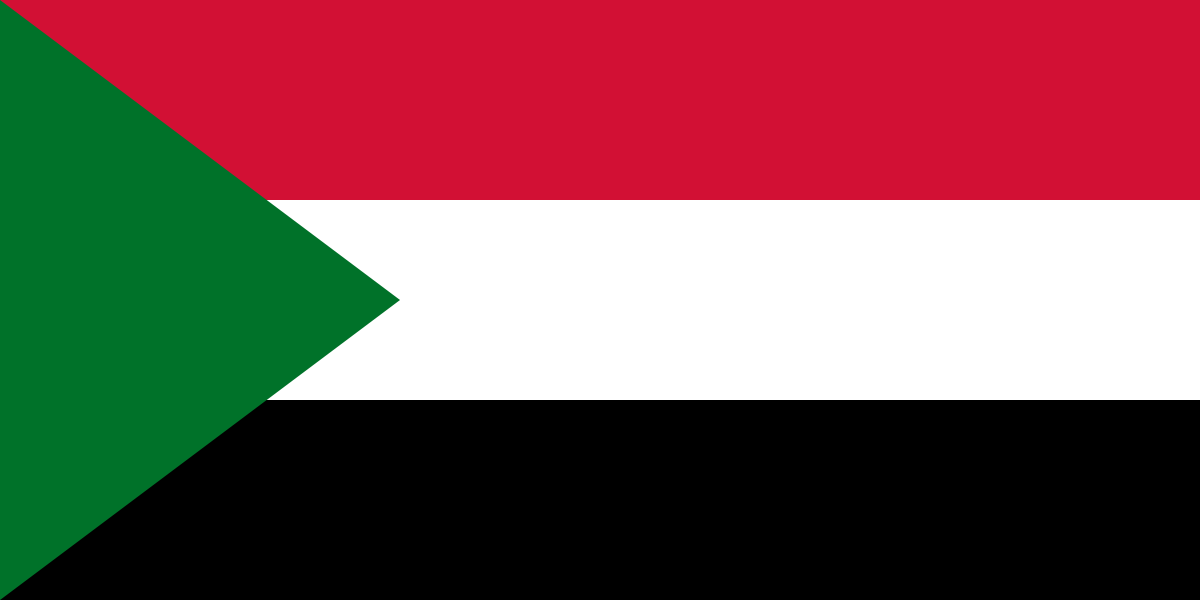

Sudan in the World

Sudan - Introduction 2021
top of pageBackground:
Long referred to as Nubia, modern-day Sudan was the site of the Kingdom of Kerma (ca. 2,500-1500 B.C.) until it was absorbed into the New Kingdom of Egypt. By the 11th century B.C., the Kingdom of Kush gained independence from Egypt; it lasted in various forms until the middle of the fourth century A.D. After the fall of Kush, the Nubians formed three Christian kingdoms of Nobatia, Makuria, and Alodia. The latter two endured until around 1500. Between the 14th and 15th centuries much of Sudan was settled by Arab nomads, and between the 16th–19th centuries it underwent extensive Islamization. Following Egyptian occupation early in the 19th century, the British established an Anglo-Egyptian Sudan - nominally a condominium, but in effect a British colony.
Military regimes favoring Islamic-oriented governments have dominated national politics since Sudan gained independence from Anglo-Egyptian co-rule in 1956. The 30-year reign of President Umar Hassan Ahmad al-BASHIR, following months of nationwide protests, ended with the military forcing him out in April 2019. In October 2021, the Sudanese military deposed Prime Minister HAMDOUK but reinstated him in November 2021. As of December 2021, a joint civilian-military-executive body known as the Sovereign Council rules Sudan; the transitional government has stated it intends to hold elections that result in a civilian led government by early 2024.
During most of the second half of the 20th century, Sudan was embroiled in two prolonged civil wars rooted in northern economic, political, and social domination of the largely non-Muslim, non-Arab southern portion of the country. The first civil war ended in 1972, but another broke out in 1983. Peace talks gained momentum in 2002-04, and the final North/South Comprehensive Peace Agreement (CPA), signed in January 2005, granted the southern rebels autonomy for six years followed by a referendum on independence for Southern Sudan. South Sudan became independent on 9 July 2011, but Sudan and South Sudan have yet to fully implement security and economic agreements relating to the normalization of relations between the two countries.
In the 21st century, Sudan faced conflict in Darfur, Southern Kordofan, and Blue Nile starting in 2003. Together, these conflicts displaced more than 3 million people; while some repatriation has taken place, about 2.28 million IDPs remained in Sudan as of December 2020. Sudan also faces refugee influxes from neighboring countries, primarily Central African Republic, Chad, Eritrea, Ethiopia, and South Sudan.
Military regimes favoring Islamic-oriented governments have dominated national politics since Sudan gained independence from Anglo-Egyptian co-rule in 1956. The 30-year reign of President Umar Hassan Ahmad al-BASHIR, following months of nationwide protests, ended with the military forcing him out in April 2019. In October 2021, the Sudanese military deposed Prime Minister HAMDOUK but reinstated him in November 2021. As of December 2021, a joint civilian-military-executive body known as the Sovereign Council rules Sudan; the transitional government has stated it intends to hold elections that result in a civilian led government by early 2024.
During most of the second half of the 20th century, Sudan was embroiled in two prolonged civil wars rooted in northern economic, political, and social domination of the largely non-Muslim, non-Arab southern portion of the country. The first civil war ended in 1972, but another broke out in 1983. Peace talks gained momentum in 2002-04, and the final North/South Comprehensive Peace Agreement (CPA), signed in January 2005, granted the southern rebels autonomy for six years followed by a referendum on independence for Southern Sudan. South Sudan became independent on 9 July 2011, but Sudan and South Sudan have yet to fully implement security and economic agreements relating to the normalization of relations between the two countries.
In the 21st century, Sudan faced conflict in Darfur, Southern Kordofan, and Blue Nile starting in 2003. Together, these conflicts displaced more than 3 million people; while some repatriation has taken place, about 2.28 million IDPs remained in Sudan as of December 2020. Sudan also faces refugee influxes from neighboring countries, primarily Central African Republic, Chad, Eritrea, Ethiopia, and South Sudan.
Sudan - Geography 2021
top of pageLocation: north-eastern Africa, bordering the Red Sea, between Egypt and Eritrea
Geographic coordinates: 15 00 N, 30 00 E
Map reference: Africa
Area
Total: 1,861,484 km²
Land: 1,731,671 km²
Water: 129,813 km²
Comparative: slightly less than one-fifth the size of the US
Land boundaries
Total: 6,819 km
Border countries: (7) Central African Republic 174 km; , Chad 1403 km; , Egypt 1276 km; , Eritrea 682 km; , Ethiopia 744 km; , Libya 382 km; , South Sudan 2,158 km
Note: Sudan-South Sudan boundary represents 1 January 1956 alignment; final alignment pending negotiations and demarcation; final sovereignty status of Abyei region pending negotiations between Sudan and South Sudan
Coastline: 853 km
Maritime claims
Territorial sea: 12 nm
Contiguouszone: 18 nm
Continental shelf: 200-m depth or to the depth of exploitation
Climate: hot and dry; arid desert; rainy season varies by region (April to November)
Terrain: generally flat, featureless plain; desert dominates the north
Elevation
Highest point: Jabal Marrah 3,042 m
Lowest point: Red Sea 0 m
Mean elevation: 568 m
Natural resources: petroleum; small reserves of iron ore, copper, chromium ore, zinc, tungsten, mica, silver, gold; hydropower
Land use
Land use
Agricultural land: 100% (2018 est.)
Agricultural land arable land: 15.7% (2018 est.)
Agricultural land permanent crops: 0.2% (2018 est.)
Agricultural land permanent pasture: 84.2% (2018 est.)
Forest: 0% (2018 est.)
Other: 0% (2018 est.)
Irrigated land: 18,900 km² (2012)
Major rivers
By length in km: Nile (shared with Rwanda [s], Tanzania, Uganda, South Sudan, and Egypt [m]) - 6,650 km; Blue Nile river mouth (shared with Ethiopia [s]) - 1,600 km
Major watersheds area km²: Atlantic Ocean drainage: (Mediterranean Sea) Nile (3,254,853 km²)
Internal (endorheic basin) drainage: Lake Chad (2,497,738 km²)
Total water withdrawal
Municipal: 950 million cubic meters (2017 est.)
Industrial: 75 million cubic meters (2017 est.)
Agricultural: 25.91 billion cubic meters (2017 est.)
Total renewable water resources: 37.8 billion cubic meters (2017 est.)
Natural hazards: dust storms and periodic persistent droughts
Geography
Note: the Nile is Sudan's primary water source; its major tributaries, the White Nile and the Blue Nile, meet at Khartoum to form the River Nile which flows northward through Egypt to the Mediterranean Sea
Sudan - People 2021
top of pagePopulation
Distribution: with the exception of a ribbon of settlement that corresponds to the banks of the Nile, northern Sudan, which extends into the dry Sahara, is sparsely populated; more abundant vegetation and broader access to water increases population distribution in the south extending habitable range along nearly the entire border with South Sudan; sizeable areas of population are found around Khartoum, southeast between the Blue and White Nile Rivers, and througout South Darfur : 46,751,152 (July 2021 est.)
Growth rate: 2.55% (2021 est.)
Below poverty line: 46.5% (2009 est.)
Nationality
Noun: Sudanese (singular and plural)
Adjective: Sudanese
Ethnic groups: Sudanese Arab (approximately 70%), Fur, Beja, Nuba, Fallata
Languages: Arabic (official), English (official), Nubian, Ta Bedawie, Fur
Major language samples:
كتاب حقائق العالم، المصدر الذي لا يمكن الاستغناء عنه للمعلومات الأساسية (Arabic)
The Gheos World Guide, the indispensable source for basic information. (English)
The Gheos World Guide, the indispensable source for basic information. (English)
Religions: Sunni Muslim, small Christian minority
Demographic profile
Age structure
Age structure
0-14 years: 42.01% (male 9,726,937/female 9,414,988)
15-24 years: 20.94% (male 4,852,903/female 4,687,664)
25-54 years: 29.89% (male 6,633,567/female 6,986,241)
55-64 years: 4.13% (male 956,633/female 923,688)
65 years and over: 3.03% (male 729,214/female 649,721) (2020 est.)
Dependency ratios
Total dependency ratio: 76.9
Youth dependency ratio: 70.4
Elderly dependency ratio: 6.5
Potential support ratio: 15.4 (2020 est.)
Median age
Total: 18.3 years
Male: 18.1 years
Female: 18.5 years (2020 est.)
Population growth rate: 2.55% (2021 est.)
Birth rate: 33.63 births/1000 population (2021 est.)
Death rate: 6.41 deaths/1000 population (2021 est.)
Net migration rate: -1.71 migrant(s)/1000 population (2021 est.)
Population distribution: with the exception of a ribbon of settlement that corresponds to the banks of the Nile, northern Sudan, which extends into the dry Sahara, is sparsely populated; more abundant vegetation and broader access to water increases population distribution in the south extending habitable range along nearly the entire border with South Sudan; sizeable areas of population are found around Khartoum, southeast between the Blue and White Nile Rivers, and througout South Darfur
Urbanization
Urban population: 35.6% of total population (2021)
Rate of urbanization: 3.43% annual rate of change (2020-25 est.)
Major urban areas
Population: 5.989 million KHARTOUM (capital), 967,000 Nyala (2021)
Environment
Current issues: water pollution; inadequate supplies of potable water; water scarcity and periodic drought; wildlife populations threatened by excessive hunting; soil erosion; desertification; deforestation; loss of biodiversity
International agreements party to: Biodiversity, Climate Change, Climate Change-Kyoto Protocol, Climate Change-Paris Agreement, Comprehensive Nuclear Test Ban, Desertification, Endangered Species, Hazardous Wastes, Law of the Sea, Nuclear Test Ban, Ozone Layer Protection, Wetlands
International agreements signed but not ratified: none of the selected agreements
Air pollutants
Particulate matter emissions: 47.92 micrograms per cubic meter (2016 est.)
Carbon dioxide emissions: 20 megatons (2016 est.)
Methane emissions: 75.1 megatons (2020 est.)
Sex ratio
At birth: 1.05 male(s)/female
0-14 years: 1.03 male(s)/female
15-24 years: 1.04 male(s)/female
25-54 years: 0.95 male(s)/female
55-64 years: 1.04 male(s)/female
65 years and over: 1.12 male(s)/female
Total population: 1.01 male(s)/female (2020 est.)
Mothers mean age at first birth
Maternal mortality ratio: 295 deaths/100,000 live births (2017 est.)
Infant mortality rate
Total: 43.15 deaths/1000 live births
Male: 48.66 deaths/1000 live births
Female: 37.36 deaths/1000 live births (2021 est.)
Life expectancy at birth
Total population: 66.79 years
Male: 64.58 years
Female: 69.11 years (2021 est.)
Total fertility rate: 4.66 children born/woman (2021 est.)
Contraceptive prevalence rate: 12.2% (2014)
Drinking water source
Improved urban: 99% of population
Improved rural: 80.7% of population
Improved total: 87% of population
Unimproved urban: 1% of population
Unimproved rural: 19.3% of population
Unimproved total: 13% of population (2017 est.)
Current health expenditure: 4.5% (2018)
Physicians density: 0.26 physicians/1000 population (2017)
Hospital bed density: 0.7 beds/1000 population (2017)
Sanitation facility access
Improved urban: 72.1% of population
Improved rural: 30.6% of population
Improved total: 44.9% of population
Unimproved urban: 27.9% of population
Unimproved rural: 69.4% of population
Unimproved total: 55.1% of population (2017 est.)
Hiv/Aids
Adult prevalence rate: 0.2% (2020 est.)
People living with hivaids: 49,000 (2020 est.)
Deaths: 2,300 (2020 est.)
Major infectious diseases
Degree of risk: very high (2020)
Food or water borne diseases: bacterial and protozoal diarrhea, hepatitis A and E, and typhoid fever
Vector borne diseases: malaria, dengue fever, and Rift Valley fever
Watercontactdiseases: schistosomiasis
Animalcontactdiseases: rabies
Respiratorydiseases: meningococcal meningitis
Obesity adult prevalence rate: 6.6% (2014)
Alcohol consumption
Tobacco use
Children under the age of 5 years underweight: 33% (2014)
Education expenditures: NA
Literacy
Definition: age 15 and over can read and write
Total population: 60.7%
Male: 65.4%
Female: 56.1% (2018)
School life expectancy primary to tertiary education
Total: 8 years
Male: 8 years
Female: 7 years (2015)
Youth unemployment
Rate ages 15-24 total: 32.6%
Rate ages 15-24 male: 27.4%
Rate ages 15-24 female: 43.5% (2011 est.)
Sudan - Government 2021
top of pageCountry name
Conventional long form: Republic of the Sudan
Conventional short form: Sudan
Local long form: Jumhuriyat as-Sudan
Local short form: As-Sudan
Former: Anglo-Egyptian Sudan, Democratic Republic of the Sudan
Etymology: the name 'Sudan' derives from the Arabic 'bilad-as-sudan' meaning 'Land of the Black [peoples]'
Government type: presidential republic
Capital
Name: Khartoum
Geographic coordinates: 15 36 N, 32 32 E
Time difference: UTC+3 (8 hours ahead of Washington, DC, during Standard Time)
Etymology: several explanations of the name exist; two of the more plausible are that it is derived from Arabic 'al-jartum' meaning 'elephant's trunk' or 'hose,' and likely referring to the narrow strip of land extending between the Blue and White Niles; alternatively, the name could derive from the Dinka words 'khar-tuom,' indicating a 'place where rivers meet'
Administrative divisions: 18 states (wilayat, singular - wilayah); Blue Nile, Central Darfur, East Darfur, Gedaref, Gezira, Kassala, Khartoum, North Darfur, North Kordofan, Northern, Red Sea, River Nile, Sennar, South Darfur, South Kordofan, West Darfur, West Kordofan, White Nile
note: the peace accord signed in October 2020 included a protocol to restructure the country's current 18 provinces/states into eight regions
Dependent areas
Independence: 1 January 1956 (from Egypt and the UK)
National holiday: Independence Day, 1 January (1956)
Constitution
History: previous 1973, 1998; 2005 (interim constitution, which was suspended in April 2019); latest initial draft completed by Transitional Military Council in May 2019; revised draft known as the 'Draft Constitutional Charter for the 2019 Transitional Period,' was signed by the Council and opposition coalition on 4 August 2019
Amendments: amended 2020 to incorporate the Juba Agreement for Peace in Sudan
Legal system: mixed legal system of Islamic law and English common law; note - in mid-July 2020, Sudan amended 15 provisions of its 1991 penal code
International law organization participation: accepts compulsory ICJ jurisdiction with reservations; withdrew acceptance of ICCt jurisdiction in 2008
Citizenship
Citizenship by birth: no
Citizenship by descentonly: the father must be a citizen of Sudan
Dual citizenship recognized: no
Residency requirement for naturalization: 10 years
Suffrage: 17 years of age; universal
Executive branch
Chief of state: president (vacant); Sovereign Council Chairman General Abd-al-Fatah al-BURHAN Abd-al-Rahman; note - in August 2019, the ruling military council and civilian opposition alliance signed a power-sharing deal forming a 'Sovereign Council,' which served as a transitional collective chief of state chaired by al-BURHAN; on 25 October 2021, al-BURHAN dissolved the Sovereign Council but subsequently reinstated it on 11 November 2021, serving again as its Chairman; the Sovereign Council currently consists of 5 civilians, 5 generals, and 3 rebel leaders (2021)
Head of government: Prime Minister Abdallah HAMDOUK (since August 2019, reinstated November 2021); note - on 25 October 2021, General Abd-al-Fatah al-BURHAN Abd-al-Rahman dissolved the Sovereign Council and temporarily arrested HAMDOUK until his reinstatement on 21 November 2021 (2021)
Cabinet: Council of Ministers primarily appointed by the prime minister (2021)
Elections and appointments: president directly elected by absolute majority popular vote in 2 rounds if needed; last held on 13-16 April 2015 (next to be held at an undetermined date between July 2023 and January 2024 at the end of the transitional period); prime minister typically appointed by the president; note - the position of prime minister was reinstated in December 2016 as a result of the 2015-16 national dialogue process, and President al-BASHIR appointed BAKRI Hassan Salih to the position on 2 March 2017; on 21 August 2019, the Forces for Freedom and Change, the civilian opposition alliance, named Abdallah HAMDOUK as Prime Minister of Sudan for the transitional period; on 25 October 2021, General Abd-al-Fatah al-BURHAN Abd-al-Rahman dissolved the Sovereign Council and temporarily arrested HAMDOUK until his reinstatement on 21 November 2021 (2021)
Election results: Umar Hassan Ahmad al-BASHIR reelected president; percent of vote - Umar Hassan Ahmad al-BASHIR (NCP) 94.1%, other (15 candidates) 5.9%
Legislative branch
Description: according to the August 2019 Constitutional Decree, which established Sudan's transitional government, the Transitional Legislative Council (TLC) will serve as the national legislature during the transitional period until elections can be held in 2022; as of early December 2019, the TLC had not been established
Elections: Council of State - last held 1 June 2015
National Assembly - last held on 13-15 April 2015
note - elections for an as yet defined new legislature to be held in 2022 at the expiry of the Transnational Legislative Council
Judicial branch
Highest courts: National Supreme Court (consists of 70 judges organized into panels of 3 judges and includes 4 circuits that operate outside the capital); Constitutional Court (consists of 9 justices including the court president); note - the Constitutional Court resides outside the national judiciary
Judge selection and term of office: National Supreme Court and Constitutional Court judges selected by the Supreme Judicial Council, which replaced the National Judicial Service Commission upon enactment of the Draft Constitutional Charter for the 2019 Transitional Period
Subordinate courts: Court of Appeal; other national courts; public courts; district, town, and rural courts
Political parties and leaders: Democratic Unionist Party or DUP [Jalal al-DIGAIR]
Democratic Unionist Party [Muhammad Uthman al-MIRGHANI]
Federal Umma Party [Dr. Ahmed Babikir NAHAR]
Muslim Brotherhood or MB
National Congress Party or NCP (in November 2019, Sudan's transitional government approved a law to 'dismantle' the regime of former President Omar al-Bashir, including the dissolution of his political party, the NCP)
National Umma Party or NUP [Saddiq al-MAHDI]
Popular Congress Party or PCP [Hassan al-TURABI]
Reform Movement Now [Dr. Ghazi Salahuddin al-ATABANI]Sudan National Front [Ali Mahmud HASANAYN]
Sudanese Communist Party or SCP [Mohammed Moktar Al-KHATEEB]
Sudanese Congress Party or SCoP [Ibrahim Al-SHEIKH]
Umma Party for Reform and Development
Unionist Movement Party or UMP
International organization participation: ABEDA, ACP, AfDB, AFESD, AMF, AU, CAEU, COMESA, FAO, G-77, IAEA, IBRD, ICAO, ICC (NGOs), ICRM, IDA, IDB, IFAD, IFC, IFRCS, IGAD, ILO, IMF, IMO, Interpol, IOC, IOM, IPU, ISO, ITSO, ITU, LAS, MIGA, NAM, OIC, OPCW, PCA, UN, UNCTAD, UNESCO, UNHCR, UNIDO, UNWTO, UPU, WCO, WFTU (NGOs), WHO, WIPO, WMO, WTO (observer)
Diplomatic representation
In the us chief of mission: Ambassador Nureldin Mohamed Hamed SATTI (since 17 September 2020)
In the us chancery: 2,210 Massachusetts Avenue NW, Washington, DC 20,008
In the us telephone: [1] (202) 338-8,565
In the us FAX: [1] (202) 667-2,406
In the us email address and website:
consular@sudanembassy.org
[link]
[link]
From the us chief of mission: Ambassador (vacant); Charge d'Affaires Brian SHUKAN (since October 2019)
From the us embassy: P.O. Box 699, Kilo 10, Soba, Khartoum
From the us mailing address: 2,200 Khartoum Place, Washington DC 20,521-2,200
From the us telephone: [249] 187-0-22,000
From the us email address and website:
ACSKhartoum@state.gov
[link]
[link]
Flag description: three equal horizontal bands of red (top), white, and black with a green isosceles triangle based on the hoist side; colors and design based on the Arab Revolt flag of World War I, but the meanings of the colors are expressed as follows: red signifies the struggle for freedom, white is the color of peace, light, and love, black represents the people of Sudan (in Arabic 'Sudan' means black), green is the color of Islam, agriculture, and prosperity
National symbols: secretary bird; national colors: red, white, black, green
National anthem
Name: 'Nahnu Djundulla Djundulwatan' (We Are the Army of God and of Our Land)
Lyrics and music: Sayed Ahmad Muhammad SALIH/Ahmad MURJAN
Note: adopted 1956; originally served as the anthem of the Sudanese military
National heritage
Sudan - Economy 2021
top of pageEconomy overview
Real gdp purchasing power parity:
$176.4 billion - note: data are in 2017 dollars (2020 est.)
$179.2 billion - note: data are in 2017 dollars (2019 est.)
$181.61 billion - note: data are in 2017 dollars (2018 est.)
$179.2 billion - note: data are in 2017 dollars (2019 est.)
$181.61 billion - note: data are in 2017 dollars (2018 est.)
Note: data are in 2010 dollars
Real gdp growth rate: 1.4% (2017 est.)
3% (2016 est.)
1.3% (2015 est.)
Real gdp per capita:
$4,000 - note: data are in 2017 dollars (2020 est.)
$4,200 - note: data are in 2017 dollars (2019 est.)
$4,300 - note: data are in 2017 dollars (2018 est.)
$4,200 - note: data are in 2017 dollars (2019 est.)
$4,300 - note: data are in 2017 dollars (2018 est.)
Note: data are in 2010 dollars
Gross national saving
Gdp composition by sector of origin
Gdp composition by end use
Household consumption: 77.3% (2017 est.)
Government consumption: 5.8% (2017 est.)
Investment in fixed capital: 18.4% (2017 est.)
Investment in inventories: 0.6% (2017 est.)
Exports of goods and services: 9.7% (2017 est.)
Imports of goods and services: -11.8% (2017 est.)
Gdp composition by sector of origin
Agriculture: 39.6% (2017 est.)
Industry: 2.6% (2017 est.)
Services: 57.8% (2017 est.)
Agriculture products: sugar cane, sorghum, milk, groundnuts, onions, sesame seed, goat milk, millet, bananas, wheat
Industries: oil, cotton ginning, textiles, cement, edible oils, sugar, soap distilling, shoes, petroleum refining, pharmaceuticals, armaments, automobile/light truck assembly, milling
Industrial production growth rate: 4.5% (2017 est.)
Labor force: 11.92 million (2007 est.)
By occupation agriculture: 80%
By occupation industry: 7%
By occupation services: 13% (1998 est.)
Labor force
Unemployment rate: 19.6% (2017 est.)
20.6% (2016 est.)
Youth unemployment
Rate ages 15-24 total: 32.6%
Rate ages 15-24 male: 27.4%
Rate ages 15-24 female: 43.5% (2011 est.)
Population below poverty line: 46.5% (2009 est.)
Gini index
Coefficient distribution of family income: 34.2 (2014 est.)
Household income or consumption by percentage share
Lowest 10: 2.7%
Highest 10: 26.7% (2009 est.)
Distribution of family income gini index
Budget
Revenues: $8.48 billion (2017 est.)
Expenditures: $13.36 billion (2017 est.)
Surplus or deficit: $-10.6% (of GDP) (2017 est.)
Taxes and other revenues: 18.5% (of GDP) (2017 est.)
Public debt: 121.6% of GDP (2017 est.)
99.5% of GDP (2016 est.)
Revenue
From forest resources forest revenues: 3.01% of GDP (2018 est.)
From coal coal revenues: 0% of GDP (2018 est.)
Fiscal year: calendar year
Inflation rate consumer prices: 50.2% (2019 est.)
62.8% (2018 est.)
32.5% (2017 est.)
Central bank discount rate
Commercial bank prime lending rate
Stock of narrow money
Stock of broad money
Stock of domestic credit
Market value of publicly traded shares
Current account balance: -$4.811 billion (2017 est.)
-$4.213 billion (2016 est.)
Exports: $5.11 billion note: data are in current year dollars (2019 est.)
$5 billion note: data are in current year dollars (2018 est.)
Partners: United Arab Emirates 31%, China 19%, Saudi Arabia 14%, India 12%, Egypt 5% (2019)
Commodities: gold, crude petroleum, sesame seeds, sheep, goats, cotton, ground nuts (2019)
Imports: $9.79 billion note: data are in current year dollars (2019 est.)
$8.24 billion note: data are in current year dollars (2018 est.)
Partners: China 31%, India 14%, United Arab Emirates 11%, Egypt 6% (2019)
Commodities: raw sugar, wheat, packaged medicines, jewelry, tires, cars and vehicle parts (2019)
Reserves of foreign exchange and gold: $198 million (31 December 2017 est.)
$168.3 million (31 December 2016 est.)
Debt external: $56.05 billion (31 December 2017 est.)
$51.26 billion (31 December 2016 est.)
Stock of direct foreign investment at home
Stock of direct foreign investment abroad
Exchange rates:
Sudanese pounds (SDG) per US dollar
6.72 (2017 est.)
6.14 (2016 est.)
6.14 (2015 est.)
6.03 (2014 est.)
5.74 (2013 est.)
6.72 (2017 est.)
6.14 (2016 est.)
6.14 (2015 est.)
6.03 (2014 est.)
5.74 (2013 est.)
Sudan - Energy 2021
top of pageElectricity
Access electrification total population: 47% (2019)
Access electrification urban areas: 71% (2019)
Access electrification rural areas: 35% (2019)
Production: 13.99 billion kWh (2016 est.)
Consumption: 12.12 billion kWh (2016 est.)
Exports: 0 kWh (2016 est.)
Imports: 0 kWh (2016 est.)
Installed generating capacity: 3.437 million kW (2016 est.)
Generation sources fossil fuels: 44% of total installed capacity (2016 est.)
Generation sources nuclear: 0% of total installed capacity (2017 est.)
Generation sources hydroelectricity: 51% of total installed capacity (2017 est.)
Generation sources other renewable sources: 6% of total installed capacity (2017 est.)
Coal
Petroleum
Petroleum total petroleum production: 95,000 bbl/day (2018 est.)
Crude oil exports: 19,540 bbl/day (2015 est.)
Crude oil imports: 9,440 bbl/day (2015 est.)
Crude oil proven reserves: 5 billion bbl (1 January 2018 est.)
Crude oil
Refined petroleum
Products production: 94,830 bbl/day (2015 est.)
Products consumption: 112,000 bbl/day (2016 est.)
Products exports: 8,541 bbl/day (2015 est.)
Products imports: 24,340 bbl/day (2015 est.)
Natural gas
Production: 0 m³ (2017 est.)
Consumption: 0 m³ (2017 est.)
Exports: 0 m³ (2017 est.)
Imports: 0 m³ (2017 est.)
Proven reserves: 84.95 billion m³ (1 January 2018 est.)
Carbon dioxide emissions
Energy consumption per capita
Sudan - Communication 2021
top of pageTelephones
Fixed lines total subscriptions: 129,408 (2020)
Fixed lines subscriptions per 100 inhabitants: less than 1 (2020 est.)
Mobile cellular total subscriptions: 35,195,207 (2020)
Mobile cellular subscriptions per 100 inhabitants: 80.26 (2020 est.)
Telephone system
Broadcast media: the Sudanese Government directly controls TV and radio, requiring that both media reflect government policies; TV has a permanent military censor (2019)
Internet
Country code: .sd
Users total: 13.7 million (2021 est.)
Users percent of population: 30.87% (2019 est.)
Broadband fixed subscriptions
Total: 28,782 (2020)
Subscriptions per 100 inhabitants: less than 1 (2018 est.)
Sudan - Military 2021
top of pageMilitary expenditures: 1.1% of GDP (2020 est.)
1.7% of GDP (2019 est.)
2.3% of GDP (2018 est.)
3.5% of GDP (2017 est.)
2.9% of GDP (2016 est.)
Military and security forces:
Sudanese Armed Forces (SAF): Ground Force, Navy, Sudanese Air Force; Rapid Support Forces (RSF); Reserve Department (formerly the paramilitary Popular Defense Forces); Border Guards (Ministry of Defense)
Ministry of Interior: security police, special forces police, traffic police, and the combat-trained Central Reserve Police (2021)
note - the RSF is a semi-autonomous paramilitary force formed in 2013 to fight armed rebel groups in Sudan, with Mohammed Hamdan DAGALO (aka Hemeti) as its commander (he is also Deputy Chairman of the Sovereign Council); it was initially placed under the National Intelligence and Security Service, then came under the direct command of former president Omar al-BASHIR, who boosted the RSF as his own personal security force; the RSF has been accused of committing rights abuses against civilians; it is also reportedly involved in business enterprises, such as gold mining; in late 2019, Sovereign Council Chairman and SAF Commander-in-Chief General Abd-al-Fatah al-BURHAN said the RSF would be fully integrated into the SAF, but did not give a timeline
Ministry of Interior: security police, special forces police, traffic police, and the combat-trained Central Reserve Police (2021)
note - the RSF is a semi-autonomous paramilitary force formed in 2013 to fight armed rebel groups in Sudan, with Mohammed Hamdan DAGALO (aka Hemeti) as its commander (he is also Deputy Chairman of the Sovereign Council); it was initially placed under the National Intelligence and Security Service, then came under the direct command of former president Omar al-BASHIR, who boosted the RSF as his own personal security force; the RSF has been accused of committing rights abuses against civilians; it is also reportedly involved in business enterprises, such as gold mining; in late 2019, Sovereign Council Chairman and SAF Commander-in-Chief General Abd-al-Fatah al-BURHAN said the RSF would be fully integrated into the SAF, but did not give a timeline
Military service age and obligation: 18-33 years of age for male and female compulsory or voluntary military service; 1-2 year service obligation (2021)
Space program
Terrorist groups: Islamic State of Iraq and ash-Sham (ISIS), al-Qa’ida, Harakat Sawa’d Misr
Sudan - Transportation 2021
top of pageNational air transport system
Number of registered air carriers: 9 (2020)
Inventory of registered aircraft operated by air carriers: 42
Annual passenger traffic on registered air carriers: 269,958 (2018)
Civil aircraft registration country code prefix: ST
Airports
Total: 67 (2020)
With paved runways total: 17
With paved runways over 3047 m: 2
With paved runways 2438 to 3047 m: 11
With paved runways 15-24 to 2437 m: 2
With paved runways 914 to 1523 m: 1
With paved runways under 914 m: 1 (2020)
With unpaved runways total: 50
With unpaved runways 15-24 to 2437 m: 17
With unpaved runways 914 to 1523 m: 24
With unpaved runways under 914 m: 9 (2020)
Heliports: 7 (2020)
Pipelines: 156 km gas, 4,070 km oil, 1613 km refined products (2013)
Railways
Total: 7,251 km (2014)
Narrowgauge: 5,851 km 1.067-m gauge (2014)
Roadways
Total: 31,000 km (2019)
Paved: 8,000 km (2019)
Unpaved: 23,000 km (2019)
Urban: 1,000 km (2019)
Waterways: 4,068 km (1,723 km open year-round on White and Blue Nile Rivers) (2011)
Merchant marine
Total: 15
By type: other 15 (2021)
Ports and terminals
Major seaport: Port Sudan
Sudan - Transnational issues 2021
top of pageDisputes international: the effects of Sudan's ethnic and rebel militia fighting since the mid-20th century have penetrated all of the neighboring states; Chad wishes to be a helpful mediator in resolving the Darfur conflict, and in 2010 established a joint border monitoring force with Sudan, which has helped to reduce cross-border banditry and violence; civil unrest in eastern Sudan has hampered efforts to demarcate the porous boundary with Ethiopia; as of early 2019, more than 590,000 Sudanese refugees are being hosted in the Central African Republic, Chad, Egypt, Ethiopia, Kenya, and South Sudan; Sudan, in turn, is hosting more than 975,000 refugees and asylum seekers, including more than 845,000 from South Sudan; Sudan accuses South Sudan of supporting Sudanese rebel groups; Sudan claims but Egypt de facto administers security and economic development of the Halaib region north of the 22nd parallel boundary; periodic violent skirmishes with Sudanese residents over water and grazing rights persist among related pastoral populations along the border with the Central African Republic; South Sudan-Sudan boundary represents 1 January 1956 alignment, final alignment pending negotiations and demarcation; final sovereignty status of Abyei Area pending negotiations between South Sudan and Sudan
Refugees and internally displaced persons
Refugees country of origin: 798,406 (South Sudan) (refugees and asylum seekers), 125,997 (Eritrea) (refugees and asylum seekers), 93,483 (Syria) (refugees and asylum seekers), 71,993 (Ethiopia) (refugees and asylum seekers), 27,610 (Central African Republic) (2021)
IDPs: 2,276,000 (civil war 1983-2005; ongoing conflict in Darfur region; government and rebel fighting along South Sudan border; inter-tribal clashes) (2020)
Illicit drugs

