Statistical information Mauritius 2022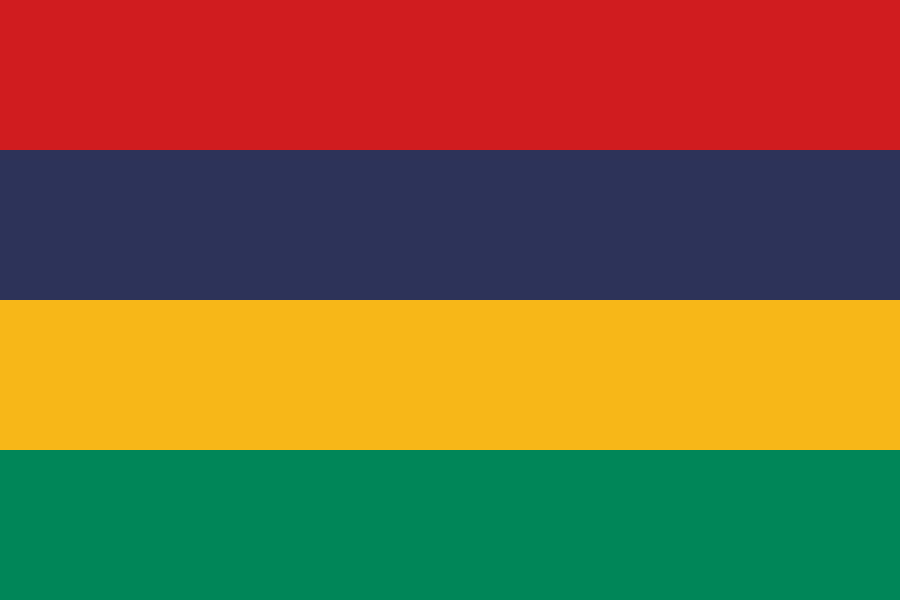

Mauritius in the World

Mauritius - Introduction 2022
top of pageBackground: Although known to Arab and European sailors since at least the early 1500s, the island of Mauritius was uninhabited until 1638 when the Dutch established a settlement named in honor of Prince Maurits van NASSAU. Their presence led to the rapid disappearance of the flightless dodo bird that has since become one of the most well-known examples of extinction in modern times. The Dutch abandoned their financially distressed settlement in 1710, although a number of formerly enslaved people remained. In 1722, the French established what would become a highly profitable settlement focused on sugar cane plantations that were reliant on the labor of enslaved people brought to Mauritius from other parts of Africa. In the 1790s, the island had a brief period of autonomous rule when plantation owners rejected French control because of laws ending slavery that were temporarily in effect during the French Revolution. Britain captured the Island in 1810 as part of the Napoleonic Wars but kept most of the French administrative structure, which remains to this day in the form of the country’s legal codes and widespread use of the French Creole language. The abolition of slavery in 1835 - later than most other British colonies - led to increased reliance on contracted laborers from the Indian subcontinent to work on plantations. Today their descendants form the majority of the population. Mauritius remained a strategically important British naval base, and later an air station, playing a role during World War II for anti-submarine and convoy operations, as well as for the collection of signals intelligence.
Mauritius - Geography 2022
top of pageLocation: Southern Africa, island in the Indian Ocean, about 800 km (500 mi) east of Madagascar
Geographic coordinates: 20 17 S, 57 33 E
Map reference: Africa
Area
Total: 2,040 km²
Land: 2,030 km²
Water: 10 km²
Note: includes Agalega Islands, Cargados Carajos Shoals (Saint Brandon), and Rodrigues
Comparative: almost 11 times the size of Washington, DC
Land boundaries
Total: 0 km
Coastline: 177 km
Maritime claims
Territorial sea: 12 nm
Exclusive economic zone: 200 nm
Continental shelf:
200 nm or to the edge of the continental margin
measured from claimed archipelagic straight baselines
measured from claimed archipelagic straight baselines
Climate: tropical, modified by southeast trade winds; warm, dry winter (May to November); hot, wet, humid summer (November to May)
Terrain: small coastal plain rising to discontinuous mountains encircling central plateau
Elevation
Highest point: Mont Piton 828 m
Lowest point: Indian Ocean 0 m
Natural resources: arable land, fish
Land use
Land use
Agricultural land: 43.8% (2018 est.)
arable land: 38.4% (2018 est.)
permanent crops: 2% (2018 est.)
permanent pasture: 3.4% (2018 est.)
permanent crops: 2% (2018 est.)
permanent pasture: 3.4% (2018 est.)
Forest: 17.3% (2018 est.)
Other: 38.9% (2018 est.)
Irrigated land: 158 km² (2020)
Major rivers
Major watersheds area km²
Total water withdrawal
Municipal: 260 million cubic meters (2017 est.)
Industrial: 12 million cubic meters (2017 est.)
Agricultural: 344 million cubic meters (2017 est.)
Total renewable water resources: 2.751 billion cubic meters (2017 est.)
Natural hazards: cyclones (November to April); almost completely surrounded by reefs that may pose maritime hazards
Geography
Note: the main island, from which the country derives its name, is of volcanic origin and is almost entirely surrounded by coral reefs; former home of the dodo, a large flightless bird related to pigeons, driven to extinction by the end of the 17th century through a combination of hunting and the introduction of predatory species
Mauritius - People 2022
top of pagePopulation
Distribution: population density is one of the highest in the world; urban clusters are found throughout the main island, with a greater density in and around Port Luis; population on Rodrigues Island is spread across the island with a slightly denser cluster on the north coast : 1,308,222 (2022 est.)
Growth rate: 0.1% (2022 est.)
Below poverty line: 10.3% (2017 est.)
Nationality
Noun: Mauritian(s)
Adjective: Mauritian
Ethnic groups: Indo-Mauritian (compose approximately two thirds of the total population), Creole, Sino-Mauritian, Franco-Mauritian
Note: Mauritius has not had a question on ethnicity on its national census since 1972
Languages: Creole 86.5%, Bhojpuri 5.3%, French 4.1%, two languages 1.4%, other 2.6% (includes English, one of the two official languages of the National Assembly, which is spoken by less than 1% of the population), unspecified 0.1% (2011 est.)
Religions: Hindu 48.5%, Roman Catholic 26.3%, Muslim 17.3%, other Christian 6.4%, other 0.6%, none 0.7%, unspecified 0.1% (2011 est.)
Demographic profile: Mauritius has transitioned from a country of high fertility and high mortality rates in the 1950s and mid-1960s to one with among the lowest population growth rates in the developing world today. After World War II, Mauritius’ population began to expand quickly due to increased fertility and a dramatic drop in mortality rates as a result of improved health care and the eradication of malaria. This period of heightened population growth - reaching about 3% a year - was followed by one of the world’s most rapid birth rate declines.
Age structure
Age structure
0-14 years: 19.44% (male 137,010/female 131,113)
15-24 years: 14.06% (male 98,480/female 95,472)
25-54 years: 43.11% (male 297,527/female 297,158)
55-64 years: 12.31% (male 80,952/female 88,785)
65 years and over: 11.08% (male 63,230/female 89,638) (2020 est.)
Dependency ratios
Total dependency ratio: 40.7
Youth dependency ratio: 23.4
Elderly dependency ratio: 17.3
Potential support ratio: 5.8 (2021 est.)
Median age
Total: 36.3 years
Male: 35 years
Female: 37.6 years (2020 est.)
Population growth rate: 0.1% (2022 est.)
Birth rate: 9.86 births/1000 population (2022 est.)
Death rate: 8.86 deaths/1000 population (2022 est.)
Net migration rate: 0 migrant(s)/1000 population (2022 est.)
Population distribution: population density is one of the highest in the world; urban clusters are found throughout the main island, with a greater density in and around Port Luis; population on Rodrigues Island is spread across the island with a slightly denser cluster on the north coast
Urbanization
Urban population: 40.9% of total population (2023)
Rate of urbanization: 0.28% annual rate of change (2020-25 est.)
Major urban areas
Population: 149,000 PORT LOUIS (capital) (2018)
Environment
Current issues: water pollution, degradation of coral reefs; soil erosion; wildlife preservation; solid waste disposal
International agreements party to: Antarctic-Marine Living Resources, Biodiversity, Climate Change, Climate Change-Kyoto Protocol, Climate Change-Paris Agreement, Desertification, Endangered Species, Environmental Modification, Hazardous Wastes, Law of the Sea, Marine Life Conservation, Nuclear Test Ban, Ozone Layer Protection, Ship Pollution, Wetlands
International agreements signed but not ratified: none of the selected agreements
Air pollutants
Particulate matter emissions: 13.54 micrograms per cubic meter (2016 est.)
Carbon dioxide emissions: 4.35 megatons (2016 est.)
Methane emissions: 2.06 megatons (2020 est.)
Sex ratio
At birth: 1.07 male(s)/female
0-14 years: 1.05 male(s)/female
15-24 years: 1.03 male(s)/female
25-54 years: 1 male(s)/female
55-64 years: 0.9 male(s)/female
65 years and over: 0.47 male(s)/female
Total population: 0.95 male(s)/female (2022 est.)
Mothers mean age at first birth
Maternal mortality ratio: 61 deaths/100,000 live births (2017 est.)
Infant mortality rate
Total: 12.08 deaths/1000 live births
Male: 13.63 deaths/1000 live births
Female: 10.43 deaths/1000 live births (2022 est.)
Life expectancy at birth
Total population: 74.86 years
Male: 72.04 years
Female: 77.88 years (2022 est.)
Total fertility rate: 1.35 children born/woman (2022 est.)
Contraceptive prevalence rate: 63.8% (2014)
Drinking water source
Improved:
urban: 99.9% of population
rural: 99.8% of population
total: 99.9% of population
rural: 99.8% of population
total: 99.9% of population
Unimproved:
urban: 0.1% of population
rural: 0.2% of population
total: 0.1% of population (2020 est.)
rural: 0.2% of population
total: 0.1% of population (2020 est.)
Current health expenditure: 6.2% of GDP (2019)
Physicians density: 2.71 physicians/1000 population (2020)
Hospital bed density: 3.7 beds/1000 population (2020)
Sanitation facility access
Improved:
urban: 99.9% of population
rural: NA
total: NA
rural: NA
total: NA
Unimproved:
urban: 0.1% of population
rural: NA
total: (2020 est.) NA
rural: NA
total: (2020 est.) NA
Hiv/Aids
Adult prevalence rate: 1.4% (2021 est.)
Major infectious diseases
Obesity adult prevalence rate: 10.8% (2016)
Alcohol consumption
Per capita total: 3.39 liters of pure alcohol (2019 est.)
Per capita beer: 1.94 liters of pure alcohol (2019 est.)
Per capita wine: 0.23 liters of pure alcohol (2019 est.)
Per capita spirits: 0.88 liters of pure alcohol (2019 est.)
Per capita other alcohols: 0.03 liters of pure alcohol (2019 est.)
Tobacco use
Total: 20.2% (2020 est.)
Male: 37.3% (2020 est.)
Female: 3% (2020 est.)
Children under the age of 5 years underweight: NA
Education expenditures: 4.9% of GDP (2021 est.)
Literacy
Definition: age 15 and over can read and write
Total population: 91.3%
Male: 93.4%
Female: 89.4% (2018)
School life expectancy primary to tertiary education
Total: 15 years
Male: 14 years
Female: 16 years (2017)
Youth unemployment
Rate ages 15-24 total: 24.5%
Rate ages 15-24 male: 21.7%
Rate ages 15-24 female: 28% (2020 est.)
Mauritius - Government 2022
top of pageCountry name
Conventional long form: Republic of Mauritius
Conventional short form: Mauritius
Local long form: Republic of Mauritius
Local short form: Mauritius
Etymology: island named after Prince Maurice VAN NASSAU, stadtholder of the Dutch Republic, in 1598
Note: pronounced mah-rish-us
Government type: parliamentary republic
Capital
Name: Port Louis
Geographic coordinates: 20 09 S, 57 29 E
Time difference: UTC+4 (9 hours ahead of Washington, DC, during Standard Time)
Etymology: named after LOUIS XV, who was king of France in 1736 when the port became the administrative center of Mauritius and a major reprovisioning stop for French ships traveling between Europe and Asia
Administrative divisions: 9 districts and 3 dependencies*; Agalega Islands*, Black River, Cargados Carajos Shoals*, Flacq, Grand Port, Moka, Pamplemousses, Plaines Wilhems, Port Louis, Riviere du Rempart, Rodrigues*, Savanne
Dependent areas
Independence: 12 March 1968 (from the UK)
National holiday: Independence and Republic Day, 12 March (1968 & 1992); note - became independent and a republic on the same date in 1968 and 1992 respectively
Constitution
History: several previous; latest adopted 12 March 1968
Amendments: proposed by the National Assembly; passage of amendments affecting constitutional articles, including the sovereignty of the state, fundamental rights and freedoms, citizenship, or the branches of government, requires approval in a referendum by at least three-fourths majority of voters followed by a unanimous vote by the Assembly; passage of other amendments requires only two-thirds majority vote by the Assembly; amended many times, last in 2016
Legal system: civil legal system based on French civil law with some elements of English common law
International law organization participation: accepts compulsory ICJ jurisdiction with reservations; accepts ICCt jurisdiction
Citizenship
Citizenship by birth: yes
Citizenship by descentonly: yes
Dual citizenship recognized: yes
Residency requirement for naturalization: 5 out of the previous 7 years including the last 12 months
Suffrage: 18 years of age; universal
Executive branch
Chief of state: President Pritivirajsing ROOPUN (since 2 December 2019); Vice President Marie Cyril EDDY Boissézon (since 2 December 2019); note - President Ameenah GURIB-FAKIM, the country's first female president, resigned on 23 March 2018 amid a credit card scandal; Acting Presidents served from March 2018 until ROOPUN's appointment in 2019
Head of government: Prime Minister Pravind JUGNAUTH (since 23 January 2017); note - Prime Minister Sir Anerood JUGNAUTH stepped down on 23 January 2017 in favor of his son, Pravind Kumar JUGNAUTH, who was then appointed prime minister; following 7 November 2019 parliamentary elections, Pravind JUGNAUTH remained prime minister and home affairs minister and also became defense minister
Cabinet: Cabinet of Ministers (Council of Ministers) appointed by the president on the recommendation of the prime minister
Elections and appointments: president and vice president indirectly elected by the National Assembly for 5-year renewable terms; election last held on 7 November 2019 (next to be held in 2024); the president appoints the prime minister and deputy prime minister who have the majority support in the National Assembly
Election results: 2019: Pritivirajsing ROOPUN (MSM) Legislative branch
Description: unicameral National Assembly or Assemblee Nationale (70 seats maximum; 62 members directly elected multi-seat constituencies by simple majority vote and up to 8 seats allocated to non-elected party candidates by the Office of Electoral Commissioner; members serve a 5-year term)
Elections: last held on 7 November 2019 (next to be held by late 2024)
Election results: percent of vote by party - Mauritian Alliance 2019 (MSM, ML, MAG, and PM) 37.7%, National Alliance (PTR, PMSD, and MJCB) 32.8%, MMM 20.6%, OPR 1%, Other 7.9%; elected seats by party as of November 2019 - the Militant Socialist Movement (MSM) 38 seats, the Mauritius Labour Party (PTR) or (MLP) 14, Mauritian Militant Movement (MMM) 8, and the Rodrigues People's Organization (OPR) 2; composition as of July 2022 - men 56, women 14, percent of women 20% (2019)
Judicial branch
Highest courts: Supreme Court of Mauritius (consists of the chief justice, a senior puisne judge, and 24 puisne judges); note - the Judicial Committee of the Privy Council (in London) serves as the final court of appeal
Judge selection and term of office: chief justice appointed by the president after consultation with the prime minister; senior puisne judge appointed by the president with the advice of the chief justice; other puisne judges appointed by the president with the advice of the Judicial and Legal Commission, a 4-member body of judicial officials including the chief justice; all judges serve until retirement at age 67
Subordinate courts: lower regional courts known as District Courts, Court of Civil Appeal; Court of Criminal Appeal; Public Bodies Appeal Tribunal
Political parties and leaders: Alliance Morisien (Mauritian Alliance 2019; coalition includes PM, MSM, ML, and MAG) [Pravind JUGNAUTH]
Jean-Claude Barbier Movement (Mouvement Jean-Claude Barbier) or MJCB [Jean-Claude Barbier]
Mauritian Militant Movement (Mouvement Militant Mauricien) or MMM [Paul BERENGER]
Mauritian Social Democratic Party (Parti Mauricien Social Democrate) or PMSD [Xavier Luc DUVAL]
Mauritius Labor Party (Parti Travailliste) or PTR or MLP [Navinchandra RAMGOOLAM]
Militant Platform or PM (Plateforme Militante) [Steven OBEEGADOO]
Militant Socialist Movement (Mouvement Socialist Mauricien) or MSM [Pravind JUGNAUTH]
Muvman Liberater or ML [Ivan COLLENDAVELLOO]
National Alliance (coalition includes PTR, PMSD, and MJCB) [Navinchandra RAMGOOLAM]
Patriotic Movement (Mouvement Patriotique) or MAG [Alan GANOO]
Rodrigues Peoples Organization (Organisation du Peuple Rodriguais) or OPR [Serge CLAIR]
International organization participation: ACP, AfDB, AOSIS, AU, C, CD, COMESA, CPLP (associate), FAO, G-77, IAEA, IBRD, ICAO, ICC (NGOs), ICCt, ICRM, IDA, IFAD, IFC, IFRCS, IHO, ILO, IMF, IMO, IMSO, InOC, Interpol, IOC, IOM, IPU, ISO, ITSO, ITU, ITUC (NGOs), MIGA, NAM, OIF, OPCW, PCA, SAARC (observer), SADC, UN, UNCTAD, UNESCO, UNIDO, UNWTO, UPU, WCO, WFTU (NGOs), WHO, WIPO, WMO, WTO
Diplomatic representation
In the us chief of mission: Ambassador [link]

