Statistical information Ukraine 2022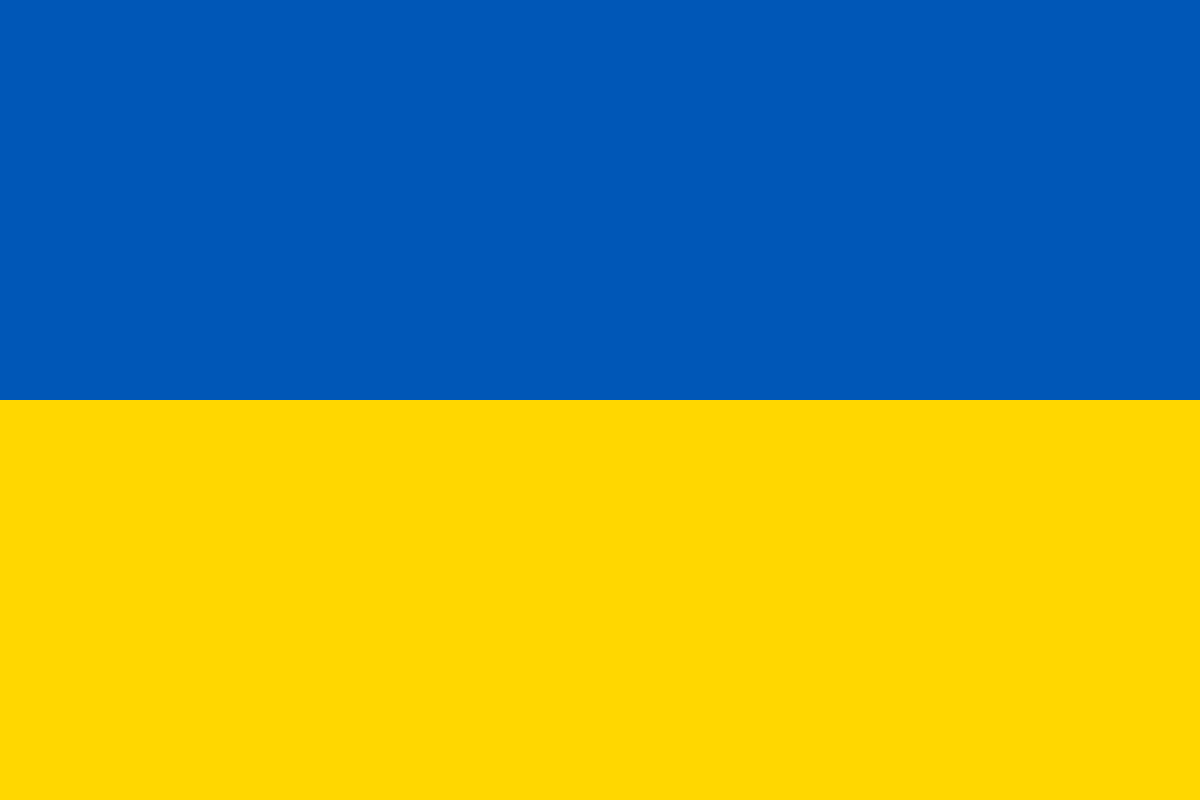

Ukraine in the World

Ukraine - Introduction 2022
top of pageBackground: Ukraine was the center of the first eastern Slavic state, Kyivan Rus, which during the 10th and 11th centuries was the largest and most powerful state in Europe. Weakened by internecine quarrels and Mongol invasions, Kyivan Rus was incorporated into the Grand Duchy of Lithuania and eventually into the Polish-Lithuanian Commonwealth. The cultural and religious legacy of Kyivan Rus laid the foundation for Ukrainian nationalism through subsequent centuries. A new Ukrainian state, the Cossack Hetmanate, was established during the mid-17th century after an uprising against the Poles. Despite continuous Muscovite pressure, the Hetmanate managed to remain autonomous for well over 100 years. During the latter part of the 18th century, most Ukrainian ethnographic territory was absorbed by the Russian Empire. Following the collapse of czarist Russia in 1917, Ukraine achieved a short-lived period of independence (1917-20) but was reconquered and endured a brutal Soviet rule that engineered two forced famines (1921-22 and 1932-33) in which over 8 million died. In World War II, German and Soviet armies were responsible for 7 to 8 million more deaths. Although Ukraine achieved independence in 1991 with the dissolution of the USSR, democracy and prosperity remained elusive as the legacy of state control and endemic corruption stalled efforts at economic reform, privatization, and civil liberties.
Ukraine - Geography 2022
top of pageLocation: Eastern Europe, bordering the Black Sea, between Poland, Romania, and Moldova in the west and Russia in the east
Geographic coordinates: 49 00 N, 32 00 E
Map reference: AsiaEurope
Area
Total: 603,550 km²
Land: 579,330 km²
Water: 24,220 km²
Note: approximately 43,133 km², or about 7.1% of Ukraine's area, is Russian occupied; the seized area includes all of Crimea and about one-third of both Luhans'k and Donets'k oblasts
Comparative: almost four times the size of Georgia; slightly smaller than Texas
Land boundaries
Total: 5,581 km
Border countries: (7) Belarus 1,111 km; Hungary 128 km; Moldova 1,202 km; Poland 498 km; Romania 601 km; Russia 1,944 km; , Slovakia 97 km
Coastline: 2,782 km
Maritime claims
Territorial sea: 12 nm
Exclusive economic zone: 200 nm
Continental shelf: 200 m or to the depth of exploitation
Climate: temperate continental; Mediterranean only on the southern Crimean coast; precipitation disproportionately distributed, highest in west and north, lesser in east and southeast; winters vary from cool along the Black Sea to cold farther inland; warm summers across the greater part of the country, hot in the south
Terrain: mostly fertile plains (steppes) and plateaus, with mountains found only in the west (the Carpathians) or in the extreme south of the Crimean Peninsula
Elevation
Highest point: Hora Hoverla 2,061 m
Lowest point: Black Sea 0 m
Mean elevation: 175 m
Natural resources: iron ore, coal, manganese, natural gas, oil, salt, sulfur, graphite, titanium, magnesium, kaolin, nickel, mercury, timber, arable land
Land use
Land use
Agricultural land: 71.2% (2018 est.)
arable land: 56.1% (2018 est.)
permanent crops: 1.5% (2018 est.)
permanent pasture: 13.6% (2018 est.)
permanent crops: 1.5% (2018 est.)
permanent pasture: 13.6% (2018 est.)
Forest: 16.8% (2018 est.)
Other: 12% (2018 est.)
Irrigated land: 4,350 km² (2020)
Major rivers
By length in km: Danube (shared with Germany [s], Austria, Slovakia, Czechia, Hungary, Croatia, Serbia, Bulgaria, Moldova, and Romania [m]) - 2,888 km; Dnieper river mouth (shared with Russia [s] and Belarus) - 2,287 km; Dniester river source and mouth (shared with Moldova) - 1,411 km; Vistula (shared with Poland [s/m] and Belarus) - 1,213 km
Major watersheds area km²: Atlantic Ocean drainage: (Black Sea) Danube (795,656 km²), Don (458,694 km²), Dnieper (533,966 km²)
Total water withdrawal
Municipal: 2.397 billion cubic meters (2017 est.)
Industrial: 3.577 billion cubic meters (2017 est.)
Agricultural: 3.206 billion cubic meters (2017 est.)
Total renewable water resources: 175.28 billion cubic meters (2017 est.)
Natural hazards: occasional floods; occasional droughts
Geography
Note: strategic position at the crossroads between Europe and Asia; second-largest country in Europe after Russia
Ukraine - People 2022
top of pagePopulation
Distribution: densest settlement in the eastern (Donbas) and western regions; noteable concentrations in and around major urban areas of Kyiv, Kharkiv, Donets'k, Dnipropetrovs'k, and Odesa: 43,528,136 (2022 est.)
Growth rate: -0.5% (2022 est.)
Below poverty line: 1.1% (2019 est.)
Nationality
Noun: Ukrainian(s)
Adjective: Ukrainian
Ethnic groups: Ukrainian 77.8%, Russian 17.3%, Belarusian 0.6%, Moldovan 0.5%, Crimean Tatar 0.5%, Bulgarian 0.4%, Hungarian 0.3%, Romanian 0.3%, Polish 0.3%, Jewish 0.2%, other 1.8% (2001 est.)
Languages: Ukrainian (official) 67.5%, Russian (regional language) 29.6%, other (includes small Crimean Tatar-, Moldovan/Romanian-, and Hungarian-speaking minorities) 2.9% (2001 est.); note - in February 2018, the Constitutional Court ruled that 2012 language legislation entitling a language spoken by at least 10% of an oblast's population to be given the status of "regional language" - allowing for its use in courts, schools, and other government institutions - was unconstitutional, thus making the law invalid; Ukrainian remains the country's only official nationwide language
Major language samples:
Свiтова Книга Фактiв - найкраще джерело базової інформації. (Ukrainian)
The Gheos World Guide, the indispensable source for basic information.
Religions: Orthodox (includes the Orthodox Church of Ukraine (OCU), Ukrainian Autocephalous Orthodox Church (UAOC), and the Ukrainian Orthodox - Moscow Patriarchate (UOC-MP)), Ukrainian Greek Catholic, Roman Catholic, Protestant, Muslim, Jewish (2013 est.)
Note: Ukraine's population is overwhelmingly Christian; the vast majority - up to two thirds - identify themselves as Orthodox, but many do not specify a particular branch; the OCU and the UOC-MP each represent less than a quarter of the country's population, the Ukrainian Greek Catholic Church accounts for 8-10%, and the UAOC accounts for 1-2%; Muslim and Jewish adherents each compose less than 1% of the total population
Demographic profile
Age structure
Age structure
0-14 years: 16.16% (male 3,658,127/female 3,438,887)
15-24 years: 9.28% (male 2,087,185/female 1,987,758)
25-54 years: 43.66% (male 9,456,905/female 9,718,758)
55-64 years: 13.87% (male 2,630,329/female 3,463,851)
65 years and over: 17.03% (male 2,523,600/female 4,957,539) (2020 est.)
Dependency ratios
Total dependency ratio: 48.4
Youth dependency ratio: 22.6
Elderly dependency ratio: 25.8
Potential support ratio: 3.9 (2021 est.) data include Crimea
Median age
Total: 41.2 years
Male: 38.2 years
Female: 44.3 years (2020 est.)
Population growth rate: -0.5% (2022 est.)
Birth rate: 9 births/1000 population (2022 est.)
Death rate: 13.77 deaths/1000 population (2022 est.)
Net migration rate: -0.26 migrant(s)/1000 population (2022 est.)
Population distribution: densest settlement in the eastern (Donbas) and western regions; noteable concentrations in and around major urban areas of Kyiv, Kharkiv, Donets'k, Dnipropetrovs'k, and Odesa
Urbanization
Urban population: 70.1% of total population (2023)
Rate of urbanization: -0.27% annual rate of change (2020-25 est.)
Major urban areas
Population: 3.017 million KYIV (capital), 1.421 million Kharkiv, 1.008 million Odesa, 942,000 Dnipropetrovsk, 888,000 Donetsk (2023)
Environment
Current issues: air and water pollution; land degradation; solid waste management; biodiversity loss; deforestation; radiation contamination in the northeast from 1986 accident at Chornobyl' Nuclear Power Plant
International agreements party to: Air Pollution, Air Pollution-Nitrogen Oxides, Air Pollution-Sulphur 85, Antarctic-Environmental Protection, Antarctic-Marine Living Resources, Antarctic Treaty, Biodiversity, Climate Change, Climate Change-Kyoto Protocol, Climate Change-Paris Agreement, Comprehensive Nuclear Test Ban, Desertification, Endangered Species, Environmental Modification, Hazardous Wastes, Law of the Sea, Marine Dumping-London Convention, Nuclear Test Ban, Ozone Layer Protection, Ship Pollution, Wetlands
International agreements signed but not ratified: Air Pollution-Heavy Metals, Air Pollution-Persistent Organic Pollutants, Air Pollution-Sulfur 94, Air Pollution-Volatile Organic Compounds
Air pollutants
Particulate matter emissions: 18.29 micrograms per cubic meter (2016 est.)
Carbon dioxide emissions: 202.25 megatons (2016 est.)
Methane emissions: 63.37 megatons (2020 est.)
Sex ratio
At birth: 1.06 male(s)/female
0-14 years: 1.06 male(s)/female
15-24 years: 1.05 male(s)/female
25-54 years: 0.98 male(s)/female
55-64 years: 0.77 male(s)/female
65 years and over: 0.42 male(s)/female
Total population: 0.86 male(s)/female (2022 est.)
Mothers mean age at first birth: 26.2 years (2019 est.)
Maternal mortality ratio: 19 deaths/100,000 live births (2017 est.)
Infant mortality rate
Total: 7.33 deaths/1000 live births
Male: 8.26 deaths/1000 live births
Female: 6.33 deaths/1000 live births (2022 est.)
Life expectancy at birth
Total population: 73.45 years
Male: 68.8 years
Female: 78.39 years (2022 est.)
Total fertility rate: 1.56 children born/woman (2022 est.)
Contraceptive prevalence rate: 65.4% (2012)
Drinking water source
Improved:
urban: 99.4% of population
rural: 100% of population
total: 99.6% of population
rural: 100% of population
total: 99.6% of population
Unimproved:
urban: 0.6% of population
rural: 0% of population
total: 0.4% of population (2020 est.)
rural: 0% of population
total: 0.4% of population (2020 est.)
Current health expenditure: 7.1% of GDP (2019)
Physicians density: 2.99 physicians/1000 population (2014)
Hospital bed density: 7.5 beds/1000 population (2014)
Sanitation facility access
Improved:
urban: 100% of population
rural: 100% of population
total: 100% of population
rural: 100% of population
total: 100% of population
Unimproved:
urban: 0% of population
rural: 0% of population
total: 0% of population (2020 est.)
rural: 0% of population
total: 0% of population (2020 est.)
Hiv/Aids
Adult prevalence rate: 0.9% (2021 est.)
Major infectious diseases
Note: on 21 March 2022, the US Centers for Disease Control and Prevention (CDC) issued a Travel Alert for polio in Eastern Europe; Ukraine is currently considered a high risk to travelers for circulating vaccine-derived polioviruses (cVDPV); vaccine-derived poliovirus (VDPV) is a strain of the weakened poliovirus that was initially included in oral polio vaccine (OPV) and that has changed over time and behaves more like the wild or naturally occurring virus; this means it can be spread more easily to people who are unvaccinated against polio and who come in contact with the stool or respiratory secretions, such as from a sneeze, of an “infected” person who received oral polio vaccine; the CDC recommends that before any international travel, anyone unvaccinated, incompletely vaccinated, or with an unknown polio vaccination status should complete the routine polio vaccine series; before travel to any high-risk destination, the CDC recommends that adults who previously completed the full, routine polio vaccine series receive a single, lifetime booster dose of polio vaccine
Obesity adult prevalence rate: 24.1% (2016)
Alcohol consumption
Per capita total: 5.69 liters of pure alcohol (2019 est.)
Per capita beer: 2.44 liters of pure alcohol (2019 est.)
Per capita wine: 0.32 liters of pure alcohol (2019 est.)
Per capita spirits: 2.88 liters of pure alcohol (2019 est.)
Per capita other alcohols: 0.05 liters of pure alcohol (2019 est.)
Tobacco use
Total: 25.8% (2020 est.)
Male: 40% (2020 est.)
Female: 11.5% (2020 est.)
Children under the age of 5 years underweight: NA
Education expenditures: 5.4% of GDP (2020 est.)
Literacy
Definition: age 15 and over can read and write
Total population: 99.8%
Male: 99.8%
Female: 99.7% (2015)
School life expectancy primary to tertiary education
Total: 15 years
Male: 15 years
Female: 15 years (2014)
Youth unemployment
Rate ages 15-24 total: 19.3%
Rate ages 15-24 male: 19.8%
Rate ages 15-24 female: 18.5% (2020 est.)
Ukraine - Government 2022
top of pageCountry name
Conventional long form: none
Conventional short form: Ukraine
Local long form: none
Local short form: Ukraina
Former: Ukrainian National Republic, Ukrainian State, Ukrainian Soviet Socialist Republic
Etymology: name derives from the Old East Slavic word "ukraina" meaning "borderland or march (militarized border region)" and began to be used extensively in the 19th century; originally Ukrainians referred to themselves as Rusyny (Rusyns, Ruthenians, or Ruthenes), an endonym derived from the medieval Rus state (Kyivan Rus)
Government type: semi-presidential republic
Capital
Name: Kyiv (Kiev)
Geographic coordinates: 50 26 N, 30 31 E
Time difference: UTC+2 (7 hours ahead of Washington, DC, during Standard Time)
Daylight saving time: +1hr, begins last Sunday in March; ends last Sunday in October
Etymology: the name is associated with that of Kyi, who along with his brothers Shchek and Khoryv, and their sister Lybid, are the legendary founders of the medieval city of Kyiv; Kyi being the eldest brother, the city was named after him
Note: pronounced KAY-yiv
Administrative divisions: 24 provinces (oblasti, singular - oblast'), 1 autonomous republic* (avtonomna respublika), and 2 municipalities** (mista, singular - misto) with oblast status; Cherkasy, Chernihiv, Chernivtsi, Crimea or Avtonomna Respublika Krym* (Simferopol), Dnipropetrovsk (Dnipro), Donetsk, Ivano-Frankivsk, Kharkiv, Kherson, Khmelnytskyi, Kirovohrad (Kropyvnytskyi), Kyiv**, Kyiv, Luhansk, Lviv, Mykolaiv, Odesa, Poltava, Rivne, Sevastopol**, Sumy, Ternopil, Vinnytsia, Volyn (Lutsk), Zakarpattia (Uzhhorod), Zaporizhzhia, Zhytomyr
Dependent areas
Independence: 24 August 1991 (from the Soviet Union); notable earlier dates: ca. 982 (VOLODYMYR I consolidates Kyivan Rus); 1199 (Principality (later Kingdom) of Ruthenia formed); 1648 (establishment of the Cossack Hetmanate); 22 January 1918 (from Soviet Russia)
National holiday: Independence Day, 24 August (1991); note - 22 January 1918, the day Ukraine first declared its independence from Soviet Russia, and the date the short-lived Western and Greater (Eastern) Ukrainian republics united (1919), is now celebrated as Unity Day
Constitution
History: several previous; latest adopted and ratified 28 June 1996
Amendments: proposed by the president of Ukraine or by at least one third of the Supreme Council members; adoption requires simple majority vote by the Council and at least two-thirds majority vote in its next regular session; adoption of proposals relating to general constitutional principles, elections, and amendment procedures requires two-thirds majority vote by the Council and approval in a referendum; constitutional articles on personal rights and freedoms, national independence, and territorial integrity cannot be amended; amended several times, last in 2019
Legal system: civil law system; judicial review of legislative acts
International law organization participation: has not submitted an ICJ jurisdiction declaration; non-party state to the ICCt
Citizenship
Citizenship by birth: no
Citizenship by descentonly: at least one parent must be a citizen of Ukraine
Dual citizenship recognized: no
Residency requirement for naturalization: 5 years
Suffrage: 18 years of age; universal
Executive branch
Chief of state: President Volodymyr ZELENSKYY (since 20 May 2019)
Head of government: Prime Minister Denys SHMYHAL (since 4 March 2020)
Cabinet: Cabinet of Ministers nominated by the prime minister, approved by the Verkhovna Rada
Elections and appointments: president directly elected by absolute majority popular vote in 2 rounds if needed for a 5-year term (eligible for a second term); election last held on 31 March and 21 April 2019 (next to be held in March 2024); prime minister selected by the Verkhovna Rada
Election results:
2019: Volodymyr ZELENSKYY elected president; percent of vote in the first round Volodymyr ZELENSKYY (Servant of the People) 30.2%, Petro POROSHENKO (BPP-Solidarity) 15.6%, Yuliya TYMOSHENKO (Fatherland) 13.4%, Yuriy BOYKO (Opposition Platform-For Life) 11.7%, 35 other candidates 29.1%; percent of vote in the second round Volodymyr ZELENSKYY (Servant of the People) 73.2%, Petro POROSHENKO (BPP-Solidarity) 24.5%, other 2.3%; Denys SHMYHAL (independent) elected prime minister; Verkhovna Rada vote - 291-59
2014: Petro POROSHENKO elected president in the first round; percent of vote - Petro POROSHENKO (independent) 54.5%, Yuliya TYMOSHENKO (Fatherland) 12.9%, Oleh LYASHKO (Radical Party) 8.4%, other 24.2%; Volodymyr HROYSMAN (BPP) elected prime minister; Verkhovna Rada vote - 257-50
2014: Petro POROSHENKO elected president in the first round; percent of vote - Petro POROSHENKO (independent) 54.5%, Yuliya TYMOSHENKO (Fatherland) 12.9%, Oleh LYASHKO (Radical Party) 8.4%, other 24.2%; Volodymyr HROYSMAN (BPP) elected prime minister; Verkhovna Rada vote - 257-50
Note: there is also a National Security and Defense Council or NSDC originally created in 1992 as the National Security Council; the NSDC staff is tasked with developing national security policy on domestic and international matters and advising the president; a presidential administration helps draft presidential edicts and provides policy support to the president
Legislative branch
Description: unicameral Supreme Council or Verkhovna Rada (450 seats; 225 members directly elected in single-seat constituencies by simple majority vote and 225 directly elected in a single nationwide constituency by closed, party-list proportional representation vote; members serve 5-year terms)
Elections: last held on 21 July 2019 (next to be held in July 2024)
Election results: percent of vote by party - Servant of the People 43.2%, Opposition Platform-For Life 13.1%, Batkivshchyna 8.2%, European Solidarity 8.1%, Voice 5.8%, other 21.6%; Servant of the People 254, Opposition Platform for Life 43, Batkivshchyna 26, European Solidarity 25, Voice 20, Opposition Bloc 6, Svoboda 1, Self Reliance 1, United Centre 1, Bila Tserkva Together 1, Independents 46; note - voting not held in Crimea and parts of two Russian-occupied eastern oblasts leaving 26 seats vacant; although this brings the total to 424 elected members (of 450 potential), article 83 of the constitution mandates that a parliamentary majority consists of 226 seats
Judicial branch
Highest courts: Supreme Court of Ukraine or SCU (consists of 100 judges, organized into civil, criminal, commercial and administrative chambers, and a grand chamber); Constitutional Court (consists of 18 justices); High Anti-Corruption Court (consists of 39 judges, including 12 in the Appeals Chamber)
Judge selection and term of office: Supreme Court judges recommended by the High Qualification Commission of Judges (a 16-member state body responsible for judicial candidate testing and assessment and judicial administration), submitted to the High Council of Justice, a 21-member independent body of judicial officials responsible for judicial self-governance and administration, and appointed by the president; judges serve until mandatory retirement at age 65; High Anti-Corruption Court judges are selected by the same process as Supreme Court justices, with one addition - a majority of a combined High Qualification Commission of Judges and a 6-member Public Council of International Experts must vote in favor of potential judges in order to recommend their nomination to the High Council of Justice; this majority must include at least 3 members of the Public Council of International Experts; Constitutional Court justices appointed - 6 each by the president, by the Congress of Judges, and by the Verkhovna Rada; judges serve 9-year nonrenewable terms
Political parties and leaders: Batkivshchyna (Fatherland) [Yuliya TYMOSHENKO]
European Solidarity or YeS [Petro POROSHENKO]
Holos (Voice or Vote) [Kira RUDYK]
Opposition Bloc [Evgeny MURAYEV] (formerly known as Opposition Bloc — Party for Peace and Development, successor of the Industrial Party of Ukraine, and resulted from a schism in the original Opposition Bloc in 2019; banned in court June 2022; ceased to exist in July 2022)
Opposition Bloc or OB (divided into Opposition Bloc - Party for Peace and Development and Opposition Platform - For Life in 2019; ceased to exist in July 2022)
Opposition Platform - For Life [Yuriy BOYKO] (resulted from a schism in the original Opposition Bloc in 2019; activities suspended by the National Security and Defense Countil in March 2022; dissolved in April 2022)
Radical Party or RPOL [Oleh LYASHKO]
Samopomich (Self Reliance) [Oksana Ivanivna SYROYID]
Servant of the People [Olena Oleksiivna SHULIAK]
Svoboda (Freedom) [Oleh TYAHNYBOK]
International organization participation: Australia Group, BSEC, CBSS (observer), CD, CE, CEI, CICA (observer), CIS (participating member, has not signed the 1993 CIS charter), EAEC (observer), EAPC, EBRD, FAO, GCTU, GUAM, IAEA, IBRD, ICAO, ICC (national committees), ICRM, IDA, IFC, IFRCS, IHO, ILO, IMF, IMO, IMSO, Interpol, IOC, IOM, IPU, ISO, ITU, ITUC (NGOs), LAIA (observer), MIGA, MONUSCO, NAM (observer), NSG, OAS (observer), OIF (observer), OPCW, OSCE, PCA, PFP, SELEC (observer), UN, UNCTAD, UNESCO, UNFICYP, UNHRC, UNIDO, UNISFA, UNMIL, UNMISS, UNOCI, UNWTO, UPU, Wassenaar Arrangement, WCO, WFTU (NGOs), WHO, WIPO, WMO, WTO, ZC
Diplomatic representation
In the us chief of mission: Ambassador Oksana Serhiyivna MARKAROVA (since 7 July 2021)
In the us chancery: 3,350 M Street NW, Washington, DC 20,007
In the us telephone: [1] (202) 349-2,963
In the us FAX: [1] (202) 333-0817
In the us email address and website:
From the us chief of mission: Ambassador Bridget A. BRINK (since 18 May 2022)
From the us embassy: 4 A. I. Igor Sikorsky Street, 4,112 Kyiv
From the us mailing address: 5,850 Kyiv Place, Washington, DC 20,521-5,850
From the us telephone: [380] (44) 521-5,000
From the us FAX: [380] (44) 521-5,544
From the us email address and website:
Flag description: two equal horizontal bands of azure (top) and golden yellow; although the colors date back to medieval heraldry, in modern times they are sometimes claimed to represent grain fields under a blue sky
National symbols: tryzub (trident), sunflower; national colors: blue, yellow
National anthem
Name: "Shche ne vmerla Ukraina" (Ukraine Has Not Yet Perished)
Lyrics and music: Paul CHUBYNSKYI/Mikhail VERBYTSKYI
Note: music adopted 1991, lyrics adopted 2003; song first performed in 1864 at the Ukraine Theatre in Lviv; the lyrics, originally written in 1862, were revised in 2003
National heritage
Total world heritage sites: 7 (6 cultural, 1 natural)
Selected world heritage site locales:
Ukraine - Economy 2022
top of pageEconomy overview
Real gdp purchasing power parity:
$516.68 billion (2020 est.)
$538.33 billion (2019 est.)
$521.52 billion (2018 est.)
$538.33 billion (2019 est.)
$521.52 billion (2018 est.)
Note: data are in 2017 dollars
Real gdp growth rate:
3.24% (2019 est.)
3.41% (2018 est.)
2.48% (2017 est.)
3.41% (2018 est.)
2.48% (2017 est.)
Real gdp per capita:
$12,400 (2020 est.)
$12,800 (2019 est.)
$12,300 (2018 est.)
$12,800 (2019 est.)
$12,300 (2018 est.)
Note: data are in 2017 dollars
Gross national saving
Gdp composition by sector of origin
Gdp composition by end use
Household consumption: 66.5% (2017 est.)
Government consumption: 20.4% (2017 est.)
Investment in fixed capital: 16% (2017 est.)
Investment in inventories: 4.7% (2017 est.)
Exports of goods and services: 47.9% (2017 est.)
Imports of goods and services: -55.6% (2017 est.)
Gdp composition by sector of origin
Agriculture: 12.2% (2017 est.)
Industry: 28.6% (2017 est.)
Services: 60% (2017 est.)
Agriculture products: maize, wheat, potatoes, sunflower seed, sugar beet, milk, barley, soybeans, rapeseed, tomatoes
Industries: coal, electric power, ferrous and nonferrous metals, machinery and transport equipment, chemicals, food processing
Industrial production growth rate: 3.1% (2017 est.)
Labor force: 16.033 million (2017 est.)
By occupation agriculture: 5.8%
By occupation industry: 26.5%
By occupation services: 67.8% (2014)
Labor force
Unemployment rate:
8.89% (2019 est.)
9.42% (2018 est.)
9.42% (2018 est.)
Note: officially registered workers; large number of unregistered or underemployed workers
Youth unemployment
Rate ages 15-24 total: 19.3%
Rate ages 15-24 male: 19.8%
Rate ages 15-24 female: 18.5% (2020 est.)
Population below poverty line: 1.1% (2019 est.)
Gini index
Coefficient distribution of family income:
26.1 (2018 est.)
28.2 (2009)
28.2 (2009)
Household income or consumption by percentage share
Lowest 10: 4.2%
Highest 10: 21.6% (2015 est.)
Distribution of family income gini index
Budget
Revenues: $29.82 billion (2017 est.)
Expenditures: $31.55 billion (2017 est.)
Note: this is the planned, consolidated budget
Surplus or deficit: -1.5% (of GDP) (2017 est.)
Taxes and other revenues: 26.6% (of GDP) (2017 est.)
Public debt:
71% of GDP (2017 est.)
81.2% of GDP (2016 est.)
81.2% of GDP (2016 est.)
Note: the total public debt of $64.5 billion consists of: domestic public debt ($23.8 billion); external public debt ($26.1 billion); and sovereign guarantees ($14.6 billion)
Revenue
From forest resources forest revenues: 0.34% of GDP (2018 est.)
From coal coal revenues: 0.42% of GDP (2018 est.)
Fiscal year: calendar year
Inflation rate consumer prices:
7.9% (2019 est.)
11% (2018 est.)
14.4% (2017 est.)
11% (2018 est.)
14.4% (2017 est.)
Note: Excluding the temporarily occupied territories of the Autonomous Republic of Crimea, the city of Sevastopol and part of the anti-terrorist operation zone
Central bank discount rate
Commercial bank prime lending rate
Stock of narrow money
Stock of broad money
Stock of domestic credit
Market value of publicly traded shares
Current account balance:
-$4.124 billion (2019 est.)
-$6.432 billion (2018 est.)
-$6.432 billion (2018 est.)
Exports:
$60.67 billion (2020 est.) note: data are in current year dollars
$63.56 billion (2019 est.) note: data are in current year dollars
$59.18 billion (2018 est.) note: data are in current year dollars
$63.56 billion (2019 est.) note: data are in current year dollars
$59.18 billion (2018 est.) note: data are in current year dollars
Partners: Russia 9%, China 8%, Germany 6%, Poland 6%, Italy 5%, Turkey 5% (2019)
Commodities: corn, sunflower seed oils, iron and iron products, wheat, insulated wiring, rapeseed (2019)
Imports:
$62.46 billion (2020 est.) note: data are in current year dollars
$76.07 billion (2019 est.) note: data are in current year dollars
$70.56 billion (2018 est.) note: data are in current year dollars
$76.07 billion (2019 est.) note: data are in current year dollars
$70.56 billion (2018 est.) note: data are in current year dollars
Partners: China 13%, Russia 12%, Germany 10%, Poland 9%, Belarus 7% (2019)
Commodities: refined petroleum, cars, packaged medicines, coal, natural gas (2019)
Reserves of foreign exchange and gold:
$18.81 billion (31 December 2017 est.)
$15.54 billion (31 December 2016 est.)
$15.54 billion (31 December 2016 est.)
Debt external:
$117.41 billion (2019 est.)
$114.449 billion (2018 est.)
$114.449 billion (2018 est.)
Stock of direct foreign investment at home
Stock of direct foreign investment abroad
Exchange rates:
hryvnia (UAH) per US dollar
28.10001 (2020 est.)
23.7 (2019 est.)
27.80499 (2018 est.)
21.8447 (2014 est.)
11.8867 (2013 est.)
28.10001 (2020 est.)
23.7 (2019 est.)
27.80499 (2018 est.)
21.8447 (2014 est.)
11.8867 (2013 est.)
Ukraine - Energy 2022
top of pageElectricity
Access electrification total population: 100% (2020)
Installed generating capacity: 56.816 million kW (2020 est.)
Consumption: 124,533,790,000 kWh (2019 est.)
Exports: $5.139 billion kWh (2020 est.)
Imports: 2.72 billion kWh (2020 est.)
Transmission distribution losses: 16.434 billion kWh (2019 est.)
Generation sources fossil fuels: 37.6% of total installed capacity (2020 est.)
Generation sources nuclear: 55.9% of total installed capacity (2020 est.)
Generation sources solar: 1.2% of total installed capacity (2020 est.)
Generation sources wind: 1.4% of total installed capacity (2020 est.)
Generation sources hydroelectricity: 3.6% of total installed capacity (2020 est.)
Generation sources tide and wave: 0% of total installed capacity (2020 est.)
Generation sources geothermal: 0% of total installed capacity (2020 est.)
Generation sources biomass and waste: 0.3% of total installed capacity (2020 est.)
Coal
Production: 23.908 million metric tons (2020 est.)
Consumption: 41.181 million metric tons (2020 est.)
Exports: 61,000 metric tons (2020 est.)
Imports: 17.333 million metric tons (2020 est.)
Proven reserves: 34.375 billion metric tons (2019 est.)
Petroleum
Total petroleum production: 57,700 bbl/day (2021 est.)
Refined petroleum consumption: 248,100 bbl/day (2019 est.)
Crude oil and lease condensate exports: 700 bbl/day (2018 est.)
Crude oil and lease condensate imports: 6,500 bbl/day (2018 est.)
Crude oil estimated reserves: 395 million barrels (2021 est.)
Crude oil
Refined petroleum
Products production: 63,670 bbl/day (2017 est.)
Products exports: 1,828 bbl/day (2015 est.)
Products imports: 167,000 bbl/day (2015 est.)
Natural gas
Production: 19,511,040,000 cubic meters (2019 est.)
Consumption: 26,413,486,000 cubic meters (2019 est.)
Exports: 0 cubic meters (2021 est.)
Imports: 10,740,619,000 cubic meters (2019 est.)
Proven reserves: 1,104,355,000,000 cubic meters (2021 est.)
Carbon dioxide emissions: 185.686 million metric tonnes of CO2 (2019 est.)
From coal and metallurgical coke: 105.929 million metric tonnes of CO2 (2019 est.)
From petroleum and other liquids: 30.365 million metric tonnes of CO2 (2019 est.)
From consumed natural gas: 49.392 million metric tonnes of CO2 (2019 est.)
Energy consumption per capita: 82.571 million Btu/person (2019 est.)
Ukraine - Communication 2022
top of pageTelephones
Fixed lines total subscriptions: 3,314,263 (2020 est.)
Fixed lines subscriptions per 100 inhabitants: 8 (2020 est.)
Mobile cellular total subscriptions: 54,842,900 (2019)
Mobile cellular subscriptions per 100 inhabitants: 130.63 (2019)
Telephone system
Broadcast media: Ukraine’s media landscape is dominated by oligarch-owned news outlets, which are often politically motivated and at odds with one another and/or the government; while polls suggest most Ukrainians still receive news from traditional media sources, social media is a crucial component of information dissemination in Ukraine; almost all Ukrainian politicians and opinion leaders communicate with the public via social media and maintain at least one social media page, if not more; this allows them direct communication with audiences, and news often breaks on Facebook or Twitter before being picked up by traditional news outlets Ukraine television serves as the principal source of news; the largest national networks are controlled by oligarchs: TRK Ukraina is owned by Rinat Akhmetov; Studio 1+1 is owned by Ihor Kolomoyskyy; Inter is owned by Dmytro Firtash and Serhiy Lyovochkin; and StarlightMedia channels (ICTV, STB, and Novyi Kanal) are owned by Victor Pinchuk; a set of 24-hour news channels also have clear political affiliations: pro-Ukrainian government Channel 5 and Pryamyi are linked to President Petro Poroshenko; 24 is owned by opposition, but not pro-Russian, politicians; UA: Suspilne is a public television station under the umbrella of the National Public Broadcasting Company of Ukraine; while it is often praised by media experts for balanced coverage, it lags in popularity; Ukrainian Radio, institutionally linked to UA: Suspilne, is one of only two national talk radio networks, with the other being the privately owned Radio NV
Internet
Country code: .ua
Users total: 40,912,381 (July 2022 est.)
Users percent of population: 94.5% (July 2022 est.)
Broadband fixed subscriptions
Total: 7,769,401 (2020 est.)
Subscriptions per 100 inhabitants: 19 (2020 est.)
Ukraine - Military 2022
top of pageMilitary expenditures:
4% of GDP (2021 est.)
4% of GDP (2020 est.)
3.4% of GDP (2019) (approximately $9.7 billion)
3.1% of GDP (2018) (approximately $8.87 billion)
3.1% of GDP (2017) (approximately $8.54 billion)
4% of GDP (2020 est.)
3.4% of GDP (2019) (approximately $9.7 billion)
3.1% of GDP (2018) (approximately $8.87 billion)
3.1% of GDP (2017) (approximately $8.54 billion)
Military and security forces: Armed Forces of Ukraine (AFU; Zbroyni Syly Ukrayiny or ZSU): Ground Forces (Sukhoputni Viys’ka), Naval Forces (Viys’kovo-Mors’ki Syly, VMS), Air Forces (Povitryani Syly, PS), Air Assault Forces (Desantno-shturmovi Viyska, DShV), Ukrainian Special Operations Forces (UASOF), Territorial Defense Forces (Reserves); Ministry of Internal Affairs: National Guard of Ukraine, State Border Guard Service of Ukraine (includes Maritime Border Guard) (2022)
Military service age and obligation: conscription abolished in 2012, but reintroduced in 2014; 20-27 years of age for compulsory military service; prior to the Russian invasion of February 2022, conscript service obligation was 12-18 months, depending on the service (2022)
Note1: following the Russian invasion in 2022, all nonexempt men ages 18 to 60 were required to register with their local recruitment offices and undergo medical screening for possible service; the Territorial Defense Forces (TDF) accepts volunteers, 18-60 years of age; since the invasion, hundreds of thousands of Ukrainians have volunteered for the regular armed forces, the TDF, or to work in civilian defense activities
Note2: women have been able to volunteer for military service since 1993; as of September 2022, approximately 50,000 were serving
Space program
Terrorist groups
Ukraine - Transportation 2022
top of pageNational air transport system
Number of registered air carriers: 14 (2020)
Inventory of registered aircraft operated by air carriers: 126
Annual passenger traffic on registered air carriers: 7,854,842 (2018)
Annual freight traffic on registered air carriers: 75.26 million (2018) mt-km
Civil aircraft registration country code prefix: UR
Airports
Total: 215 (2021)
With paved runways total: 108
With paved runways over 3047 m: 13
With paved runways 2438 to 3047 m: 42
With paved runways 15-24 to 2437 m: 22
With paved runways 914 to 1523 m: 3
With paved runways under 914 m: 28 (2021)
With unpaved runways total: 79
With unpaved runways 15-24 to 2437 m: 5
With unpaved runways 914 to 1523 m: 5
With unpaved runways under 914 m: 69 (2021)
Heliports: 9 (2021)
Pipelines: 36,720 km gas, 4,514 km oil, 4,363 km refined products (2013)
Railways
Total: 21,733 km (2014)
Standard gauge: 49 km (2014) 1.435-m gauge (49 km electrified)
Broadgauge: 21,684 km (2014) 1.524-m gauge (9,250 km electrified)
Roadways
Total: 169,694 km (2012)
Paved: 166,095 km (2012) (includes 17 km of expressways)
Unpaved: 3,599 km (2012)
Waterways: 1,672 km (2012) (most on Dnieper River)
Merchant marine
Total: 409
By type: bulk carrier 1, container ship 1, general cargo 84, oil tanker 15, other 308 (2021)
Ports and terminals
Major seaport: Feodosiia, Chornomorsk, Mariupol, Mykolaiv, Odesa, Yuzhne
River ports: Kherson, Kyiv (Dnieper River), Mykolaiv (Pivdennyy Buh River)
Ukraine - Transnational issues 2022
top of pageDisputes international: Ukraine-Belarus: in 1997, Ukraine and Belarus signed a boundary delimitation treaty; the instruments of ratification were exchanged in 2013; a joint commission should be established to enable the actual demarcation to begin
Refugees and internally displaced persons
IDPs: 1,461,700 (Russian-sponsored separatist violence in Crimea and eastern Ukraine) (2021); 5.91 million (Russian invasion), according to the UN (as of 5 December 2022); note - the more recent invasion total may reflect some double counting, since it is impossible to determine how many of the recent IDPs may also include IDPs from the earlier Russian-sponsored violence in Crimea and eastern Ukraine
Illicit drugs: a transit country for illicit drug trafficking into the European Union due to its location amidst several important trafficking routes into western Europe, ports on the Black and Azov seas, extensive river routes, and porous northern and eastern borders; South American cocaine moves through Ukrainian seaports and airports; amphetamine and methamphetamine laboratories supply the local market

