Statistical information Algeria 2025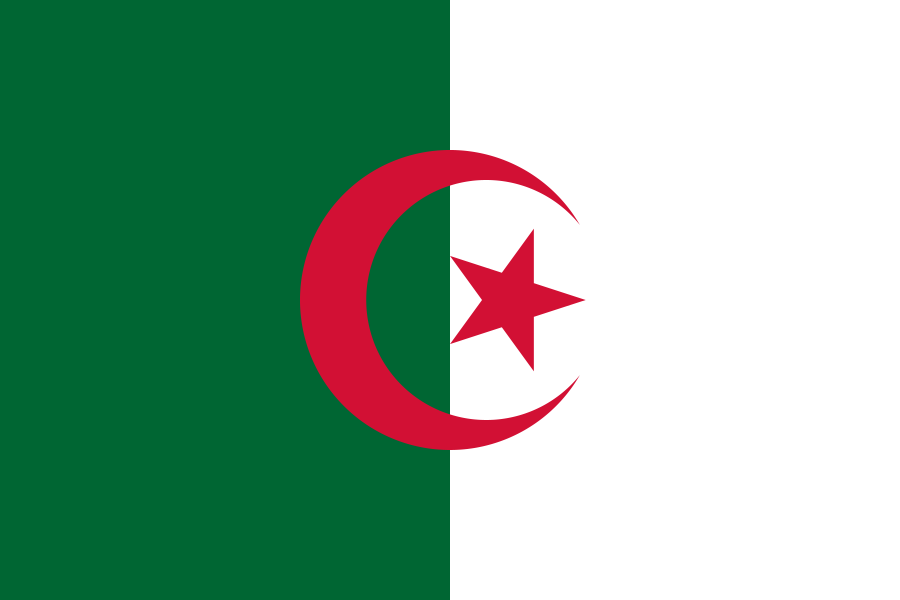

Algeria in the World

Algeria - Introduction 2025
top of pageBackground: Algeria has known many empires and dynasties, including the ancient Numidians (3rd century B.C.), Phoenicians, Carthaginians, Romans, Vandals, Byzantines, over a dozen different Arab and Amazigh dynasties, Spaniards, and Ottoman Turks. Under the Turks, the Barbary pirates operated from North Africa and preyed on shipping, from about 1500 until the French captured Algiers in 1830. The French southward conquest of Algeria proceeded throughout the 19th century and was marked by many atrocities. A bloody eight-year struggle culminated in Algerian independence in 1962. Algeria's long-dominant political party, the National Liberation Front (FLN), was established in 1954 as part of the struggle for independence and has since played a large role in politics, though it is falling out of favor with the youth and current President Abdelmadjid TEBBOUNE. The Government of Algeria in 1988 instituted a multi-party system in response to public unrest, but the surprising first-round success of the Islamic Salvation Front (FIS) in the 1991 legislative election led the Algerian military to intervene and postpone the second round of elections to prevent what the secular elite feared would be an extremist-led government from assuming power. An army crackdown on the FIS escalated into an FIS insurgency and intense violence from 1992-98 that resulted in over 100,000 deaths, many of which were attributed to extremist groups massacring villagers. The government gained the upper hand by the late 1990s, and FIS’s armed wing, the Islamic Salvation Army, disbanded in 2000. FIS membership is now illegal. In 1999, Abdelaziz BOUTEFLIKA won the presidency with the backing of the military, in an election that was boycotted by several candidates protesting alleged fraud. He won subsequent elections in 2004, 2009, and 2014. Widespread protests against his decision to seek a fifth term broke out in early 2019. BOUTEFLIKA resigned in April 2019, and in December 2019, Algerians elected former Prime Minister Abdelmadjid TEBBOUNE as the country’s new president. A longtime FLN member, TEBBOUNE ran for president as an independent. In 2020, Algeria held a constitutional referendum on governmental reforms, which TEBBOUNE enacted in 2021. Subsequent reforms to the national electoral law introduced open-list voting to curb corruption. The new law also eliminated gender quotas in Parliament, and the 2021 legislative elections saw female representation plummet. The referendum, parliamentary elections, and local elections saw record-low voter turnout.
Algeria - Geography 2025
top of pageLocation
Geographic coordinates
Map reference
Area
Total: 2,381,740 km²
Land: 2,381,740 km²
Water: 0 km²
Comparative: slightly less than 3.5 times the size of Texas
Land boundaries
Total: 6,734 km
Border countries (6): (6) Libya 989 km; Mali 1,359 km; Mauritania 460 km; Morocco 1,941 km; Niger 951 km; Tunisia 1,034 km
Coastline: 998 km
Maritime claims
Territorial sea: 12 nm
Contiguous zone: 24 nm
Exclusive fishing zone: 32-52 nm
Climate: arid to semiarid; mild, wet winters with hot, dry summers along coast; drier with cold winters and hot summers on high plateau; sirocco is a hot, dust/sand-laden wind especially common in summer
Terrain: mostly high plateau and desert; Atlas Mountains in the far north and Hoggar Mountains in the south; narrow, discontinuous coastal plain
Elevation
Highest point: Tahat 2,908 m
Lowest point: Chott Melrhir -40 m
Mean elevation: 800 m
Natural resources
Land use
Land use
Agricultural land: 17.4% (2023 est.)
Arable land: 3.2% (2023 est.)
Permanent crops: 0.4% (2023 est.)
Permanent pasture: 13.8% (2023 est.)
Forest: 0.7% (2023 est.)
Other: 81.9% (2023 est.)
Irrigated land: 13,819 km² (2019)
Major rivers
Major watersheds area km²
Total water withdrawal
Total renewable water resources
Natural hazards: mountainous areas subject to severe earthquakes; mudslides and floods in rainy season; droughts
Geography
Note: largest country in Africa but 80% desert; canyons and caves in the southern Hoggar Mountains and in the barren Tassili n'Ajjer area in the southeast of the country contain numerous examples of prehistoric art -- rock paintings and carvings depicting human activities and wild and domestic animals (elephants, giraffes, cattle) -- that date to the African Humid Period, roughly 5,000 to 11,000 years ago, when the region was completely vegetated
Algeria - People 2025
top of pagePopulation
Total: 47,022,473 (2024 est.)
Male: 23,854,821
Female: 23,167,652
Distribution: the vast majority of the populace is found in the extreme northern part of the country along the Mediterranean Coast
Growth rate: 1.54% (2024 est.)
Nationality
Ethnic groups
Languages: Arabic (official), French (lingua franca), Tamazight (official) (dialects include Kabyle (Taqbaylit), Shawiya (Tacawit), Mzab, Tuareg (Tamahaq))
Major-language sample(s): ; كتاب حقائق العالم، المصدر الذي لا يمكن الاستغناء عنه للمعلومات الأساسية (Arabic); The World Factbook, the indispensable source for basic information.
Religions: Muslim (official; predominantly Sunni) 99%, other (includes Christian, Jewish, Ahmadi Muslim, Shia Muslim, Ibadi Muslim) <1% (2012 est.)
Demographic profile
Age structure
Age structure
0-14 years: 30.8% (male 7,411,337/female 7,062,794)
15-64 years: 62.3% (male 14,846,102/female 14,441,034)
65 years and over: 6.9% (2024 est.) (male 1,597,382/female 1,663,824)
Dependency ratios
Total dependency ratio: 60.6 (2024 est.)
Youth dependency ratio: 49.4 (2024 est.)
Elderly dependency ratio: 11.1 (2024 est.)
Potential support ratio: 9 (2024 est.)
Median age
Total: 29.1 years (2024 est.)
Male: 28.8 years
Female: 29.4 years
Population growth rate: 1.54% (2024 est.)
Birth rate: 20.2 births/1,000 population (2024 est.)
Death rate: 4.4 deaths/1,000 population (2024 est.)
Net migration rate
Population distribution: the vast majority of the populace is found in the extreme northern part of the country along the Mediterranean Coast
Urbanization
Urban population: 75.3% of total population (2023)
Rate of urbanization: 1.99% annual rate of change (2020-25 est.)
Major urban areas
Population: 2.902 million ALGIERS (capital), 936,000 Oran (2022)
Environment
Air pollutants
Sex ratio
At birth: 1.05 male(s)/female
0-14 years: 1.05 male(s)/female
15-64 years: 1.03 male(s)/female
65 years and over: 0.96 male(s)/female
Total population: 1.03 male(s)/female (2024 est.)
Mothers mean age at first birth
Maternal mortality ratio: 62 deaths/100,000 live births (2023 est.)
Infant mortality rate
Total: 18.7 deaths/1,000 live births (2024 est.)
Male: 19.8 deaths/1,000 live births
Female: 17.5 deaths/1,000 live births
Life expectancy at birth
Total population: 77.9 years (2024 est.)
Male: 77.2 years
Female: 78.7 years
Total fertility rate: 2.94 children born/woman (2024 est.)
Contraceptive prevalence rate
Drinking water source
Urban: 3.9% of population (2022 est.)
Rural: 9.6% of population (2022 est.)
Total: 5.3% of population (2022 est.)
Current health expenditure
Physicians density
Hospital bed density
Sanitation facility access
Urban: 1.7% of population (2022 est.)
Rural: 8.3% of population (2022 est.)
Total: 3.4% of population (2022 est.)
Hiv/Aids
Major infectious diseases
Obesity adult prevalence rate
Alcohol consumption
Tobacco use
Children under the age of 5 years underweight: 2.7% (2019 est.)
Education expenditures
Literacy
School life expectancy primary to tertiary education
Youth unemployment
Rate (ages 15-24): 11.5% (2024 est.); 11.8% (2023 est.); 12.4% (2022 est.)
Rate (ages 15-24) note: % of labor force seeking employment
Algeria - Government 2025
top of pageCountry name
Government type
Capital
Name: Algiers
Geographic coordinates: 36 45 N, 3 03 E
Time difference: UTC+1 (6 hours ahead of Washington, DC, during Standard Time)
Etymology: name derives from the Arabic al-jazair, meaning 'the islands,' and refers to the four islands formerly off the coast of the capital but joined to the mainland since 1525
Administrative divisions: 58 provinces (wilayas, singular - wilaya); Adrar, Ain Defla, Ain Temouchent, Alger (Algiers), Annaba, Batna, Bechar, Bejaia, Beni Abbes, Biskra, Blida, Bordj Badji Mokhtar, Bordj Bou Arreridj, Bouira, Boumerdes, Chlef, Constantine, Djanet, Djelfa, El Bayadh, El Meghaier, El Meniaa, El Oued, El Tarf, Ghardaia, Guelma, Illizi, In Guezzam, In Salah, Jijel, Khenchela, Laghouat, Mascara, Medea, Mila, Mostaganem, M'Sila, Naama, Oran, Ouargla, Ouled Djellal, Oum el Bouaghi, Relizane, Saida, Setif, Sidi Bel Abbes, Skikda, Souk Ahras, Tamanrasset, Tebessa, Tiaret, Timimoun, Tindouf, Tipaza, Tissemsilt, Tizi Ouzou, Tlemcen, Touggourt
Dependent areas
Independence
National holiday
Constitution
Legal system: mixed system of French civil law and Islamic law; judicial review of legislative acts in ad hoc Constitutional Council composed of various public officials including several Supreme Court justices
International law organization participation: has not submitted an ICJ jurisdiction declaration; non-party state to the ICCt
Citizenship
Suffrage
Executive branch
Chief of state: President Abdelmadjid TEBBOUNE (since 12 December 2019)
Head of government: Prime Minister Sifi GHRIEB (since 28 August 2025)
Cabinet: Cabinet of Ministers appointed by the president
Election/appointment process: president directly elected by absolute majority popular vote in two rounds if needed for a 5-year term (eligible for a second term); prime minister nominated by the president after consultation with the majority party in Parliament
Most recent election date: 7 September 2024
2024: Abdelmadjid TEBBOUNE (NLF) 94.7%, Abdelaali Hassani CHERIF (MSP) 3.2%, Youcef AOUCHICHE (FFS) 2.2%
2019: (FLN) 58.1%, Abdelkader BENGRINA (El-Bina) 17.4%, Ali BENFLIS (Talaie El Hurriyet) 10.6%, Azzedine MIHOUBI (RND) 7.3%, Abdelaziz BELAID (Future Front) 6.7%
Expected date of next election: 2,029
Legislative branch
Legislature name: Parliament (Barlaman)
Legislative structure: bicameral
Judicial branch
Political parties and leaders
International organization participation
Diplomatic representation
Flag description: two equal vertical bands of green (left) and white; a red, five-pointed star inside a red crescent, centered over the two-color boundary
National symbols
National anthem
Title: 'Kassaman' (We Pledge)
Lyrics/music: Mufdi ZAKARIAH/Mohamed FAWZI
History: adopted 1962; ZAKARIAH wrote 'Kassaman' as a poem while imprisoned in Algiers by French colonial forces
National heritage
Total World Heritage Sites: 7 (6 cultural, 1 mixed)
Selected World Heritage Site locales:
Algeria - Economy 2025
top of pageEconomy overview
Real gdp purchasing power parity
Real gdp growth rate: 3.3% (2024 est.); 4.1% (2023 est.); 3.6% (2022 est.)
Note: annual GDP % growth based on constant local currency
Real gdp per capita: 3.3% (2024 est.); 4.1% (2023 est.); 3.6% (2022 est.)
Note: annual GDP % growth based on constant local currency
Gross national saving
Gdp composition by sector of origin
Gdp composition by end use
Household consumption: 40.8% (2023 est.)
Government consumption: 17.9% (2023 est.)
Investment in fixed capital: 32.8% (2023 est.)
Investment in inventories: 4.9% (2023 est.)
Exports of goods and services: 23.6% (2023 est.)
Imports of goods and services: -20.1% (2023 est.)
Note: figures may not total 100% due to rounding or gaps in data collection
Gdp composition by sector of origin
Agriculture: 13.1% (2023 est.)
Industry: 37.8% (2023 est.)
Services: 45.6% (2023 est.)
Note: figures may not total 100% due to non-allocated consumption not captured in sector-reported data
Agriculture products
Industries: petroleum, natural gas, light industries, mining, electrical, petrochemical, food processing
Industrial production growth rate: 3.9% (2023 est.)
Note: annual % change in industrial value added based on constant local currency
Labor force: 13.294 million (2024 est.)
Note: number of people ages 15 or older who are employed or seeking work
Labor force
Unemployment rate: 11.5% (2024 est.); 11.8% (2023 est.); 12.4% (2022 est.)
Note: % of labor force seeking employment
Youth unemployment
Rate (ages 15-24): 11.5% (2024 est.); 11.8% (2023 est.); 12.4% (2022 est.)
Rate (ages 15-24) note: % of labor force seeking employment
Population below poverty line
Gini index
Household income or consumption by percentage share
Distribution of family income gini index
Budget
Revenues: $55.185 billion (2019 est.)
Expenditures: $64.728 billion (2019 est.)
Taxes and other revenues
Public debt
Revenue
Fiscal year
Inflation rate consumer prices
Central bank discount rate
Commercial bank prime lending rate
Stock of narrow money
Stock of broad money
Stock of domestic credit
Market value of publicly traded shares
Current account balance
Exports: $59.426 billion (2023 est.); $69.226 billion (2022 est.); $41.846 billion (2021 est.)
Note: balance of payments - exports of goods and services in current dollars
Commodities: natural gas, crude petroleum, refined petroleum, fertilizers, iron bars (2023)
Commodities note: top five export commodities based on value in dollars
Imports: $51.131 billion (2023 est.); $46.613 billion (2022 est.); $44.287 billion (2021 est.)
Note: balance of payments - imports of goods and services in current dollars
Commodities: wheat, plastics, cars, milk, corn (2023)
Commodities note: top five import commodities based on value in dollars
Reserves of foreign exchange and gold
Debt external
Stock of direct foreign investment at home
Stock of direct foreign investment abroad
Exchange rates
Algeria - Energy 2025
top of pageElectricity
Installed generating capacity: 22.591 million kW (2023 est.)
Consumption: 85.687 billion kWh (2023 est.)
Exports: 2.753 billion kWh (2023 est.)
Imports: 475.8 million kWh (2023 est.)
Transmission/distribution losses: 9.237 billion kWh (2023 est.)
Access electrification - total population: 100% (2022 est.)
Access electrification - urban areas: 100%
Access electrification - rural areas: 99.3%
Generation sources fossil fuels: 98.1% of total installed capacity (2023 est.)
Generation sources solar: 0.9% of total installed capacity (2023 est.)
Generation sources hydroelectricity: 0.9% of total installed capacity (2023 est.)
Coal
Consumption: 3,000 metric tons (2023 est.)
Imports: 241,000 metric tons (2023 est.)
Proven reserves: 223 million metric tons (2023 est.)
Petroleum
Total petroleum production: 1.443 million bbl/day (2023 est.)
Refined petroleum consumption: 446,000 bbl/day (2023 est.)
Crude oil estimated reserves: 12.2 billion barrels (2021 est.)
Crude oil
Refined petroleum
Natural gas
Production: 104.896 billion cubic meters (2023 est.)
Consumption: 52.831 billion cubic meters (2023 est.)
Exports: 51.566 billion cubic meters (2023 est.)
Proven reserves: 4.504 trillion cubic meters (2021 est.)
Carbon dioxide emissions: 163.661 million metric tonnes of CO&sub2; (2023 est.)
From coal and metallurgical coke: 741,000 metric tonnes of CO&sub2; (2023 est.)
From petroleum and other liquids: 57.795 million metric tonnes of CO&sub2; (2023 est.)
From consumed natural gas: 105.125 million metric tonnes of CO&sub2; (2023 est.)
Energy consumption per capita: 61.843 million Btu/person (2023 est.)
Algeria - Communication 2025
top of pageTelephones
Fixed lines total subscriptions: 6.324 million (2023 est.)
Fixed lines subscriptions per 100 inhabitants: 14 (2023 est.)
Mobile cellular total subscriptions: 51.5 million (2023 est.)
Mobile cellular subscriptions per 100 inhabitants: 109 (2022 est.)
Telephone system
Broadcast media
Internet
Users percent of population: 77% (2023 est.)
Broadband fixed subscriptions
Total: 5.54 million (2023 est.)
Subscriptions per 100 inhabitants: 12 (2023 est.)
Algeria - Military 2025
top of pageMilitary expenditures: 8% of GDP (2024 est.); 8% of GDP (2023 est.); 4.8% of GDP (2022 est.); 5.6% of GDP (2021 est.); 6.7% of GDP (2020 est.)
Military and security forces
Military service age and obligation
Space program
Terrorist groups
Algeria - Transportation 2025
top of pageNational air transport system
Civil aircraft registration country code prefix
Airports: 95 (2025)
Heliports: 11 (2025)
Pipelines
Railways
Total: 4,020 km (2019)
Roadways
Waterways
Merchant marine
Total: 119 (2022)
By type: bulk carrier 1, container ship 4, general cargo 11, oil tanker 14, other 89
Ports and terminals
Algeria - Transnational issues 2025
top of pageDisputes international
Refugees and internally displaced persons
Illicit drugs

You found a piece of the puzzle
Please click here to complete it
Please click here to complete it