Statistical information Myanmar 2025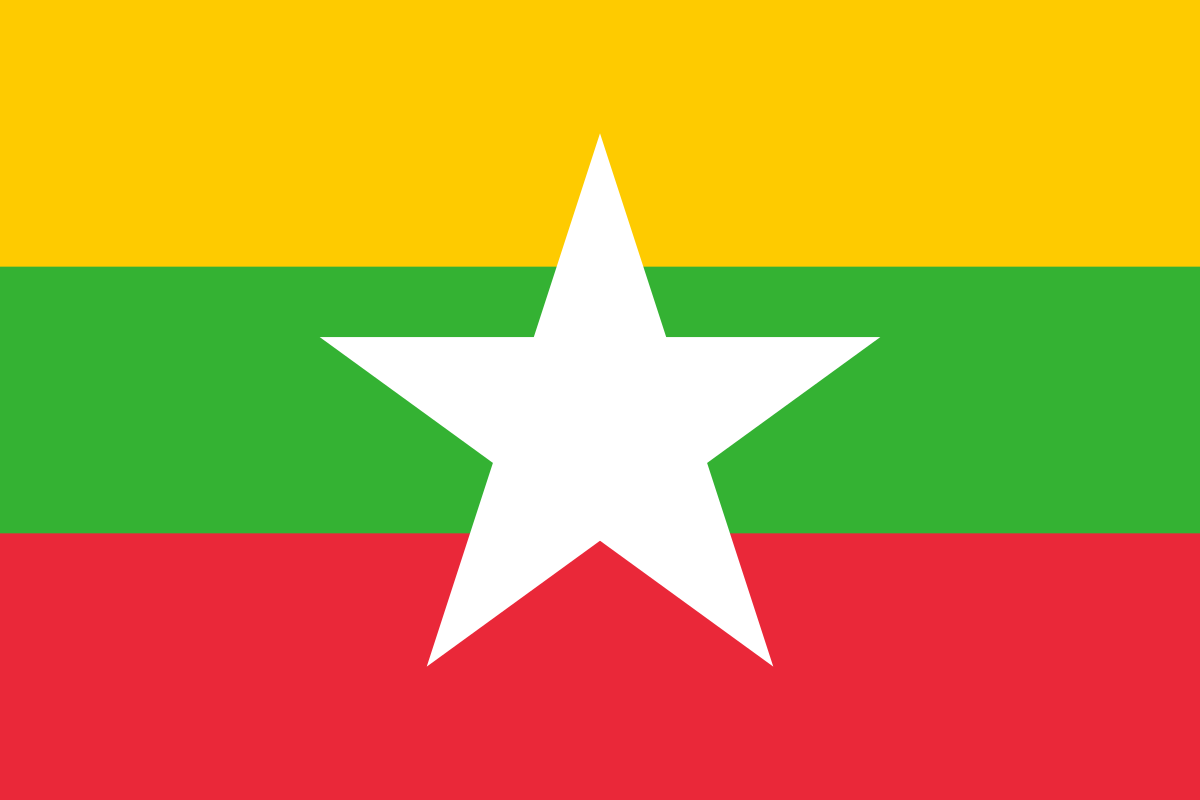

Myanmar in the World

Myanmar - Introduction 2025
top of pageBackground: Burma is home to ethnic Burmans and scores of other ethnic and religious minority groups that have resisted external efforts to consolidate control of the country throughout its history. Britain conquered Burma over a period extending from the 1820s to the 1880s and administered it as a province of India until 1937, when Burma became a self-governing colony. Burma gained full independence in 1948. In 1962, General NE WIN seized power and ruled the country until 1988 when a new military regime took control. In 1990, the military regime permitted an election but then rejected the results after the main opposition National League for Democracy (NLD) and its leader AUNG SAN SUU KYI (ASSK) won in a landslide. The military regime placed ASSK under house arrest until 2010. In 2007, rising fuel prices in Burma led pro-democracy activists and Buddhist monks to launch a 'Saffron Revolution' consisting of large protests against the regime, which violently suppressed the movement. The regime prevented new elections until it had drafted a constitution designed to preserve the military's political control; it passed the new constitution in its 2008 referendum. The regime conducted an election in 2010, but the NLD boycotted the vote, and the military’s political proxy, the Union Solidarity and Development Party, easily won; international observers denounced the election as flawed. Burma nonetheless began a halting process of political and economic reforms. ASSK's return to government in 2012 eventually led to the NLD's sweeping victory in the 2015 election. With ASSK as the de facto head of state, Burma’s first credibly elected civilian government drew international criticism for blocking investigations into Burma’s military operations -- which the US Department of State determined constituted genocide -- against its ethnic Rohingya population. When the 2020 elections resulted in further NLD gains, the military denounced the vote as fraudulent. In 2021, the military's senior leader General MIN AUNG HLAING launched a coup that returned Burma to authoritarian rule, with military crackdowns that undid reforms and resulted in the detention of ASSK and thousands of pro-democracy actors. Pro-democracy organizations have formed in the wake of the coup, including the National Unity Government (NUG). Members of the NUG include representatives from the NLD, ethnic minority groups, and civil society. In 2021, the NUG announced the formation of armed militias called the People's Defense Forces (PDF) and an insurgency against the military junta. As of 2024, PDF units across the country continued to fight the regime with varying levels of support from and cooperation with the NUG and other anti-regime organizations, including armed ethnic groups that have been fighting the central government for decades.
Myanmar - Geography 2025
top of pageLocation
Geographic coordinates
Map reference
Area
Total: 676,578 km²
Land: 653,508 km²
Water: 23,070 km²
Comparative: slightly smaller than Texas
Land boundaries
Total: 6,522 km
Border countries (5): (5) Bangladesh 271 km; China 2,129 km; India 1,468 km; Laos 238 km; Thailand 2,416 km
Coastline: 1,930 km
Maritime claims
Territorial sea: 12 nm
Contiguous zone: 24 nm
Exclusive economic zone: 200 nm
Continental shelf: 200 nm or to the edge of the continental margin
Climate: tropical monsoon; cloudy, rainy, hot, humid summers (southwest monsoon, June to September); less cloudy, scant rainfall, mild temperatures, lower humidity during winter (northeast monsoon, December to April)
Terrain: central lowlands ringed by steep, rugged highlands
Elevation
Highest point: Gamlang Razi 5,870 m
Lowest point: Andaman Sea/Bay of Bengal 0 m
Mean elevation: 702 m
Natural resources
Land use
Land use
Agricultural land: 19.9% (2023 est.)
Arable land: 16.9% (2023 est.)
Permanent crops: 2.3% (2023 est.)
Permanent pasture: 0.7% (2023 est.)
Forest: 42.4% (2023 est.)
Other: 37.7% (2023 est.)
Irrigated land: 17,140 km² (2020)
Major rivers: Mekong (shared with China [s], Laos, Thailand, Cambodia, and Vietnam [m]) - 4,350 km; Salween river mouth (shared with China [s] and Thailand) - 3,060 km; Irrawaddy river mouth (shared with China [s]) - 2,809 km; Chindwin - 1,158 km
Note: [s] after country name indicates river source; [m] after country name indicates river mouth
Major watersheds area km²
Total water withdrawal
Total renewable water resources
Natural hazards: destructive earthquakes and cyclones; flooding and landslides common during rainy season (June to September); periodic droughts
Geography
Note: strategic location near major Indian Ocean shipping lanes; the north-south flowing Irrawaddy River is the country's largest and most important commercial waterway
Myanmar - People 2025
top of pagePopulation
Total: 57,527,139 (2024 est.)
Male: 28,387,831
Female: 29,139,308
Distribution: population concentrated along coastal areas and in general proximity to the shores of the Irrawaddy River; the extreme north is relatively underpopulated
Growth rate: 0.71% (2024 est.)
Nationality
Ethnic groups
Languages: Burmese (official)
Major-language sample(s): ; ကမ္ဘာ့အချက်အလက်စာအုပ်- အခြေခံအချက်အလက်တွေအတွက် မရှိမဖြစ်တဲ့ အရင်းအမြစ် (Burmese); The World Factbook, the indispensable source for basic information.
Note: minority ethnic groups use their own languages
Religions: Buddhist 87.9%, Christian 6.2%, Muslim 4.3%, Animist 0.8%, Hindu 0.5%, other 0.2%, none 0.1% (2014 est.)
Note: religion estimate is based on the 2014 national census, including an estimate for the non-enumerated population of Rakhine State, which is assumed to mainly affiliate with the Islamic faith; as of December 2019, Muslims probably make up less than 3% of Burma's total population due to the large outmigration of the Rohingya population since 2017
Demographic profile
Age structure
Age structure
0-14 years: 24.4% (male 7,197,177/female 6,843,879)
15-64 years: 68.5% (male 19,420,361/female 19,998,625)
65 years and over: 7.1% (2024 est.) (male 1,770,293/female 2,296,804)
Dependency ratios
Total dependency ratio: 45.9 (2024 est.)
Youth dependency ratio: 35.6 (2024 est.)
Elderly dependency ratio: 10.3 (2024 est.)
Potential support ratio: 9.7 (2024 est.)
Median age
Total: 30.8 years (2024 est.)
Male: 29.9 years
Female: 31.6 years
Population growth rate: 0.71% (2024 est.)
Birth rate: 15.7 births/1,000 population (2024 est.)
Death rate: 7.3 deaths/1,000 population (2024 est.)
Net migration rate
Population distribution: population concentrated along coastal areas and in general proximity to the shores of the Irrawaddy River; the extreme north is relatively underpopulated
Urbanization
Urban population: 32.1% of total population (2023)
Rate of urbanization: 1.85% annual rate of change (2020-25 est.)
Major urban areas
Population: 5.610 million RANGOON (Yangon) (capital), 1.532 million Mandalay (2023)
Environment
Air pollutants
Sex ratio
At birth: 1.06 male(s)/female
0-14 years: 1.05 male(s)/female
15-64 years: 0.97 male(s)/female
65 years and over: 0.77 male(s)/female
Total population: 0.97 male(s)/female (2024 est.)
Mothers mean age at first birth
Maternal mortality ratio: 185 deaths/100,000 live births (2023 est.)
Infant mortality rate
Total: 32.1 deaths/1,000 live births (2024 est.)
Male: 35.4 deaths/1,000 live births
Female: 28.5 deaths/1,000 live births
Life expectancy at birth
Total population: 70.3 years (2024 est.)
Male: 68.5 years
Female: 72.1 years
Total fertility rate: 1.97 children born/woman (2024 est.)
Contraceptive prevalence rate
Drinking water source
Urban: 6.3% of population (2022 est.)
Rural: 22.9% of population (2022 est.)
Total: 17.6% of population (2022 est.)
Current health expenditure
Physicians density
Hospital bed density
Sanitation facility access
Urban: 5.9% of population (2022 est.)
Rural: 18% of population (2022 est.)
Total: 14.1% of population (2022 est.)
Hiv/Aids
Major infectious diseases
Obesity adult prevalence rate
Alcohol consumption
Tobacco use
Children under the age of 5 years underweight: 19.5% (2018 est.)
Education expenditures
Literacy
School life expectancy primary to tertiary education
Youth unemployment
Rate (ages 15-24): 3.1% (2024 est.); 3.1% (2023 est.); 3.1% (2022 est.)
Rate (ages 15-24) note: % of labor force seeking employment
Myanmar - Government 2025
top of pageCountry name
Government type
Capital
Name: Rangoon (aka Yangon, continues to be recognized as the primary Burmese capital by the US Government); Nay Pyi Taw is the administrative capital
Geographic coordinates: 16 48 N, 96 10 E
Time difference: UTC+6.5 (11.5 hours ahead of Washington, DC, during Standard Time)
Etymology: Rangoon/Yangon derives from the Burmese words yan and koun, commonly translated as 'end of strife'; Nay Pyi Taw translates as 'abode of kings'
Administrative divisions: 7 regions (taing-myar, singular - taing), 7 states (pyi ne-myar, singular - pyi ne), 1 union territory
Regions: Ayeyarwady (Irrawaddy), Bago, Magway, Mandalay, Sagaing, Tanintharyi, Yangon (Rangoon)
States: Chin, Kachin, Kayah, Karen, Mon, Rakhine, Shan
Union territory: Nay Pyi Taw
Dependent areas
Independence
National holiday
Constitution
Legal system: mixed legal system of English common law (as introduced in codifications designed for colonial India) and customary law
International law organization participation: has not submitted an ICJ jurisdiction declaration; non-party state to the ICCt
Citizenship
Suffrage
Executive branch
Chief of state: Acting President Sr. Gen. MIN AUNG HLAING (since 31 July 2025)
Head of government: Prime Minister NYO SAW (since 31 July 2025)
Cabinet: Cabinet appointments shared by the president and the commander-in-chief
Election/appointment process: prior to the military takeover in 2021, president was indirectly elected by simple majority vote by the full Assembly of the Union from among 3 vice-presidential candidates nominated by the Presidential Electoral College (consists of members of the lower and upper houses and military members); the other 2 candidates became vice presidents (president elected for a 5-year term)
Most recent election date: 8 November 2020
2020: the National League for Democracy (NLD) won 396 seats across both houses -- well above the 322 required for a parliamentary majority -- but on 1 February 2021, the military claimed the results of the election were illegitimate and deposed State Counsellor AUNG SAN SUU KYI and President WIN MYINT of the NLD, causing military-affiliated Vice President MYINT SWE (USDP) to become acting president; MYINT SWE subsequently handed power to coup leader MIN AUNG HLAING; WIN MYINT and other key leaders of the ruling NLD party were placed under arrest after the military takeover
2018: WIN MYINT elected president in an indirect by-election held on 28 March 2018 after the resignation of HTIN KYAW; Assembly of the Union vote for president - WIN MYINT (NLD) 403, MYINT SWE (USDP) 211, HENRY VAN THIO (NLD) 18, 4 votes canceled (636 votes cast)
Expected date of next election: on 31 July 2025, the military government announced that it was preparing for elections to be held in December 2025
State counsellor: State Counselor AUNG SAN SUU KYI (since 6 April 2016); note - under arrest since 1 February 2021
Note 1: on 31 July 2025, the military ended the state of emergency that had been in place since taking over the government in February 2021, although martial law continues to exist in parts of the country; at the same time, the military dissolved the State Administrative Council (SAC), which had been the official name of the military government in Burma, and replaced it with the National Security and Peace Commission (NSPC), chaired by Sr. Gen. MIN AUNG HLAING, who also retains his position as chief of the armed forces
Note 2: prior to the military takeover, the state counsellor served the equivalent term of the president and was similar to a prime minister
Legislative branch
Legislature name: Assembly of the Union (Pyidaungsu Hluttaw)
Legislative structure: bicameral
Most recent election date: 8 November 2020
Expected date of next election: on 31 July 2025, the military government announced that it was preparing for elections to be held in late December 2025
Note: on 1 February 2021, the Burmese military claimed the results of the 2020 general election were illegitimate and launched a coup led by Sr. General MIN AUNG HLAING; the military subsequently dissolved the Assembly of the Union and replaced it with the military-led State Administration Council
Judicial branch
Political parties and leaders
International organization participation
Diplomatic representation
Flag description: three equal horizontal stripes of yellow (top), green, and red; centered on the green band is a five-pointed white star that overlaps onto the yellow and red stripes
National symbols
National anthem
Title: 'Kaba Ma Kyei' (Till the End of the World)
Lyrics/music: SAYA TIN
History: adopted 1948
National heritage
Total World Heritage Sites: 2 (both cultural)
Selected World Heritage Site locales:
Myanmar - Economy 2025
top of pageEconomy overview
Real gdp purchasing power parity
Real gdp growth rate: -1% (2024 est.); 1% (2023 est.); 4% (2022 est.)
Note: annual GDP % growth based on constant local currency
Real gdp per capita: -1% (2024 est.); 1% (2023 est.); 4% (2022 est.)
Note: annual GDP % growth based on constant local currency
Gross national saving
Gdp composition by sector of origin
Gdp composition by end use
Gdp composition by sector of origin
Agriculture: 20.8% (2024 est.)
Industry: 37.8% (2024 est.)
Services: 41.4% (2024 est.)
Note: figures may not total 100% due to non-allocated consumption not captured in sector-reported data
Agriculture products
Industries: agricultural processing; wood and wood products; copper, tin, tungsten, iron; cement, construction materials; pharmaceuticals; fertilizer; oil and natural gas; garments; jade and gems
Industrial production growth rate: -0.2% (2024 est.)
Note: annual % change in industrial value added based on constant local currency
Labor force: 22.742 million (2024 est.)
Note: number of people ages 15 or older who are employed or seeking work
Labor force
Unemployment rate: 3.1% (2024 est.); 3.1% (2023 est.); 3.1% (2022 est.)
Note: % of labor force seeking employment
Youth unemployment
Rate (ages 15-24): 3.1% (2024 est.); 3.1% (2023 est.); 3.1% (2022 est.)
Rate (ages 15-24) note: % of labor force seeking employment
Population below poverty line
Gini index
Household income or consumption by percentage share
Distribution of family income gini index
Budget
Revenues: $10.945 billion (2019 est.)
Expenditures: $10.22 billion (2019 est.)
Note: central government revenues (excluding grants) and expenses converted to US dollars at average official exchange rate for year indicated
Taxes and other revenues: 6% (of GDP) (2019 est.)
Note: central government tax revenue as a % of GDP
Public debt
Revenue
Fiscal year
Inflation rate consumer prices
Central bank discount rate
Commercial bank prime lending rate
Stock of narrow money
Stock of broad money
Stock of domestic credit
Market value of publicly traded shares
Current account balance
Exports: $20.4 billion (2021 est.); $17.523 billion (2019 est.); $15.728 billion (2018 est.)
Note: balance of payments - exports of goods and services in current dollars
Commodities: garments, natural gas, dried legumes, rare-earth metal compounds, precious stones (2023)
Commodities note: top five export commodities based on value in dollars
Imports: $23.1 billion (2021 est.); $17.356 billion (2019 est.); $18.664 billion (2018 est.)
Note: balance of payments - imports of goods and services in current dollars
Commodities: refined petroleum, synthetic fabric, fertilizers, crude petroleum, fabric (2023)
Commodities note: top five import commodities based on value in dollars
Reserves of foreign exchange and gold
Debt external
Stock of direct foreign investment at home
Stock of direct foreign investment abroad
Exchange rates
Myanmar - Energy 2025
top of pageElectricity
Installed generating capacity: 7.419 million kW (2023 est.)
Consumption: 23.625 billion kWh (2023 est.)
Exports: 200 million kWh (2023 est.)
Transmission/distribution losses: 1.855 billion kWh (2023 est.)
Access electrification - total population: 73.7% (2022 est.)
Access electrification - urban areas: 93.9%
Access electrification - rural areas: 62.8%
Generation sources fossil fuels: 61.8% of total installed capacity (2023 est.)
Generation sources solar: 0.4% of total installed capacity (2023 est.)
Generation sources hydroelectricity: 36.7% of total installed capacity (2023 est.)
Generation sources biomass and waste: 1% of total installed capacity (2023 est.)
Coal
Production: 1.031 million metric tons (2023 est.)
Consumption: 907,000 metric tons (2023 est.)
Exports: 221,000 metric tons (2023 est.)
Imports: 67,000 metric tons (2023 est.)
Proven reserves: 252 million metric tons (2023 est.)
Petroleum
Total petroleum production: 7,000 bbl/day (2023 est.)
Refined petroleum consumption: 122,000 bbl/day (2023 est.)
Crude oil estimated reserves: 139 million barrels (2021 est.)
Crude oil
Refined petroleum
Natural gas
Production: 13.549 billion cubic meters (2023 est.)
Consumption: 4.241 billion cubic meters (2023 est.)
Exports: 9.29 billion cubic meters (2023 est.)
Imports: 219.822 million cubic meters (2021 est.)
Proven reserves: 637.129 billion cubic meters (2021 est.)
Carbon dioxide emissions: 27.005 million metric tonnes of CO&sub2; (2023 est.)
From coal and metallurgical coke: 1.24 million metric tonnes of CO&sub2; (2023 est.)
From petroleum and other liquids: 17.39 million metric tonnes of CO&sub2; (2023 est.)
From consumed natural gas: 8.376 million metric tonnes of CO&sub2; (2023 est.)
Energy consumption per capita: 8.384 million Btu/person (2023 est.)
Myanmar - Communication 2025
top of pageTelephones
Fixed lines total subscriptions: 588,000 (2023 est.)
Fixed lines subscriptions per 100 inhabitants: 1 (2023 est.) less than 1
Mobile cellular total subscriptions: 65.5 million (2023 est.)
Mobile cellular subscriptions per 100 inhabitants: 107 (2022 est.)
Telephone system
Broadcast media
Internet
Users percent of population: 59% (2023 est.)
Broadband fixed subscriptions
Total: 1.51 million (2023 est.)
Subscriptions per 100 inhabitants: 3 (2023 est.)
Myanmar - Military 2025
top of pageMilitary expenditures: 3.9% of GDP (2023 est.); 3.6% of GDP (2022 est.); 3.5% of GDP (2021 est.); 3% of GDP (2020 est.); 4.1% of GDP (2019 est.)
Military and security forces
Military service age and obligation
Space program
Terrorist groups
Myanmar - Transportation 2025
top of pageNational air transport system
Civil aircraft registration country code prefix
Airports: 74 (2025)
Heliports: 6 (2025)
Pipelines
Railways
Total: 5,031 km (2008)
Narrow gauge: 5,031 km (2008) 1.000-m gauge
Roadways
Waterways
Merchant marine
Total: 101 (2023)
By type: bulk carrier 1, general cargo 44, oil tanker 5, other 51
Ports and terminals
Myanmar - Transnational issues 2025
top of pageDisputes international
Refugees and internally displaced persons
Illicit drugs

